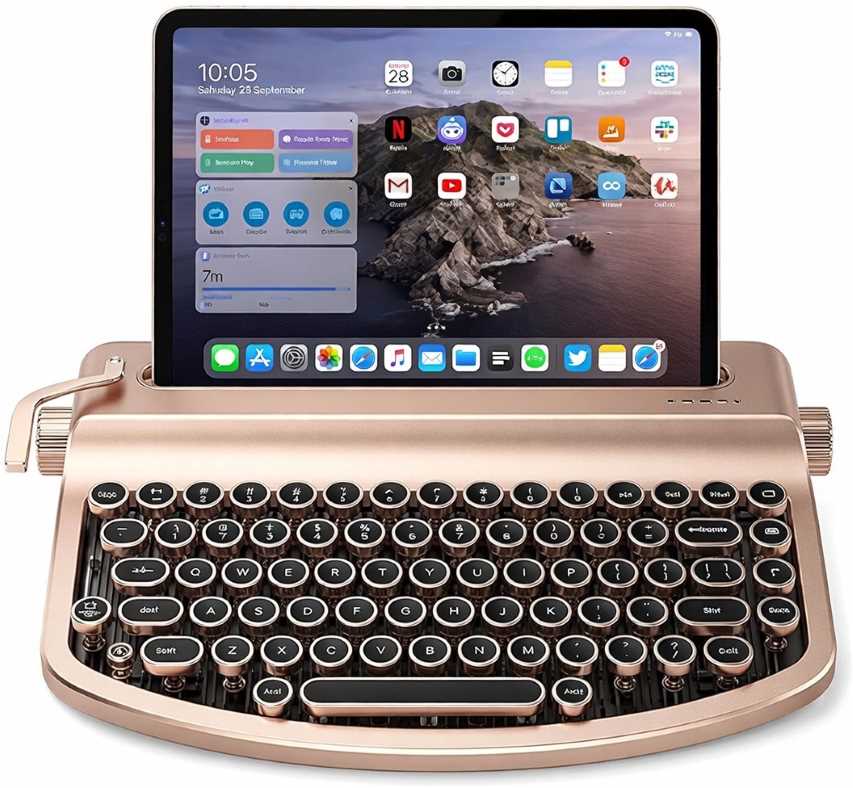
🤔 More Than Just Keys
The Typewriter Keyboard is one of the most enduring and influential interfaces in human history. For over a century, it was the primary tool for transforming thoughts into written words, revolutionizing business, literature, and personal communication. While the mechanical typewriter has largely been replaced by the computer, its keyboard—specifically the QWERTY layout—lives on, a tangible piece of 19th-century engineering embedded in every smartphone, laptop, and tablet we use today. This guide explores the fascinating story of the typewriter keyboard, from its origins to its modern incarnations.
🏛️ The Birth of QWERTY: A 150-Year-Old Legacy
The First Commercial Success
The story of the modern keyboard begins in Milwaukee, Wisconsin, in the late 1860s. A newspaper publisher and former state senator named Christopher Latham Sholes, along with fellow inventors Carlos Glidden and Samuel W. Soule, began work on a machine that could print letters. Their efforts culminated in a device patented in 1868, which was later manufactured by the firearms company E. Remington & Sons. The "Sholes and Glidden Type-Writer," which came to market in 1874 as the "Remington No. 1," was the first commercially successful typewriter.
The Mystery of the QWERTY Layout
The most enduring legacy of the Sholes and Glidden typewriter is its keyboard layout. The top row of letters spells out QWERTY, a layout that has remained the global standard for over 150 years. But why this specific arrangement? The true reason is still debated.
The Anti-Jamming Theory: The most popular theory is that QWERTY was designed to solve a mechanical problem. On early typewriters, striking the typebars too quickly would cause them to jam. The story goes that Sholes rearranged the keys to separate the most common letter pairs, slowing down the typist just enough to prevent the mechanism from jamming.
The Telegraph Theory: More recent historical research suggests a different purpose. The layout may have been optimized for telegraph operators, who were some of the first users of the machine. The arrangement needed to be efficient for transcribing Morse code, which involved translating received signals back into letters.
Regardless of its true origin, the QWERTY layout became entrenched with the success of the Remington typewriter. By 1925, a columnist could confidently advise a reader seeking a good machine to "look and see if the upper row of letters begins with QWERTY. If so, you are all right".
⚙️ How It Works: The Mechanical Magic
Before the "click" became a digital simulation, it was a purely physical phenomenon. A manual typewriter is a masterpiece of analog engineering.
The Keypress: When a finger presses a key, it lifts a metal bar called a typebar. Each typebar has a molded letter (or character) on its end.
The Strike: The typebar swings up toward the paper, striking an inked ribbon that is stretched across the typing point.
The Impression: The force of the impact transfers the ink from the ribbon to the paper, leaving an imprint of the letter.
The Carriage Return: The paper is wrapped around a rubber cylinder called a platen, which is mounted on a movable carriage. With each keypress, the carriage advances one space to the left. A small bell rings to warn the typist that the end of the line is approaching. When the line is finished, a lever is pushed to return the carriage to its starting position and rotate the platen to advance the paper to the next line.
Modern Conversion: The USB Typewriter
The enduring appeal of the typewriter experience has led to creative innovations. Inventor Jack Zylkin created the USB Typewriter, a kit that converts a classic manual typewriter into a computer keyboard. The process ingeniously uses the original mechanics:
Sensors are attached to the machine's crossbar, a part that all the typebars strike.
When a key is pressed, it completes an electrical circuit.
A microcontroller senses which key was struck and sends the corresponding signal to the computer via USB.
This allows you to type on your computer while simultaneously creating a physical document on paper, blending the old with the new.
⌨️ Beyond QWERTY: Other Keyboard Layouts and Designs
While QWERTY became the standard, it was never the only option. Inventors constantly sought to improve efficiency and ergonomics.
| Keyboard Type | Key Feature | Historical Example | Concept / Goal |
|---|---|---|---|
| QWERTY | Standard layout designed for mechanical typewriters | Sholes & Glidden (1874) | Prevent jamming / Optimize for telegraphy |
| Index Keyboard | Uses a pointer to select letters; no dedicated keys | Hall Type Writer (1881) | Simpler, cheaper, and more portable |
| Full Keyboard | Separate keys for uppercase and lowercase | Caligraph 2 (1882) | Eliminated the Shift key |
| Scientific Keyboard (DVORAK) | Arranged for maximum typing efficiency | Blickensderfer 5 (1893) | A challenger to QWERTY's dominance |
| Innovative Mechanism | Unique mechanism for typing | Hammond 1 (1884) with type-shuttle | Interchangeable fonts and languages |
One notable challenger was the Blickensderfer 5, introduced in 1893. It used a "Scientific" keyboard (a predecessor to the DVORAK layout) designed to be more efficient than QWERTY. So confident was the company in its design that they made buyers sign a form stating they knew they were choosing the "inefficient" QWERTY layout if they insisted on having one.
📜 Evolution of the Typewriter: A Visual Timeline
The typewriter's form evolved dramatically over its century-long reign, reflecting changes in technology and user needs.
Hansen Writing Ball (1870): The first commercially produced typewriter, it resembled a pincushion with keys on a brass hemisphere. Some models used a solenoid, making them the first electric typewriters.
Sholes & Glidden (1874): The first commercially successful machine, it was an "under strike" or "blind writer," meaning the typist couldn't see what was being typed.
Remington No. 2 (1878): A major innovation, this was the first typewriter that could type both upper and lower case using a single key, thanks to the introduction of the Shift key.
Blickensderfer Electric (1902): One of the first commercially produced electric typewriters, it was ahead of its time but failed due to unstandardized electricity.
IBM Selectric (1961): A revolutionary design that replaced typebars with a pivoting, interchangeable "golf ball" type element. It was incredibly fast and became a staple in offices worldwide.
💻 The Modern Revival: Typewriter-Inspired Keyboards
The mechanical typewriter is enjoying a powerful renaissance, not as a writing machine, but as an inspiration for computer peripherals. These modern devices offer the tactile feedback and nostalgic aesthetics of a classic typewriter with the connectivity of a 21st-century gadget.
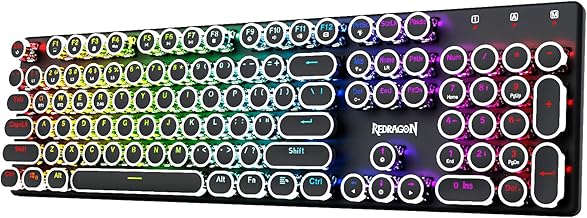
The Aesthetic: Keyboards are being designed with retro elements like high-profile, round keycaps, exposed switches, and durable materials like aluminum alloy to mimic the look of vintage machines.
The Sound and Feel: Mechanical switches provide the satisfying clicky feedback and distinct key travel that modern typists crave, offering a sensory experience absent from flat laptop keyboards.
Specialized Features: Some new devices go beyond mere imitation. The Freewrite Wordrunner, unveiled at CES 2025, is a mechanical keyboard designed specifically for writers. It features:
A large, analog-style mechanical word counter (called Wordmeter) that clicks forward with every keystroke, even when not connected to a computer.
An LED timer to track writing sessions.
Dedicated text-editing keys and customizable buttons for shortcuts.
Notable Modern Examples
Qwerkywriter: Celebrating its 10th anniversary in 2025, this keyboard is designed to look like a classic manual typewriter but connects via USB-C or Bluetooth. The anniversary edition features hot-swappable switches and improved connectivity.
Freewrite Wordrunner: A premium, aluminum-bodied keyboard that brings physical word count and timing tools to the digital writing experience.
USB Typewriter Conversion Kits: For the ultimate authentic experience, these kits allow you to turn a real, vintage typewriter into a functional computer keyboard.
🏁 The Enduring Click
From the saloons of 19th-century Milwaukee to the show floor of CES 2025, the Typewriter Keyboard has proven to be an incredibly resilient and influential design. Its history is a tale of ingenuity, from solving mechanical jams to the mystery of the QWERTY layout. While the machines themselves have become antiques, their spirit lives on. The satisfying clack of keys, the tangible connection between thought and written word, and the focused, distraction-free ritual of typing are experiences that modern technology is now striving to recreate. The typewriter keyboard is not a relic of the past; it is an inspiration for the future, a testament to the fact that sometimes, a beautiful and functional design is truly timeless.
 |  |  |
 |  |  |