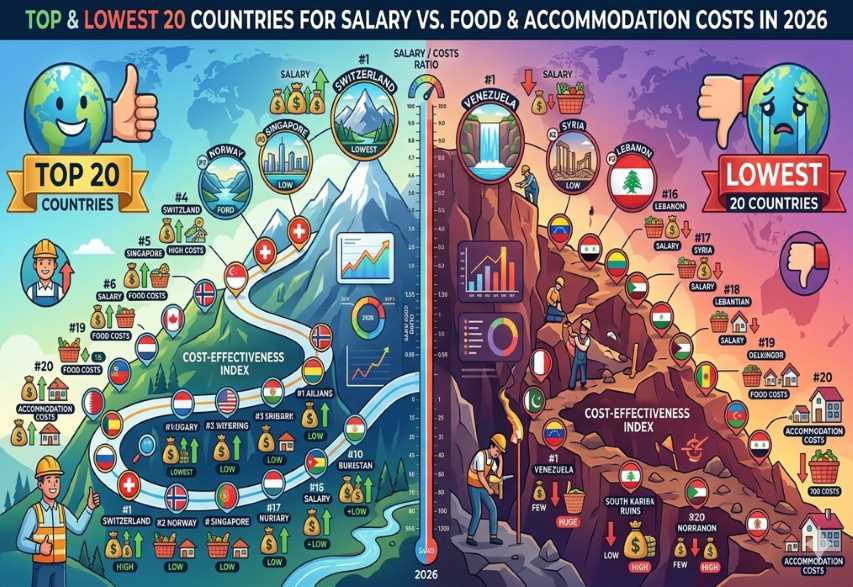
In 2026, the global economy presents a stark contrast: a six-figure salary can provide a life of luxury in one country, yet leave you with less than $10,000 a year to spend freely in another. The critical difference lies in local purchasing power—the true value of your earnings after taxes, housing, and food costs are deducted.
Here is an in-depth look at the 20 countries where your salary stretches the furthest in 2026, and the 20 where even a decent income struggles to cover the basics.
📈 Top 20 Countries: Where Your Salary Goes the Furthest
In these nations, high salaries and/or low living costs combine to create exceptional financial freedom.
Rank | Country | Key Highlight |
|---|---|---|
| 1 | 🇦🇪 Dubai, UAE | Top Disposable Income. A 100,000 earner keeps 66,520 after tax and expenses, thanks to zero income tax and a moderate cost of living. |
| 2 | 🇸🇦 Saudi Arabia | Best Salary-to-Expense Ratio. Tops the Remitly Index for the best balance of income and living costs, with high tax-free salaries. |
| 3 | 🇱🇺 Luxembourg | Highest Purchasing Power in Europe. Leads global rankings with purchasing-power-adjusted earnings exceeding $9,300/month. |
| 4 | 🇨🇭 Switzerland | World's Highest Net Salaries. A Local Purchasing Power Index of 170.6 means residents can afford 70.6% more than a New Yorker. |
| 5 | 🇶🇦 Qatar | Tax-Free Stronghold. Zero income tax, high wages, and a Cost of Living Plus Rent Index of just 45.8 create huge disposable income. |
| 6 | 🇳🇴 Norway | Nordic Powerhouse. Ranks 4th in Europe for salary-to-expense balance, with a strong purchasing power index of 124.7. |
| 7 | 🇩🇰 Denmark | High Social Benefits & Pay. Combines a Purchasing Power Index of 146.6 with excellent work-life balance. |
| 8 | 🇺🇸 United States | Exceptional Earning Potential. Despite higher costs, a robust local purchasing power index of 146.0 keeps it a top destination. |
| 9 | 🇦🇺 Australia | Lifestyle & High Wages. The highest-ranked non-European country for quality of life, pairing high minimum wages with a balanced property market. |
| 10 | 🇳🇱 Netherlands | Quality of Life Leader. Named the best country for quality of life in 2026, with strong wages that offset higher living costs. |
| 11 | 🇧🇪 Belgium | Comfortable Living. Ranks second globally for purchasing power, allowing residents to easily cover daily expenses and save. |
| 12 | 🇮🇪 Ireland | Solid Savings Potential. A top-10 country for purchasing power, with strong wages and a high standard of living. |
| 13 | 🇦🇹 Austria | Central European Stability. Rounds out the top tier for purchasing power, with a well-balanced income-to-expense ratio. |
| 14 | 🇨🇦 Canada | Stable & Solid. A 100,000 salary yields a solid 25,578 in disposable income, surpassing many major European cities. |
| 15 | 🇸🇬 Singapore | Asian Financial Hub. A 100K earner achieves 9,562 in disposable income after tax, boosted by high salaries. |
| 16 | 🇫🇮 Finland | High Purchasing Power. Features among the top global countries where salaries allow for a comfortable lifestyle and savings. |
| 17 | 🇧🇭 Bahrain | Gulf Financial Center. Average net salary of $2,256/month combined with controlled living costs make it a top low-tax destination. |
| 18 | 🇮🇸 Iceland | Resilient Economy. Ranks 2nd globally for human prosperity, ensuring high wages effectively cover the cost of living. |
| 19 | 🇸🇪 Sweden | Nordic Prosperity. Places in the global top 5 for prosperity, with a strong social safety net and high purchasing power. |
| 20 | 🇪🇪 Estonia | Digital Frontrunner. A 100K earner can expect over 30,700 in disposable income, showcasing its efficiency and lower living costs. |
📉 Bottom 20 Countries: Where a Single Salary Isn't Enough
In these nations, the cost of accommodation and food dramatically outstrips average local salaries, often pushing workers into debt or requiring a second job just to survive.
Rank | Country | Key Highlight |
|---|---|---|
| 1 | 🇵🇦 Panama | Largest Monthly Deficit. The average salary (~840) is dwarfed by rent costs (> 900), leaving workers over $850 short each month before buying food. |
| 2 | 🇩🇴 Dominican Rep. | Severe Shortfall. Workers face a monthly deficit of about $595, with housing costs consuming the majority of a single paycheck. |
| 3 | 🇲🇽 Mexico | Insufficient Local Salary. Despite a relatively low Cost of Living Index (31.5), the average local salary leaves a monthly deficit of $555.7 after rent and expenses. |
| 4 | 🇦🇷 Argentina | High Inflation Victim. Chronic inflation has decimated purchasing power, with basic expenses exceeding 1,100/month and a 418.1 monthly deficit. |
| 5 | 🇬🇪 Georgia | Widespread Overemployment. The average worker is left with a $443.0 monthly shortfall, with over 62,000 per million employed holding multiple jobs. |
| 6 | 🇺🇾 Uruguay | High Cost of Living. Salaries (~1,045)are high for the region, but living costs( 1,445) create a $399.7 monthly deficit. |
| 7 | 🇵🇹 Portugal | Western Europe's Struggle. Despite its popularity, local salaries cannot keep up. Workers face a $391.5 deficit after expenses. |
| 8 | 🇪🇨 Ecuador | Daily Hardship. A combination of rising food costs and fixed accommodation expenses leaves workers with a $321.6 monthly shortfall. |
| 9 | 🇧🇴 Bolivia | Highest Rate of Multiple Jobs. Nearly 20% of workers hold two or more jobs, yet still face a $319.6 monthly deficit. |
| 10 | 🇷🇸 Serbia | Europe's Overemployment Hub. With the highest rate of multiple jobholders in Europe, workers still face a $224.4 monthly deficit. |
| 11 | 🇻🇪 Venezuela | Economic Collapse. Hyperinflation has rendered the local currency nearly worthless, with the official monthly salary equivalent to less than $2. |
| 12 | 🇨🇺 Cuba | Survival-Level Incomes. Average net monthly salary is just ~$35, making it nearly impossible to afford basic necessities beyond a state-subsidized basket. |
| 13 | 🇳🇬 Nigeria | Currency & Inflation Crisis. With average monthly salaries around $114, purchasing power has been eroded by a weakening currency and high inflation. |
| 14 | 🇪🇬 Egypt | Basic Needs Out of Reach. Average monthly wages are around $135, leaving little to no disposable income after covering essential food and housing. |
| 15 | 🇵🇰 Pakistan | Barely Covering Basics. With an average salary of roughly $186, rising costs for food and energy are squeezing household budgets. |
| 16 | 🇮🇩 Indonesia | Growing but challenged. While the economy is growing, the average net salary of about $277 remains modest relative to living costs in major cities. |
| 17 | 🇮🇹 Italy | Stagnant Wage Growth. Real wages have fallen roughly 10 percentage points behind cumulative inflation, creating the worst gap among tracked wealthy nations. |
| 18 | 🇬🇷 Greece | Europe's Most Burdened. Tops the EU in housing cost burden, with soaring rents placing extreme pressure on households. |
| 19 | 🇪🇸 Spain | Recovery with Disparity. While a popular destination, local purchasing power lags, and many regions suffer from high unemployment and wage stagnation. |
| 20 | 🇻🇳 Vietnam | Affordable but Unequal. Extremely low costs of living attract expats, but local salaries averaging $414 make it difficult for native workers to advance. |
💎The 13x Rule
The global landscape in 2026 has created two distinct financial realities. In the top-ranked countries, high wages and favorable tax regimes amplify purchasing power, allowing a middle-class salary to feel genuinely prosperous. In the bottom-ranked countries, structural imbalances between wages and the cost of food and housing have created a cycle of deficits, forcing many into overemployment just to cover the basics.
The gap is staggering: as data from the ShouldIMove Salary Purchasing Power Index 2026 illustrates, a 100,000 salary can leave you with 66,520 in disposable income in Dubai — but just $5,046 in Amsterdam. Understanding this 13x difference in real, post-expense disposable income is the key to evaluating any economy's true standard of living.
Caveats: These are national averages — major cities are usually more expensive than rural areas. Purchasing power also ignores non-monetary factors like safety, healthcare quality, pollution, or work-life balance. Data is dynamic and crowd-sourced, so always cross-check with current city-specific figures on Numbeo or similar platforms for personal decisions (e.g., relocation or remote work).
If you’re considering a move, remote work, or just curious about a specific country (such as Egypt, which falls in the lower-mid range), ypu should know for deeper city-level breakdowns! Salaries go furthest where economic opportunity aligns with controlled essentials like food and housing.
 |  |  |
 |  |  |