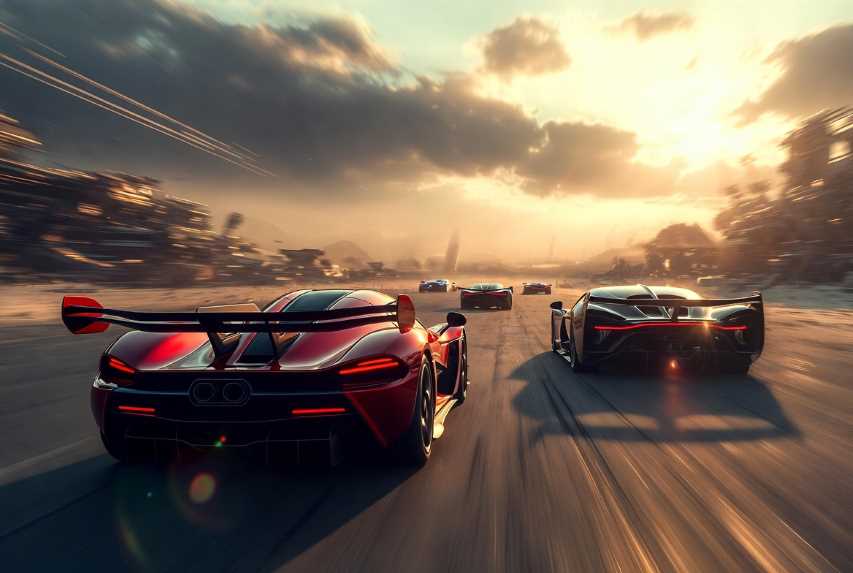
In 2026, the automotive world stands at an extraordinary crossroads where engineering ambition, advanced materials science, and powertrain innovation collide to produce machines capable of speeds once thought impossible for road-legal vehicles. The hypercar segment has evolved far beyond simple straight-line performance. Today’s fastest cars represent the pinnacle of what human ingenuity can achieve when aerodynamics, lightweight construction, hybrid and electric powertrains, and sophisticated electronic control systems work in perfect harmony.
This comprehensive ranking of the Top 10 Fastest Cars in the World for 2026 draws from verified top-speed runs, manufacturer data, independent testing, and advanced simulation results. We prioritize road-legal production or strictly limited hypercars. It is important to understand the distinction between verified records—achieved under controlled conditions with independent oversight—and theoretical or manufacturer-claimed maxima based on wind-tunnel data, computational fluid dynamics, and high-speed runway testing. Many of these vehicles have never been pushed to their absolute theoretical limits in public two-way runs because of the enormous cost, risk, and specialized facilities required.
Top speed remains a powerful benchmark even in an era dominated by electric vehicles that excel at instant acceleration. It tests the limits of tire technology, aerodynamic stability, thermal management, and driver confidence at velocities where small errors become catastrophic. In 2026 we also witness the dramatic rise of electric hypercars challenging traditional internal combustion engines, while hybrid solutions offer the best of both worlds—massive power with improved efficiency and drivability.
The cars on this list cost anywhere from roughly two million to over four million dollars. They are not transportation in the conventional sense but rolling laboratories of extreme performance. Their technologies often trickle down to more accessible sports cars over time. Here is our detailed ranking of the ten fastest cars you can actually buy and drive on public roads in 2026.
Koenigsegg Jesko Absolut – The Aerodynamic Apex Predator
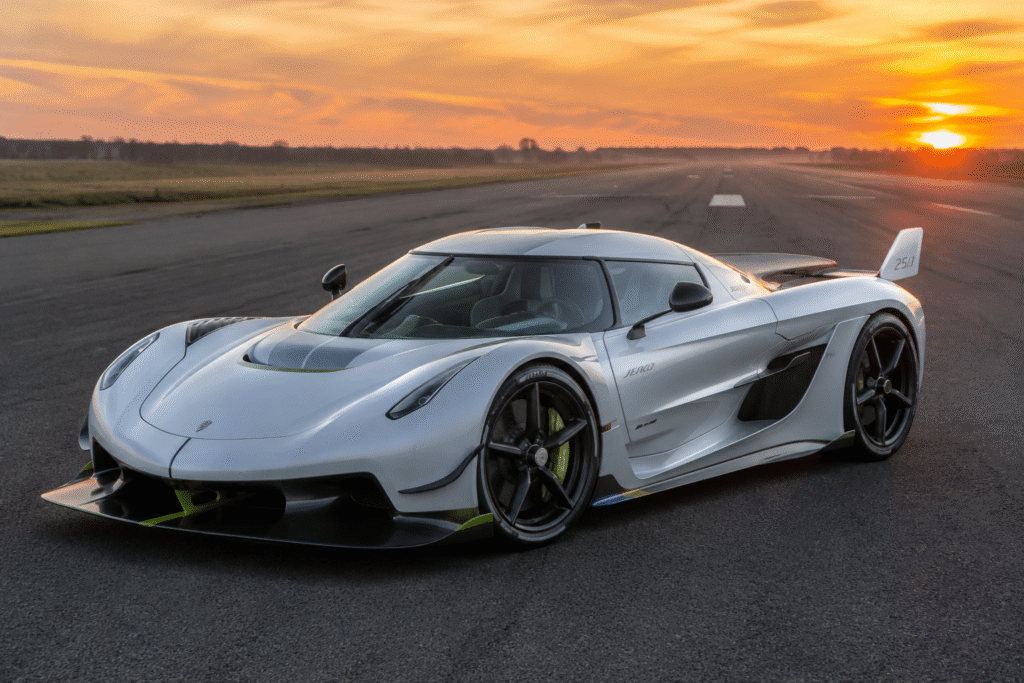
The Koenigsegg Jesko Absolut sits at the summit of our list with a theoretical top speed exceeding 310 mph (499 km/h). This Swedish hypercar was specifically engineered for one purpose: to become the fastest production car ever created. Unlike the track-focused Jesko Attack variant with its large rear wing, the Absolut version strips away downforce-generating elements in favor of pure aerodynamic efficiency. Every surface has been optimized through extensive computational modeling to reduce drag to an absolute minimum while maintaining high-speed stability.
Power comes from a 5.0-liter twin-turbocharged V8 producing 1,600 horsepower on E85 biofuel. The engine is paired with Koenigsegg’s revolutionary 9-speed Light Speed Transmission, which can shift between gears in virtually zero time. The car’s dry weight hovers around 1,390 kilograms thanks to extensive use of carbon fiber and other advanced composites. This exceptional power-to-weight ratio, combined with the ultra-slippery bodywork, allows the Jesko Absolut to achieve acceleration figures that border on the unbelievable. It already holds the record for the fastest 0-400 km/h and back to zero time at under 28 seconds.
Christian von Koenigsegg’s relentless pursuit of performance is evident in every detail, from the active suspension that lowers the car at high speed to the sophisticated aerodynamics that manage airflow under and around the vehicle. While the full theoretical top speed has not yet been publicly verified in a controlled two-way run, the engineering behind the Absolut makes it the clear benchmark for what is possible in 2026. Owners of this limited-production masterpiece are essentially purchasing a piece of automotive history in the making.
Yangwang U9 Xtreme – Electric Hypercar Revolution

The Yangwang U9 Xtreme represents a seismic shift in the hypercar world. This all-electric machine from BYD’s luxury Yangwang brand achieved a verified top speed of 308 mph (496 km/h) during testing in 2025, placing it firmly among the fastest production cars ever recorded. With approximately 3,000 combined horsepower delivered through four electric motors and a high-voltage 1,200-volt electrical architecture, the U9 Xtreme delivers instant torque that no internal combustion engine can match.
What makes this achievement even more remarkable is the relatively young history of the Yangwang brand within the massive BYD ecosystem. The company has invested billions in battery technology, electric motor development, and advanced chassis control systems. The U9 Xtreme benefits from sophisticated torque vectoring, active suspension, and thermal management systems capable of sustaining extreme performance without overheating. Production is strictly limited to just 30 units globally, ensuring exclusivity.
Electric hypercars like the U9 Xtreme challenge long-held assumptions about top-speed capability. While traditionalists once argued that battery weight and thermal limits would prevent EVs from competing at the highest velocities, the U9 Xtreme proves otherwise. Its verified performance run demonstrates that electric powertrains can now deliver both mind-bending acceleration and sustained high-speed capability. This car signals the beginning of a new era where electric hypercars will increasingly dominate the top of the speed charts.
SSC Tuatara – American Hypercar Determination

The SSC Tuatara embodies American engineering grit and determination. After early controversies surrounding its initial speed claims, the car delivered verified runs reaching 295 mph (475 km/h). Powered by a 5.9-liter twin-turbocharged V8 producing up to 1,750 horsepower on E85 fuel, the Tuatara combines raw American muscle with sophisticated aerodynamics and a lightweight carbon-fiber chassis.
SSC North America has focused on creating a car that balances outright speed with relative affordability compared to European rivals. The Tuatara’s design prioritizes high-speed stability and efficient power delivery. Its twin-turbo V8 provides massive torque across a broad rev range, making it usable in a wider variety of conditions than many pure track weapons. The car’s relatively compact size and aggressive styling give it a distinctive presence that stands apart from the more exotic European designs.
In 2026 the Tuatara remains a serious contender whenever discussions turn to the fastest production cars. Its verified performance and ongoing development program demonstrate that American manufacturers can compete at the absolute pinnacle of hypercar performance. For enthusiasts who appreciate V8 character combined with cutting-edge technology, the Tuatara offers a compelling alternative to the dominant European players.
Bugatti Tourbillon – The Hybrid Successor to Legends
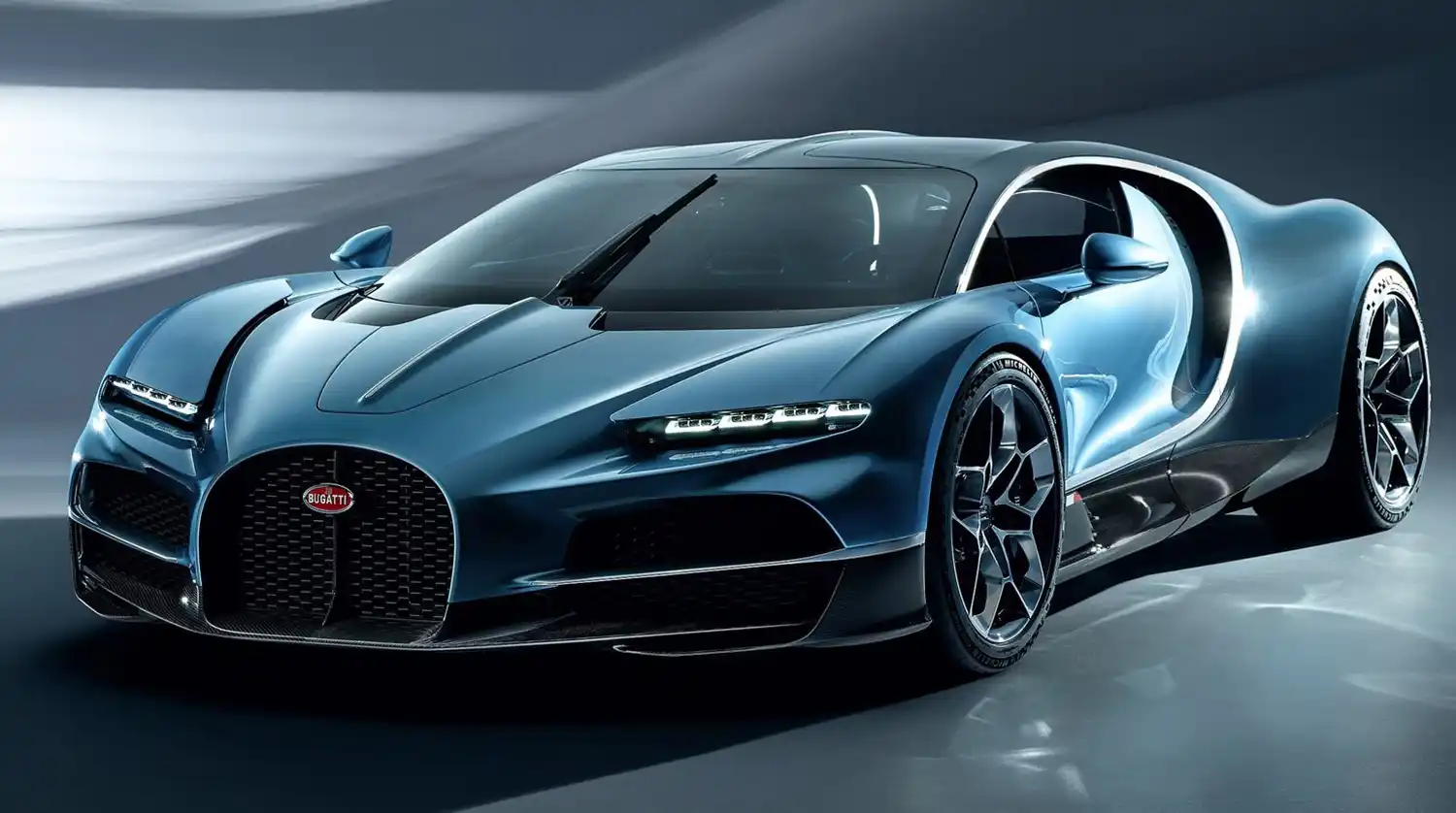
The Bugatti Tourbillon carries the enormous weight of Bugatti’s storied history while charting a bold new course. This hybrid hypercar pairs an 8.3-liter naturally aspirated V16 engine with electric motors to produce a combined 1,800 horsepower. Its electronically limited top speed reaches 276 mph (445 km/h), with potential for even higher figures when the Speed Key is engaged.
The Tourbillon represents the evolution of Bugatti under new ownership and direction. While it retains the brand’s signature focus on opulent luxury and record-breaking performance, the addition of electrification brings new dimensions of performance and refinement. The V16 engine itself is a masterpiece—high-revving, naturally aspirated, and gloriously vocal—paired with electric assistance that fills in torque gaps and enables blistering acceleration from a standstill.
Bugatti claims 0-60 mph in under two seconds, and the car’s advanced aerodynamics and chassis systems allow it to maintain composure at velocities where most vehicles would become unstable. The Tourbillon continues Bugatti’s tradition of creating cars that feel like rolling works of art while delivering performance that borders on the supernatural. Limited production ensures that each example will become a collector’s item almost immediately.
Hennessey Venom F5 – The American Tornado
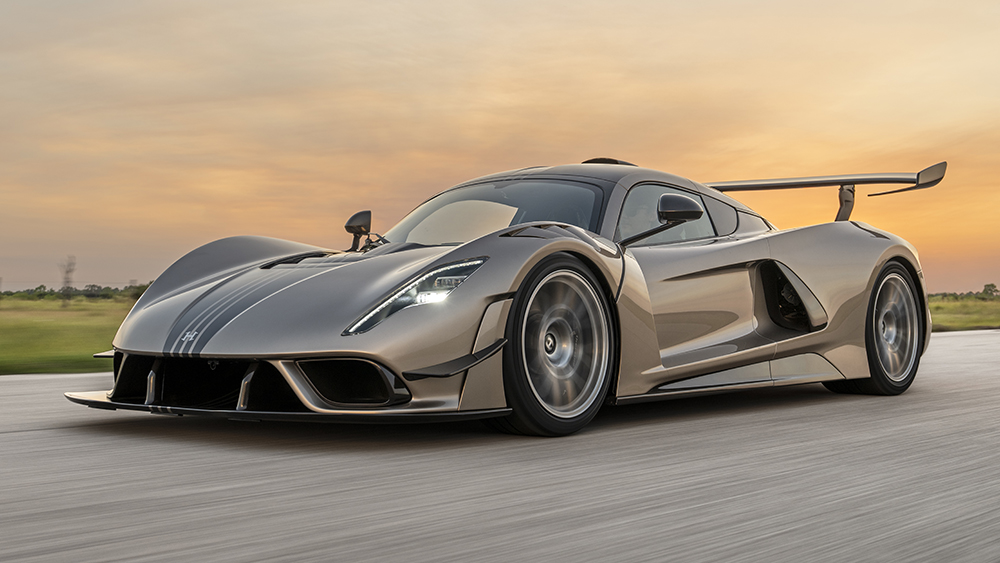
The Hennessey Venom F5 takes its name from the highest category on the Fujita tornado scale, and it lives up to that billing. This Texas-built hypercar has already demonstrated speeds exceeding 272 mph (437 km/h) in testing, with the manufacturer aggressively pursuing a target above 311 mph (500 km/h). Power comes from a 6.6-liter twin-turbocharged V8 producing 1,817 horsepower and enormous torque.
Hennessey Performance has built its reputation on taking already powerful vehicles and transforming them into monsters. With the Venom F5, the company created an all-new carbon-fiber chassis and a bespoke engine designed specifically for extreme speed. The car’s relatively straightforward mechanical layout—focusing on massive power and efficient aerodynamics—has allowed it to achieve impressive results in standing-start acceleration and high-speed testing.
The Venom F5’s 0-60 mph time of 2.6 seconds is impressive but secondary to its top-speed ambitions. Hennessey continues to refine the car through ongoing testing programs. For American buyers who want a hypercar with domestic roots and unapologetic power, the Venom F5 represents the pinnacle of what U.S. engineering can achieve when freed from traditional constraints.
Bugatti Mistral – Open-Air Speed and Drama

The Bugatti Mistral holds the distinction of being the fastest convertible hypercar ever created, with a top speed of 270 mph (435 km/h). Powered by the iconic 8.0-liter quad-turbocharged W16 engine producing 1,600 horsepower, the Mistral delivers the full sensory experience of Bugatti performance with the roof removed.
Creating a convertible capable of such extreme speeds requires extraordinary engineering. The Mistral’s chassis and body structure had to be reinforced to maintain rigidity without the roof, while aerodynamics were carefully managed to prevent buffeting and instability at high velocities. The result is a car that offers an almost spiritual driving experience—the sound of the W16 engine, the rush of air, and the visual drama of open-cockpit motoring at speeds most people will never experience.
As the final W16-powered Bugatti road car, the Mistral carries special significance. It represents the end of an era for one of the most legendary engines in automotive history while delivering performance that few vehicles in the world can match. Owners fortunate enough to secure one will experience Bugatti’s pinnacle of open-top hypercar engineering.
Rimac Nevera R – Electric Performance Redefined
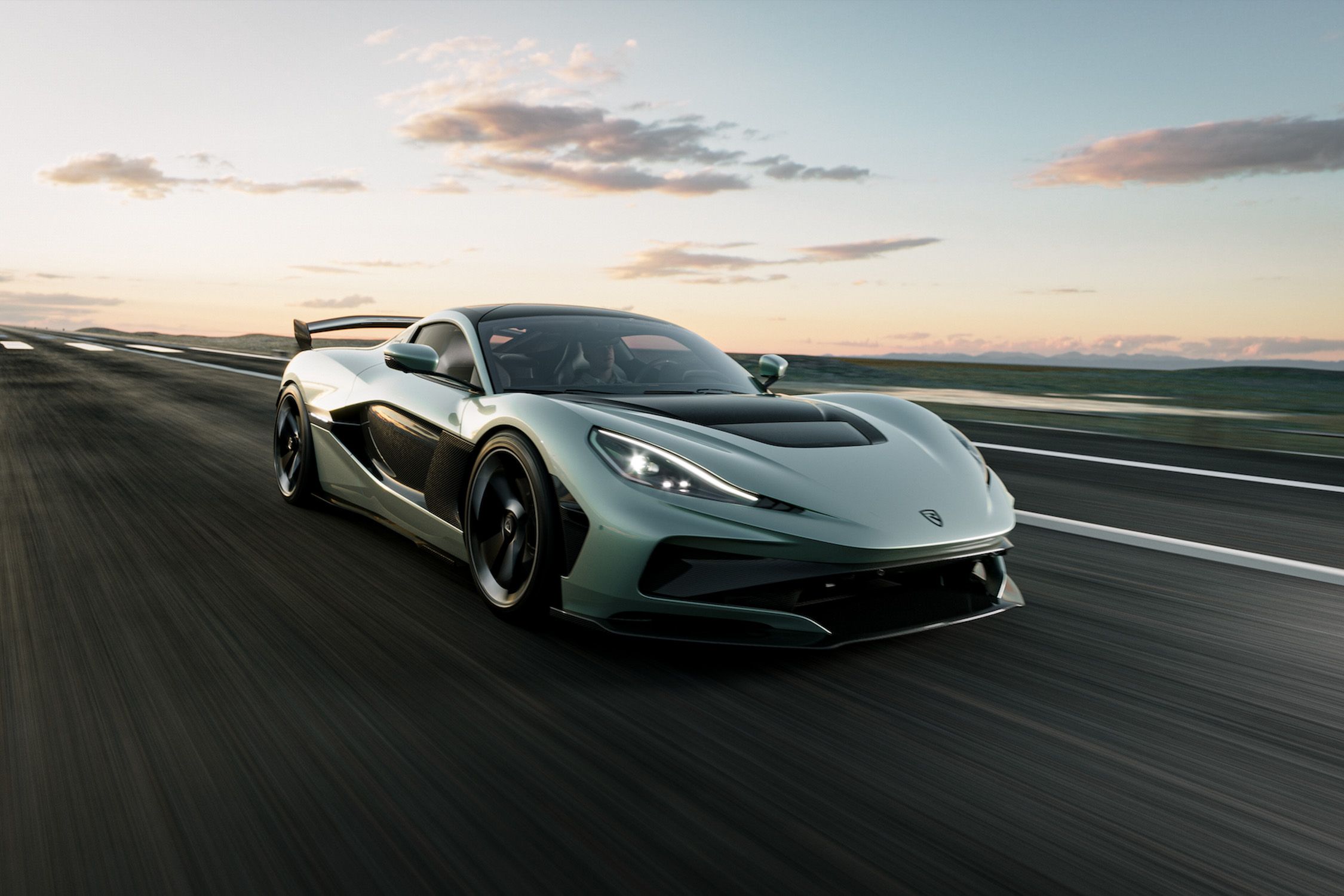
The Rimac Nevera R takes the already extraordinary Nevera platform and elevates it to new heights. With 2,107 horsepower from four electric motors, this Croatian hypercar achieves a top speed of 267 mph (430 km/h) while delivering acceleration that feels like teleportation. The 0-60 mph sprint happens in approximately 1.7 to 1.8 seconds.
What sets the Nevera R apart is not just raw numbers but the sophistication of its systems. Advanced torque vectoring, predictive chassis control, and an exceptionally rigid carbon-fiber monocoque allow the car to put its immense power down effectively in virtually any condition. The battery and thermal management systems have been engineered to sustain repeated high-performance runs without significant degradation.
Rimac has established itself as a leader in electric hypercar technology, and the Nevera R demonstrates how far the technology has progressed. While some traditionalists may prefer the character of internal combustion engines, few can argue with the Nevera R’s objective performance. It represents the cutting edge of what electric powertrains can achieve in the hypercar segment.
Aspark Owl – Compact Electric Fury

The Aspark Owl proves that electric hypercars do not need to be large to be devastatingly fast. This Japanese-developed machine produces 1,953 horsepower from four electric motors and has achieved a top speed of 256 mph (413 km/h). Its 0-60 mph time of 1.7 seconds places it among the quickest accelerating cars ever built.
The Owl’s relatively compact dimensions and low weight contribute to its exceptional performance. The engineering team focused on maximizing power density and minimizing unnecessary mass while maintaining structural integrity at extreme speeds. The result is a car that feels almost like a scaled-up electric go-kart with hypercar capabilities.
Limited production and the exotic nature of the Owl have made it a rare sight, but its performance figures ensure it earns a place among the world’s fastest cars. It demonstrates that innovation in electric powertrains can come from unexpected sources and that the future of high-speed motoring will be increasingly diverse.
Czinger 21C V Max – Innovation Through Additive Manufacturing

The Czinger 21C V Max stands out for its radical approach to construction and design. This hybrid hypercar combines a 2.9-liter twin-turbocharged V8 with electric motors for a total system output of 1,250 horsepower. Its top speed reaches 253 mph (407 km/h), with acceleration from 0-60 mph in 1.9 seconds.
What truly differentiates the 21C is its extensive use of 3D-printed components and a unique tandem seating arrangement. The seating position allows for a dramatically narrower and more aerodynamically efficient body shape. Additive manufacturing enables the creation of complex, lightweight structures that would be impossible or prohibitively expensive using traditional methods.
Czinger represents a new generation of hypercar manufacturers willing to question every assumption about how these vehicles should be built. The 21C V Max is as much a showcase of advanced manufacturing techniques as it is a pure speed machine. Its innovative approach may influence future hypercar design across the industry.
McLaren Speedtail – Sleek Hyper-GT Elegance
The McLaren Speedtail rounds out our top ten with a top speed of 250 mph (402 km/h). This hybrid hyper-GT combines a high-output V8 with electric assistance in a dramatically styled body that prioritizes aerodynamic efficiency over traditional downforce. The three-seat layout—with the driver positioned in the center—creates a unique driving experience reminiscent of the legendary McLaren F1.
The Speedtail’s design is its defining feature. The long, flowing tail and smooth surfaces minimize drag, allowing the car to reach high speeds with relative ease. Limited to just 106 units, the Speedtail was created for buyers who wanted McLaren performance with a more refined, grand-touring character than the brand’s pure track-focused models.
While its top speed is lower than the cars ranked above it, the Speedtail excels in delivering usable high-speed performance in a more comfortable and elegant package. It represents an important strand of hypercar development—machines that prioritize the overall experience rather than pure numbers.
Comparative Overview of Key Specifications
When examining these ten cars together, several patterns emerge. Electric and hybrid powertrains now dominate the very top of the acceleration charts, while pure internal combustion engines still compete strongly for outright top speed. Power outputs range from around 1,250 horsepower in the Czinger to approximately 3,000 horsepower in the Yangwang U9 Xtreme. Weights vary significantly, with the lightest cars benefiting from extensive carbon-fiber construction.
Aerodynamics play a decisive role at these speeds. Cars designed purely for top speed, such as the Koenigsegg Jesko Absolut, sacrifice downforce for minimal drag. Others balance the two requirements depending on their intended use. Tire technology has advanced tremendously, but remains one of the limiting factors at velocities above 250 mph.
The Engineering Challenges of Extreme Speed
Reaching and sustaining speeds above 250 mph requires solving multiple interconnected problems simultaneously. Aerodynamic drag increases with the square of speed, meaning enormous power is needed to overcome resistance at the highest velocities. Heat management becomes critical as brakes, tires, and powertrains generate tremendous thermal loads. Structural rigidity must be maintained without excessive weight, and driver visibility and comfort cannot be ignored even at these extremes.
Tire manufacturers have developed specialized compounds and constructions capable of withstanding the centrifugal forces and heat generated at 300+ mph. Active aerodynamic elements that adjust in real time help optimize the car for different speed ranges. Advanced driver assistance systems provide stability and predictability that would have been impossible just a decade ago.
The Rise of Electric and Hybrid Hypercars
The inclusion of multiple electric and hybrid vehicles in this 2026 ranking reflects a fundamental shift in the industry. Electric motors deliver instant torque and can be packaged in ways that optimize weight distribution. Battery technology continues to improve in energy density and thermal performance. Hybrids offer a pragmatic middle path, combining the character of internal combustion engines with the benefits of electrification.
This transition raises interesting questions about the future character of high-performance cars. Will the sound and sensation of a high-revving V8 or W16 become a luxury reserved for special editions? Or will manufacturers find new ways to deliver emotional engagement in electric vehicles? The cars on this list suggest that both paths will coexist for years to come.
Looking Ahead: What Comes Next?
The hypercar world moves quickly. Manufacturers are already developing the next generation of vehicles that will challenge these rankings. Electric powertrains will likely continue their rapid progress, while internal combustion engines may evolve toward synthetic fuels or other low-carbon alternatives to remain relevant. Aerodynamic efficiency, lightweight materials, and advanced electronics will keep pushing the boundaries of what is physically possible.
Regulatory pressures around emissions and safety will also shape development. Some markets may impose speed limits or other restrictions that affect how these cars can be used. Yet the fundamental human desire to go faster, to push limits, and to experience the extraordinary ensures that hypercar development will continue.
The Top 10 Fastest Cars in the World 2026 represent the absolute cutting edge of automotive engineering. From the theoretical maximum of the Koenigsegg Jesko Absolut to the verified performance of the Yangwang U9 Xtreme and the refined capabilities of the McLaren Speedtail, these machines showcase what is possible when the brightest minds in the industry focus on a single goal: speed.
They are expensive, exclusive, and impractical for most people. Yet they matter far beyond their price tags. They drive innovation in materials, electronics, aerodynamics, and powertrains that eventually benefits more accessible vehicles. They capture the imagination and remind us of what passionate engineers can achieve when constraints are removed.
Whether your passion lies with the screaming V8 of the Hennessey Venom F5, the silent fury of the Rimac Nevera R, or the hybrid sophistication of the Bugatti Tourbillon, these cars represent the current state of the art in automotive performance. As 2026 unfolds and new testing results emerge, the leaderboard may shift, but the pursuit of ultimate speed will remain one of the most exciting stories in the automotive world.
This level of performance demands respect, careful development, and responsible use. These vehicles exist at the intersection of art, science, and pure adrenaline. For those fortunate enough to experience them, they offer a glimpse into a future where the impossible becomes achievable—one mph at a time.
 |  |  |
 |  |  |