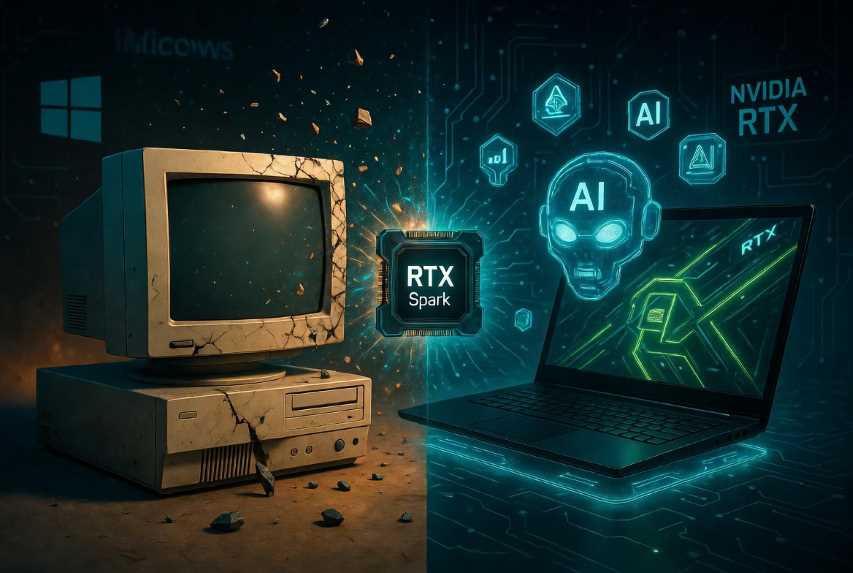
In late May and early June 2026, at NVIDIA GTC Taipei during Computex and at Microsoft Build in San Francisco, two of the world’s most influential technology companies delivered a coordinated message that sent ripples through the entire personal computing industry. NVIDIA and Microsoft jointly signaled a profound reinvention of the Windows PC. The centerpiece of this announcement was the NVIDIA RTX Spark superchip — a powerful, integrated Arm-based processor that combines a high-performance CPU and a full Blackwell-architecture RTX GPU in a single package, paired with up to 128 gigabytes of unified memory and up to one petaflop of AI performance.
NVIDIA CEO Jensen Huang captured the moment with striking clarity: “The PC is being reinvented. For forty years, you launched apps. Click. Type. With RTX Spark and Microsoft Windows, you ask — and the PC does the work.” Microsoft Chairman and CEO Satya Nadella reinforced the shared vision, stating that RTX Spark represents a real breakthrough toward delivering “unmetered intelligence to every home and every desk with Windows.”
This is not merely another incremental upgrade to existing laptops or a new marketing label for AI features. It marks a deliberate architectural and philosophical departure from the traditional PC model that has dominated since the 1980s. The old paradigm — centered on x86 processors, discrete or integrated graphics, manual application launching, and often cloud-reliant AI assistance — is being challenged by a new class of devices purpose-built for proactive, on-device artificial intelligence agents that can understand context, execute complex multi-step tasks, and operate as genuine digital teammates rather than passive tools.
The Long Evolution of the Personal Computer — and Why This Moment Feels Different
To understand the significance of RTX Spark, it helps to look back at how personal computing has evolved. The original IBM PC and its many clones established a model of modular, expandable machines powered by Intel x86 processors. Over the decades, this evolved into sleek laptops, powerful desktops, and eventually ultraportable devices. Graphics acceleration became increasingly important for gaming and creative work, leading to the rise of dedicated GPUs from NVIDIA and AMD.
The smartphone and tablet revolution in the late 2000s and early 2010s prompted repeated predictions of a “post-PC era.” While those predictions proved premature for many professional and enthusiast use cases, they did accelerate the industry’s focus on efficiency, battery life, and touch-first interfaces. Microsoft’s own earlier attempts, such as Windows RT on Arm-based hardware, struggled with application compatibility and developer support, ultimately fading from prominence.
More recently, the industry embraced the concept of the AI PC. Microsoft introduced Copilot+ PCs in 2024, requiring dedicated neural processing units (NPUs) capable of at least 40 TOPS for advanced on-device AI features. These machines represented meaningful progress, but they largely remained extensions of the existing x86-centric architecture. The NPU handled specific AI workloads while the main CPU and GPU continued to operate in more traditional roles.
RTX Spark represents something more fundamental. By tightly integrating a high-core-count Arm CPU, a full-featured Blackwell RTX GPU, and an enormous pool of unified memory into one superchip, NVIDIA and Microsoft are proposing an entirely new foundation for high-performance Windows devices. The goal is no longer simply to add AI acceleration on top of an existing computer — it is to build the computer around AI from the silicon level upward.
Inside the RTX Spark Superchip: Technical Breakthroughs That Matter
At the heart of the announcement is the RTX Spark superchip itself. It fuses two critical components connected by a high-speed NVLink chip-to-chip interconnect: a custom 20-core Arm-based NVIDIA Grace CPU developed in collaboration with MediaTek, and a Blackwell-architecture RTX GPU featuring 6,144 CUDA cores along with advanced Tensor Cores and RT Cores.
The use of unified memory — up to 128 GB of LPDDR5X — is particularly important. In traditional PC designs, the CPU and GPU often maintain separate memory pools, requiring data to be copied back and forth over relatively slow PCIe connections. Unified memory eliminates much of this overhead, allowing the CPU and GPU to access the same data instantly. This architectural choice dramatically improves performance for AI workloads, content creation, and any task that involves large datasets or complex models moving between processing units.
The AI performance claim of up to one petaflop in FP4 precision is extraordinary for a device designed to fit inside slim laptops. It enables capabilities that were previously confined to data-center hardware or bulky workstations: running large language models with 120 billion parameters entirely locally, maintaining extremely long context windows up to one million tokens, performing sophisticated on-device reasoning, and executing agentic workflows without constant cloud connectivity.
Power efficiency receives equal emphasis. The design targets premium thin-and-light laptops as slim as 14 millimeters and as light as approximately three pounds, as well as compact, ultra-efficient desktop systems. This balance of performance and portability is achieved through advanced process technology (TSMC 3nm-class), intelligent power management, and the inherent efficiency advantages of the Arm architecture when optimized for specific workloads.
Because the GPU portion is a full RTX implementation, the platform inherits the entire NVIDIA software ecosystem. Developers and users gain access to CUDA, TensorRT, DLSS, OptiX, Reflex, G-SYNC, and other mature technologies that have powered professional creative applications, scientific computing, and high-end gaming for years. Bringing this full stack natively to Windows laptops and small form-factor desktops removes previous barriers that existed when NVIDIA GPUs were primarily add-in cards or secondary accelerators.
The Philosophical Shift: From Apps to Agents
Perhaps the most consequential aspect of the RTX Spark announcement is not the hardware specifications themselves, but the new interaction model they enable. Jensen Huang’s contrast between the old “click and type” paradigm and the new “ask and the PC does the work” model captures a fundamental change in how humans are expected to relate to their computers.
In the traditional model, the user bears most of the cognitive and manual load. You must know which application to open, which menu to navigate, which settings to adjust, and how to orchestrate multiple tools to accomplish a goal. Even with modern assistants, much of the work remains fragmented across different applications and services.
Agentic AI systems, by contrast, are designed to understand high-level intent, decompose goals into steps, maintain context across long interactions, use tools (both local applications and cloud services when appropriate), and execute actions autonomously while seeking clarification when needed. On RTX Spark devices, these agents can run locally with strong privacy guarantees, leveraging the massive unified memory and on-chip AI performance to handle sophisticated models without sending sensitive data to remote servers.
Concrete examples help illustrate the difference. A traditional workflow for preparing a business presentation might involve opening a spreadsheet to pull data, copying it into presentation software, searching for images or generating charts manually, and then formatting everything. An agentic workflow on an RTX Spark PC could involve simply stating the objective: “Create a quarterly business review presentation using the latest sales figures, highlight regional performance differences with clear visuals, include competitive analysis from public sources, and prepare speaker notes in my preferred style.” The agent would gather the necessary information, generate or retrieve visuals, assemble the deck, and even suggest talking points — all while the user remains in a supervisory role rather than performing every micro-task.
This shift has profound implications for productivity, accessibility, and the types of work that become feasible on personal devices. It also raises important questions about trust, oversight, and the changing nature of human-computer collaboration.
Microsoft’s Role: Deep Platform Integration and Security
Microsoft’s partnership with NVIDIA extends far beyond simply certifying hardware. The two companies have collaborated on a native Windows experience for personal agents, including new security primitives for identity management, containment, policy enforcement, and end-to-end protection of agent activities.
NVIDIA OpenShell plays a key role here. It provides a secure runtime environment that allows agents to operate according to user-defined policies, intelligently route queries between local models (for maximum privacy) and cloud models (when greater capability is required), and protect sensitive personal information even when cloud services are involved. These capabilities are especially important as agents become more autonomous and are granted broader access to user data, applications, and system resources.
At Microsoft Build, Satya Nadella highlighted developer-focused hardware such as the Surface RTX Spark Dev Box — a machine preloaded with professional tools including Visual Studio Code and GitHub Copilot, designed specifically for fine-tuning models, running large local inference workloads, and building the next generation of agentic applications. This developer-centric approach signals Microsoft’s intent to make the new platform attractive not only to end users but to the software creators who will ultimately determine its long-term success.
Transforming Creative Workflows
One of the most immediate and visible impacts of RTX Spark will likely appear in creative industries. Adobe has already committed to rearchitecting core applications including Photoshop and Premiere Pro from the ground up for the new platform, promising up to twice the performance for AI-enhanced and graphics-intensive tasks.
Consider video editing workflows. High-resolution 8K or 12K footage, complex multi-layer compositions, AI-powered object tracking, generative fill, and real-time effects have traditionally required either powerful desktop workstations or time-consuming rendering queues. RTX Spark laptops aim to bring much of this capability into portable form factors with unified memory large enough to hold entire projects in RAM and GPU acceleration sufficient for real-time playback and effects processing.
3D artists and visual effects professionals stand to benefit similarly. Rendering complex scenes, running physics simulations, and iterating on AI-assisted content generation become far more practical when the entire pipeline can leverage both the CPU and GPU portions of the superchip without data-transfer bottlenecks.
Blackmagic Design, OTOY, and other creative software companies have also expressed strong support, highlighting the potential for portable, high-performance systems that allow artists and filmmakers to work on location or in the field without sacrificing capability.
Gaming and Entertainment on the New Platform
While RTX Spark is clearly optimized for AI and creative workloads, it also delivers meaningful gaming performance. The full RTX feature set — including DLSS upscaling, ray tracing, and Reflex latency reduction — is available, and NVIDIA has worked closely with Xbox and various game developers to ensure strong compatibility and optimization.
AAA titles running at 1440p with high frame rates are cited as achievable targets on these slim laptops. The combination of a powerful integrated GPU, high-bandwidth unified memory, and efficient power management makes it possible to deliver console-like or better experiences in devices that remain highly portable.
Beyond traditional gaming, the platform opens possibilities for new forms of interactive entertainment that blend AI generation, procedural content, and real-time rendering. As agentic systems mature, entirely new categories of experiences — personalized storytelling, dynamic world-building, and AI companions within games — become technically feasible on consumer hardware.
Implications for Software Developers and the Broader Ecosystem
Bringing full CUDA and the complete NVIDIA AI software stack to mainstream Windows laptops represents a significant expansion of the addressable market for GPU-accelerated development. Previously, developers targeting NVIDIA’s ecosystem often needed dedicated workstations or cloud instances. With RTX Spark, a much larger population of Windows users will have access to high-performance CUDA capabilities in their daily drivers.
This has particular relevance for the rapidly growing field of local and on-device AI. Projects such as llama.cpp for efficient LLM inference and ComfyUI for complex diffusion-model workflows are already seeing dramatic performance improvements on the new hardware. The ability to run large models with extended context windows entirely locally changes the economics and privacy profile of many AI applications.
Independent software vendors and open-source communities will need to decide how aggressively to optimize for the new platform. Those that move quickly may gain significant advantages in performance and user experience, while broader Windows application compatibility remains an important consideration given the platform’s Arm foundation. Microsoft and NVIDIA have emphasized ongoing work to ensure excellent compatibility with the vast existing Windows software library, building on years of improvements to Windows on Arm.
Competitive Landscape and Industry Reactions
The RTX Spark announcement arrives at a moment of intense competition in the PC processor market. Intel and AMD continue to advance their own x86 platforms with integrated NPUs and strong graphics capabilities. Qualcomm has made notable progress with Snapdragon X Elite and subsequent Arm-based Windows devices focused on efficiency and battery life. Apple has demonstrated the power of tight hardware-software integration with its M-series chips, achieving impressive performance and efficiency in both laptops and desktops.
NVIDIA’s entry as a provider of complete superchip platforms for Windows represents a new competitive dynamic. By leveraging its unmatched position in AI acceleration and its mature CUDA ecosystem, NVIDIA is attempting to carve out a premium segment where AI capability, creative performance, and unified memory advantages outweigh other considerations.
Intel and AMD are unlikely to cede the market without response. Both companies have deep relationships with OEMs, extensive software optimization investments, and strong positions in enterprise and mainstream consumer segments. The most probable outcome in the near term is a period of architectural diversity, with different platforms excelling in different use cases and price points.
OEM reactions have been notably enthusiastic. ASUS, Dell, HP, Lenovo, MSI, and others have all committed to RTX Spark-powered systems. Each will likely differentiate through industrial design, display technology, thermals, keyboard and trackpad quality, port selection, and software experiences layered on top of the common platform.
Challenges, Risks, and Open Questions
No major platform transition is without friction. Several important questions remain as RTX Spark devices prepare for fall 2026 availability.
Software compatibility, while improved dramatically in recent years, is never perfect on a new architecture. Niche professional applications, older enterprise software, and certain drivers may require updates or workarounds. Microsoft and NVIDIA are investing heavily in compatibility layers and developer tooling, but real-world experience will determine how seamless the transition feels for different user populations.
Pricing will be another critical factor. Premium thin-and-light laptops with 128 GB of unified memory and workstation-class performance are unlikely to be inexpensive. Early adopters and professional users may accept higher price points in exchange for capability, but broader mainstream adoption will depend on how quickly costs come down in subsequent generations.
Thermal and battery-life realities in actual shipping products will matter greatly. While NVIDIA emphasizes efficiency, sustained high-performance workloads can still generate significant heat and power draw. The success of the platform will partly depend on how well OEMs manage thermals, fan noise, and real-world endurance.
Developer mindshare is perhaps the most important long-term variable. If major applications and frameworks optimize aggressively for the platform, the advantages will compound. If adoption remains limited to a subset of AI-focused tools, the platform may remain a niche solution for specific professional workflows rather than a broad successor to traditional Windows PCs.
Security and privacy considerations around autonomous agents also deserve careful attention. As agents gain more capability and access to user data and system resources, the attack surface expands. The security investments announced by Microsoft and NVIDIA are substantial, but the industry will need ongoing vigilance and transparent auditing as these systems become more powerful.
What This Means for Different Types of Users
For professional creators — video editors, 3D artists, graphic designers, and photographers — RTX Spark offers the tantalizing prospect of workstation-class performance in highly portable packages. The combination of unified memory, full RTX acceleration, and Adobe’s early optimization work could meaningfully change daily workflows and enable new levels of on-location productivity.
AI researchers, machine learning engineers, and developers working with large models gain a new class of personal hardware capable of running substantial local inference and fine-tuning workloads. This reduces dependence on cloud resources for many tasks and improves iteration speed and data privacy.
Enthusiast gamers and content consumers benefit from strong gaming performance alongside the new AI capabilities. The ability to run high-quality games and sophisticated local AI tools on the same device opens interesting hybrid experiences.
Mainstream consumers may see more gradual impact in the first generation. Many everyday tasks — web browsing, office productivity, media consumption — do not yet require petaflop-scale AI performance. However, as agentic interfaces mature and become more deeply integrated into Windows, even casual users may begin to experience computers that anticipate needs, handle routine tasks autonomously, and provide more natural, conversational interaction.
Enterprise IT departments will need to evaluate the platform carefully for compatibility with existing management tools, security policies, and application portfolios. The long-term trajectory toward agentic computing may eventually offer productivity benefits, but near-term adoption decisions will likely focus on specific high-value use cases.
Looking Forward: The Emerging Shape of Personal Computing
The RTX Spark announcement does not mark the immediate disappearance of traditional x86 Windows PCs. Those machines will continue to serve the majority of users effectively for years to come, supported by enormous software compatibility, established supply chains, and ongoing innovation from Intel, AMD, and their partners.
What RTX Spark does signal is the arrival of a credible, high-performance alternative architecture optimized for the coming age of personal AI agents. It demonstrates that the industry is willing to make bold bets on new silicon foundations when the potential rewards — in capability, efficiency, and new user experiences — are sufficiently large.
Over the next several years, we can expect rapid iteration. Subsequent generations of superchips will likely offer higher performance, lower power consumption, and broader market positioning. Software ecosystems will mature as developers gain experience with the platform. Agentic interfaces will become more capable and more deeply woven into the operating system.
The relationship between humans and their computers is entering a new chapter. The devices we carry and use every day are evolving from sophisticated tools that execute our explicit commands into collaborative systems that can understand goals, maintain context, and take initiative on our behalf. NVIDIA and Microsoft’s joint announcement at Computex and Build 2026 represents one of the clearest early expressions of this emerging paradigm.
Whether history ultimately judges RTX Spark as the beginning of the end for the traditional PC or simply as the first successful example of a powerful new category alongside existing architectures remains to be seen. What is already clear is that the conversation about what a personal computer should be — and how it should interact with its user — has changed in meaningful and exciting ways.
The age of the personal AI computer has begun.
 |  |  |
 |  |  |