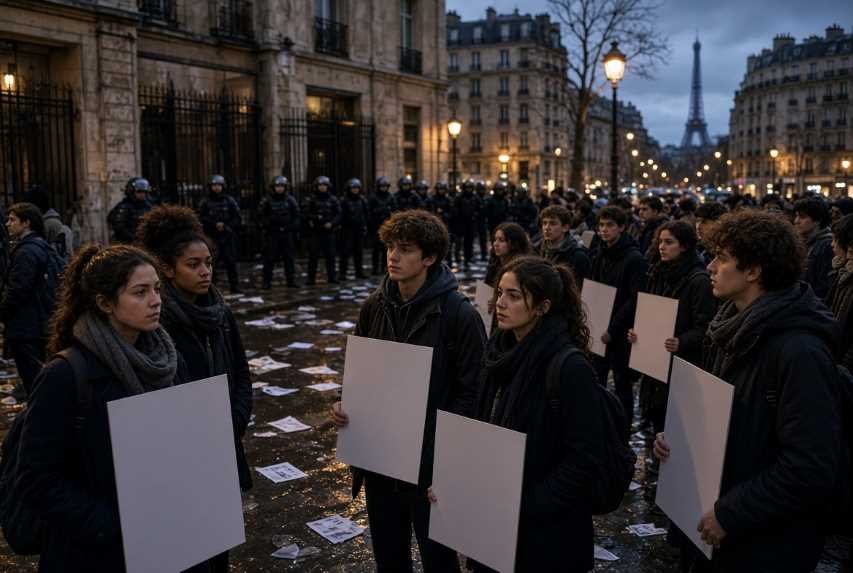
France’s Student Protests Escalate: Why Are Young People Taking to the Streets, What Are They Demanding, and How Is the Government Responding?
A fortnight of school blockades that began in a handful of lycées has become a national confrontation over classrooms, budgets, and public order — with thousands of mostly teenage arrests, damaged schools, and a government that calls the grievances real and the violence unacceptable.
Introduction
In the last two weeks of September 2026, French high-school students began blocking the gates of their lycées. What started as local actions over missing teachers, overcrowded classes, and worn-out buildings spread, within days, from the Paris suburbs to cities across the country. By early October, officials were counting disruptions at hundreds of the country’s roughly 3,700 lycées, police were making thousands of arrests, and the government was describing parts of the unrest as urban violence rather than a school protest.
The movement is mainly a lycée protest, involving students aged about 15 to 18. University students joined in smaller numbers from 1 October, with at least 26 campuses reported blocked that morning, but they have not been the core of the mobilization. Teachers’ unions and some parents have backed the demands while often rejecting the fires and clashes. A minority of blockades have stayed orderly. Others have involved burning bins, fireworks aimed at police, broken windows, and, in Nantes, a fire that regional authorities said caused more than €2 million in damage at one high school.
The timing explains the attention. The protests coincided with a public-sector strike on 29 September, landed as the government presented a tight draft budget, and arrived about six months before France’s next presidential election. President Emmanuel Macron, speaking from Spain on 30 September, said he heard the anger and that nothing justified violence. Prime Minister Sébastien Lecornu warned that escalation would be “irresponsible.” International outlets from Reuters and the BBC to The New York Times treated the unrest as a test of a government already short of political room.
France in 2026 is not in a general insurrection. Most lycées have continued to function on most days. Verified figures describe hundreds of disrupted schools on peak days, not a shutdown of the entire system. The crisis is still serious: it has closed or blockaded schools, injured staff, students, and officers, produced a very large number of arrests of minors, and reopened an old argument about whether poorer districts, especially Seine-Saint-Denis, are asked to accept a thinner version of the public school.
What Is Happening in France?
The protests have been recorded from the Paris region — Créteil, Saint-Denis, Aubervilliers, Pantin, Saint-Ouen — to Lille, Strasbourg, Dijon, Lyon, Marseille, Nantes, Rennes, Bordeaux, Toulouse, Montpellier, Nice, Tours, and smaller towns. Interior Ministry counts, education-ministry statements, and police reports cited by AFP do not always match student-union claims, so the range matters.
On the peak day, Thursday 1 October, BFM TV, citing official tallies, reported 1,027 lycées mobilized and 222 blockaded, out of about 3,700. The same morning, at least 26 universities were blocked, including sites in Strasbourg, Lyon, Aix-Marseille, Poitiers, and Montpellier. On Friday 2 October, Justice Minister Gérald Darmanin said 735 lycées had been affected “one way or another,” while the education ministry said lessons were disrupted at more than 560 schools and that more than 400 were expected to stay closed. Reuters, summarizing the week to 3 October, said protests had touched more than 1,200 high schools. That last figure is best read as a cumulative week total, not a single-day shutdown.
Teachers were already on strike on 29 September over pay and conditions, and education unions later called for support on 6 October. Some Marseille high schools switched to remote classes. Public transport was not nationally halted, but local clashes damaged bus shelters and, in several cities, set street bins alight.
Violence has been real and uneven. In Lille, students threw bottles and paving stones and burned bins; police used tear gas. In Dijon, officers dispersed groups with tear gas. In Strasbourg, firefighters were called to burning bins. In Belfort on 2 October, a 17-year-old was arrested on suspicion of attempted homicide after a police officer was chased and beaten; BBC Verify authenticated video of the assault. In Nantes, fire destroyed the glass entrance and parts of the interior of Lycée Nelson Mandela. Education Minister Édouard Geffray said some teachers had told him the people in front of their schools “were not my students,” and the Interior Ministry said the unrest had taken on “all the hallmarks of urban violence.” Student leaders, including Ryad Rani of the Union syndicale lycéenne (USL), urged protesters to stay peaceful. Nathanaël Combary of Renouveau Lycéen said his union dissociated itself from urban violence.
Arrest and injury counts rose through the week and are not interchangeable across outlets:
28 September: 164 arrests; Interior Minister Laurent Nuñez reported 12 officers, 12 students, and 3 staff injured that day. BFM later cited 12 officers, 8 education staff, and about a dozen students.
29 September: 440 people detained, mostly minors, Nuñez told BFM TV; about two-thirds placed in custody. The BBC reported 76 injured since the start, including pupils and staff, and 48 officers injured in the clashes to that point.
30 September: 625 detentions, Nuñez said. Geffray put injuries since the start at 119, mostly principals and teachers among the staff.
1 October: police reported roughly 2,000 people taken into custody that day in some accounts; the Justice Ministry said 1,798 people had been placed in custody since Monday. A government tally cited by French media put cumulative arrests near 1,949 by that evening, with 318 injured, including 65 education staff, 170 students, and 83 police and gendarmes.
2 October: Nuñez said 1,747 people were arrested that Friday.
By 3 October, Reuters reported more than 5,000 arrests over the course of the protests, with some protesters suffering eye injuries, broken teeth, and blows to the head. The New York Times, citing the scale of the week, referred to about 3,000 arrests and injuries to nearly 400 officers and more than 230 staff and students. These totals overlap and depend on the cutoff hour; they should not be added together.
Timeline
Date | What happened |
15–17 September | Early local blockades, including Villeneuve-d’Ascq, Caen, and Le Rheu near Rennes. On 17 September, students at Lycée Saint-Exupéry in Créteil joined a teachers’ strike and blocked the school. |
21 September | LFI deputies Louis Boyard and Clémence Guetté visited Saint-Exupéry. Boyard’s video drew hundreds of thousands of views. |
24–25 September | A Booska-P interview with Saint-Exupéry students reached 1.5 million TikTok views. The Créteil rectorate reported about a dozen blocked lycées, mainly in Seine-Saint-Denis and Val-de-Marne. Geffray said 58 schools had been affected the previous week. |
28 September | Interior Ministry: 180 lycées affected. 164 arrests. Spread beyond the Paris region. |
29 September | About 400 schools disrupted; public-sector strike the same day. 440 detentions. Clashes in Lille, Strasbourg, Dijon, and elsewhere. |
30 September | 356 lycées mobilized; 625 detentions. Macron, in Spain, said he understood the anger and condemned violence. |
1 October | “Acte 2.” More than 1,000 lycées mobilized, 222 blockaded; at least 26 universities blocked. Lecornu convened an interministerial cell. |
2 October | 1,747 arrests that day. Nantes school fire. Belfort assault on an officer. More than 400 schools closed. |
3–4 October | Weekend lull in street action. Reuters and French media reported no concrete concessions. USL called a further national day for 6 October. |
Why Are French Students Protesting?
The documented demands are about the lycée itself. Broader fears — jobs, housing, politics — appear in interviews, but they are not the same as the slogans on the gates.
Education and school conditions
Students and parent representatives describe classes of 34 or 35, missing chairs, and hours that run from 8 a.m. to 6 p.m. A placard at Lycée Lamartine in northern Paris read, in substance, that students had more lesson hours than sleep. At Lycée Le Corbusier in Aubervilliers, an elected parent, Karima Kara Ali, said maths, humanities, English, and sport had been cancelled since the start of the year for lack of teachers. Maisa, a 17-year-old who wants to teach English, told Reuters she had sat the French baccalauréat exam the previous year without a French teacher. “These are not conditions to study in,” she said.
Buildings are part of the complaint. At Rosa Parks high school in Seine-Saint-Denis, 15-year-old Issam Makhloufi told The New York Times that classrooms were not ventilated and windows barely opened. Two 17-year-olds at Lycée Suger described bathrooms with no doors and faulty taps. Louise Paternoster of the CGT education union in Seine-Saint-Denis said some schools had no drinking water. In Alsace, students at Théodore-Deck in Guebwiller complained of overcrowding and overheated, poorly insulated rooms. Support staff — nurses, social workers, supervisors — are described as missing in the same districts. Geffray has said that about 7 percent of lesson hours are not covered, a figure he gave on RTL.
Vocational lycées and schools in poorer catchment areas appear more often in the reporting than selective city-center lycées, although blockades have not been confined to them. A blockade also formed at Lycée David d’Angers, in a wealthier part of Angers, organized over WhatsApp and Snapchat.
Educational inequality
Seine-Saint-Denis is the clearest case. The CGT said two-thirds of the department’s high schools took part on one Thursday, and that two-thirds had unfilled teaching posts. Mayor Bally Bagayoko, of La France Insoumise, joined students at Lycée Paul-Éluard, sang the Marseillaise, and argued that low-income areas receive fewer resources. Amelia, 15, held a sign in Aubervilliers reading “Our address should not decide our future,” and told Reuters the education authority’s under-investment in the suburbs was “classist and racist.” That is her charge, not a court finding.
The pattern is familiar in French education research: national rules, uneven local means. Teacher vacancies concentrate where the job is harder and housing is tighter. A political scientist at Paris 8, Ulysse Rabaté, told Reuters that when a public service weakens, those at the bottom feel it first. Students in wealthier lycées also report long days and Parcoursup stress, but the reporting from Saint-Denis, Aubervilliers, and Pantin is more often about missing staff and decaying rooms.
Student stress and the future
Parcoursup, the national university-admissions platform introduced in 2018, is a specific grievance. The USL listed “stress caused by Parcoursup” alongside staff shortages and dilapidated buildings. Franceinfo has reported more than 126,000 candidates still waiting for an offer late in the main phase — a figure Geffray has called unacceptable while insisting places are still being found. Students experience the system as opaque. That is a documented complaint.
Other anxieties — youth unemployment, rent, climate, and the effect of artificial intelligence on future jobs — surface in the wider conversation about French youth. They are not the demands listed by the USL or the banners described by Reuters, the BBC, and The New York Times. Treating them as the cause of this movement would go beyond the evidence.
What Are the Students Demanding?
Not every person at a blockade shares one program. Unions, local groups, and unaffiliated students overlap.
More teachers and substitutes. Students want vacant hours filled. The reason is concrete: cancelled maths, French, and language classes. Geffray has called the underlying demands legitimate. Hiring at scale collides with recruitment shortfalls and a budget that is rising more slowly than prices. Teacher unions support the demand; the government has not announced a new recruitment plan in response.
Smaller classes. Reports of 34 or 35 students are repeated in Pantin, Saint-Ouen, and Saint-Denis. Smaller classes need rooms and staff the system does not currently have everywhere. No government commitment to a national cap has followed the protests.
Better buildings. Ventilation, toilets, drinking water, heating, and cooling are local and measurable. Regions own most lycée buildings, so responsibility is split between the state and regional councils. Valérie Pécresse, the conservative head of Île-de-France, has opposed what she calls political use of the movement and has been asked by critics to fund repairs. Renovation is realistic over years, not over a week.
Support staff. Nurses and social workers are a repeated suburban demand. Targeted posts are cheaper than a general pay rise and easier to defend, but they still require budget lines the draft does not clearly add.
Schedules. Students want less compressed days and a lunch break long enough to eat. Timetables are set locally. Changing them does not require a new law, which makes this one of the more negotiable demands, if principals and inspectors agree.
Parcoursup. Students want a less stressful, more transparent path into higher education. The platform is entrenched. A redesign is politically possible and administratively slow. Geffray has acknowledged the distress of unmatched candidates without offering a structural change this month.
Student welfare and equal treatment for poorer lycées. This is the demand that ties the others together. It has support from parent representatives, the CGT education union in Seine-Saint-Denis, and parts of the left. The government accepts the diagnosis in general terms and points to demographic decline to explain a below-inflation education budget.
The Technology Behind the Protests
This mobilization is legible as a social-media movement in a way the blockades of 1986 or 2006 were not.
Franceinfo reconstructed the spread. After the Créteil blockade, a 17-year-old, Cheick Sanogo, said the mobilization “took on an unexpected scale” because it was circulating on TikTok, Snapchat, and Instagram. A 24 September Booska-P interview with eight Saint-Exupéry students drew 1.5 million TikTok views; one student invited every lycée to do the same. Louis Boyard’s 21 September video from the same school drew nearly 520,000 views on X. At Lycée Auguste-Blanqui in Saint-Ouen, students told reporters the blockade started in a Snapchat group after they saw other schools succeed. In Angers, messages moved on WhatsApp and Snapchat before the gates were blocked on 1 October.
La Tribune Dimanche, on 4 October, reported that on 28 September the volume of related posts jumped from 76 to 2,394 an hour within four hours. Outside Lycée Darius-Milhaud in Kremlin-Bicêtre, students filmed every burning bin and mortar shot, posted to TikTok, or dropped the clips into private Snapchat groups. A student named Jade told the paper her TikTok feed was “100 percent blockade.”
The advantages are obvious. A lycée in Lille can copy a tactic from Créteil before the evening news. Students document tear gas and arrests without waiting for a camera crew. Slogans travel as video, not as a union tract.
The dangers are just as concrete. Dramatic clips outperform explainers, so a fire in Nantes becomes, on a phone in the Paris suburbs, proof that “the lycée burned,” whether or not the viewer knows who started it. Old footage can be reposted as new. Algorithms reward the mortar and the charge, not the meeting. The Créteil rectorate itself described social media as an amplifier of both mobilization and “appropriations” by outsiders. Officials say some people moved from school to school to stir violence. That is an official assessment, not a published network analysis, and it should be treated as a claim.
Compared with May 1968 or the 2006 CPE protests, the 2026 blockades depend less on a single union headquarters or a newspaper. The USL still called national days, on 29 September and for 6 October, and student organizations tried to steer the action. But the first copycat blockades were peer-to-peer. Decentralization makes a movement fast. It also makes it harder for anyone — union or ministry — to turn it off.
The Role of Artificial Intelligence
There is no reliable evidence that artificial intelligence organized these protests, generated the decision to blockade, or directed clashes. Claims of that kind would be speculation.
What is realistic, and worth separating from rumor, is narrower. Generative tools can already produce posters, translated captions, and short political clips. Translation tools have made French protest video easier for foreign audiences to follow, which is one reason the story traveled quickly into English-language coverage. The same tools can fabricate a speech, a police order, or a crowd scene. No major newsroom has, as of 4 October, verified a deepfake that changed the course of these protests. The risk is still structural: a fake clip can move through the same Snapchat loops that carried the real ones, faster than a prefecture can deny it.
A second, separate issue is students’ own economic anxiety about AI. French teenagers are entering a labor market in which routine white-collar tasks are being automated. That worry belongs to the wider mood of 2026. It is not one of the demands posted by the USL, and it should not be folded into the story of missing French teachers at Le Corbusier.
Government Reaction
The executive response has had two tracks: acknowledge the schools, punish the disorder.
Lecornu said the difficulties of lycées “must be heard and addressed,” and that violence had to be condemned “unequivocally.” On X he wrote that fireworks, fires, and violence near schools endangered students, staff, and police, and that exploiting anger for partisan ends was a fault. Macron, abroad on 30 September, said he understood the anger and that political leaders should not legitimize violence. Geffray has repeated that the demands are legitimate and that the violence is not. He urged parents to keep children off the streets — “in the streets, the children are in danger” — and said the movement had been joined by people who were not pupils.
Nuñez has been the public face of policing. He announced the daily arrest figures, defended the response as proportionate, and on 2 October told TF1 that France was “sliding into riot and urban violence.” A joint circular with Geffray told prefects that total blockades would bring police intervention and arrests where there was violence. Lecornu convened an interministerial crisis meeting on 1 October. Matignon then said intelligence services viewed the movement as an organized maneuver by La France Insoumise and “ultraleft proxies.” LFI called that a conspiracy theory.
Darmanin said prosecutors had been asked to hold parents financially liable for damage caused by their children. Some closed schools moved lessons online, notably in Marseille. Geffray met student and lycée representatives after the crisis meeting. BFM reported that the meeting produced no concrete measures, with officials citing the constraints of the 2027 budget, and that a longer-term “trajectory” was promised instead. The USL answered by calling a further day of action.
No proposal has been withdrawn because of the protests. The draft budget’s education line was presented during the mobilization, not redesigned by it.
Police and Civil-Liberties Controversy
Police have used tear gas, baton charges, and less-lethal launchers, including flash-ball-type rounds. Amnesty International said the force used against minors — batons, tear gas, and flash-ball guns — was disproportionate. In Tours, a prosecutor referred a head injury compatible with a launcher impact to the IGPN, the police watchdog. A student was reported injured in the face by a police-fired launcher in the Paris region. Student union leaders accused the government of repression.
The government argues that officers faced fireworks, acid in at least one reported case, paving stones, and, in Belfort, a group beating. Nuñez said 48 officers had been hurt by 29 September; later tallies put officer injuries in the dozens to the low hundreds, depending on the day. Staff injuries are also documented: the education ministry said at least 65 staff had been hurt by 2 October, including about 40 principals, and Geffray described a teacher beaten in Lille. Firefighters have been called to burning bins and to the Nantes school.
Both descriptions can be true at once. A blockade at a gate is not the same act as a mortar fired at police. A tear-gas volley against 15-year-olds is not self-justifying because a bin is on fire somewhere else. Investigations into specific launcher injuries are the right place to settle individual cases. They are not finished.
Political Dimension
La France Insoumise is the party most visibly attached to the movement. Boyard and Guetté went to Saint-Exupéry on 21 September. Jean-Luc Mélenchon wrote on X that the students were harmless, that the crackdown was irresponsible and had a racist undertone, and that LFI activists should “step in.” Bagayoko’s presence at Paul-Éluard, and his remark that violence can be legitimate when teenagers face flash-balls, drew sharp criticism from ministers and from Pécresse. LFI’s coordinator, Manuel Bompard, said the mobilization was spontaneous and born of indignities in the schools, and rejected the spy-story version.
The government’s claim of an “organized maneuver” is an allegation from Matignon and the intelligence services, not an independently published finding. Visits by deputies and supportive posts are documented. A national conspiracy is not. Many students interviewed by Reuters and regional papers talked about chairs, teachers, and toilets, not about a party line. Some have explicitly separated themselves from the fires.
The presidential election due in 2027 sits over the crisis. Six months is long enough for every opposition current to treat the lycées as proof that Macron’s governments have neglected public services, and long enough for the government to treat the same scenes as proof that the left is playing with public order. Whether that converts into youth votes is not something current reporting can settle. No reliable poll published in these first days measures a shift.
Economic Background
The fiscal argument is the government’s main defense. In the draft 2027 budget presented around 1 October, the education budget rises 1.7 percent to €65.53 billion, excluding teacher pensions. That is below inflation. Geffray said education remains a priority and that the modest rise reflects a falling school-age population. Unions counter that the state cut 3,256 teaching posts in 2026, and that a smaller cohort does not repair a lycée with no French teacher.
France sits near the OECD middle on education spending. Ministry figures cited by Reuters put average spending per secondary student at about €11,660 in 2024, against €11,910 in 2010 — a real stagnation over a decade and a half in which schools were also given Parcoursup, more inclusion duties, and hotter summers. Professor Clémence Cardon-Quint has compared the moment to the 1990s, when the baccalauréat was widened without a matching rise in per-student means.
The dilemma is ordinary and unresolved. Education is already one of the largest civilian budgets. A recruitment drive, a renovation program for suburban lycées, and more nurses would cost money that the same draft budget is trying not to spend. Refusing those costs leaves the conditions that students are blocking the gates to describe. Darmanin’s plan to bill parents for damage addresses the bill for riots, not the bill for missing teachers.
Real Examples from France
Créteil, 17 September. Lycée Saint-Exupéry. Students blocked the school the day after a teachers’ strike, with signs reading that education is a right, not a privilege. This is the blockade French media treat as the start of the national wave. It was initially about posts and equipment. It became a template once video spread.
Saint-Denis, 29–30 September. Lycée Paul-Éluard. Students blocked the entrance to demand substitute teachers and better conditions. A fire was lit in front of the gate. Bagayoko was filmed near a burning bin; he said he tried to put it out. Police and students faced each other across several days. The department’s other lycées followed in large numbers.
Aubervilliers, early October. Lycée Le Corbusier. Classes cancelled since September. Maisa and Amelia protested outside the gates. No major clash is described at that specific gathering. The example matters because the grievance is a timetable with holes, not a confrontation.
Pantin. Students, including 15-year-old Kesia, described classes of 35, too few chairs, and a lunch hour too short. Police charged after projectiles were thrown. A teacher, Dilan Roche, said the banners repeated a letter the staff had already sent the academy: no nurses, no social workers, overcrowded rooms.
Lille, 29 September. Bins burned, projectiles thrown, tear gas used. A teacher who reported a burning bin was attacked and left in shock, Geffray said.
Nantes. Fire at Lycée Nelson Mandela destroyed the glass entrance and interior areas. Regional authorities put the damage above €2 million. Students elsewhere cited the clip as evidence the movement had become dangerous; some, like Maëlle at Lycée François-Mauriac in Bordeaux, told BFM the fires were hurting a cause that had been peaceful.
Belfort, 2 October. A police officer was beaten after falling. A 17-year-old was arrested on suspicion of attempted homicide. This is the incident ministers have used to argue that the week had left school protest behind.
Strasbourg and Lyon. University sites blocked on 1 October alongside lycées. In Strasbourg, tear gas was used near high schools as police judged the crowd to be turning. These cities show the movement was no longer only a Seine-Saint-Denis story.
Teachers, Parents, and Universities
Education unions are split in tone, not in diagnosis. SNEP-FSU, SNUEP-FSU, and Solidaires have backed the students’ right to assemble and warned against firing on “our children.” The CGT in Seine-Saint-Denis has documented vacancies and unsanitary buildings and blamed post cuts. Principals are among the injured — about 40 by the education ministry’s 2 October count — and some have told the minister that outsiders were at the gates.
Parents appear on both sides. Elected parent representatives in Aubervilliers have publicly confirmed the cancelled classes. Other parents, quoted by the BBC, fear their children will be caught between a blockade and a police charge. Darmanin’s proposal that parents pay for damage has sharpened that fear.
University students joined on 1 October, with the Union étudiante and other groups citing cuts to places and frozen housing aid. Campus blockades remained far fewer than lycée actions. Administrators largely treated them as a public-order problem. Researchers such as Cardon-Quint and Rabaté have framed the week as the result of stagnant per-student spending and territorial inequality, not as a mystery.
Comparison With Earlier French Student Protests
May 1968 was a university revolt that met a labor strike and shook a government. It had leaders, amphitheaters, and newspapers. 2026 is a lycée blockade wave, faster to copy and narrower in its stated aims.
The 1986 student movement defeated a university-selection bill through large, mostly peaceful marches and a national union apparatus. The 2006 CPE protests did something similar against a youth job contract, with unions and parties in the open. Both lasted longer in the streets and ended with a withdrawn text. The 2026 movement has no single bill to withdraw. Its target is a condition: staffing, buildings, timetables.
Yellow Vest youth participation and the pension-strike years showed that French protest can spread without a traditional union script. The lycée movement rhymes with that style, but the participants are younger and the organizing layer is Snapchat as much as a union local. Police tactics — tear gas, less-lethal rounds, mass arrests of minors — echo recent public-order policing more than 1968. Public support is not yet measurable as a majority phenomenon. Sympathy for the diagnosis is widely reported; sympathy for the fires is not.
Social Impact
Students have lost class days in the schools that closed, including schools that then tried remote teaching. Examinations have not been nationally cancelled. Parents have had to decide, often on a morning’s notice, whether a child should approach a blocked gate. Teachers have been hurt and, in some lycées, unable to reach their rooms. Local businesses near clashes lost windows and bus shelters. The Nantes repair bill alone is in the millions, and regional councils in Île-de-France, Grand Est, and Auvergne-Rhône-Alpes have begun counting damage.
The less visible cost is trust. Students at Paul-Éluard told France Inter that every attempt to speak was met with tear gas. Officers and principals describe being targeted for doing their jobs. Those two accounts, repeated often enough, harden a generation’s view of the police and a precinct’s view of a school gate. Whether that produces higher youth turnout or simple withdrawal is not yet visible.
Impact on France’s Political Future
The protests expose a weakness any 2027 candidate will have to answer: visible decay in parts of the lycée system during a budget squeeze. They do not, by themselves, predict a winner. Left parties will argue the week proves the state has abandoned poorer students. The government and parts of the right will argue it proves that legitimate anger was turned into riot. Populist currents on either side can use the footage. None of that is an electoral result.
What can be said is narrower. A large number of minors now have a custody record from a school protest. Education spending is on the table earlier than the government wanted. Relations between suburban youth and the police have a new set of videos. Those are political facts even without a poll.
Impact on Europe and International Perception
France remains a reference point for European protest. Coverage in Britain, the United States, and international agencies has framed the story as underfunded schools meeting riot policing, not as a European education policy crisis. Similar complaints — teacher shortages, hot classrooms, unequal suburbs — exist in other EU countries, but no comparable lycée blockade wave has been reported elsewhere this week.
EU education policy is mostly national. A French budget fight does not rewrite it. It does add France to the list of member states where public-service quality and fiscal rules are in open conflict, a tension already familiar from pension and hospital disputes. Youth movements abroad can copy a tactic; they do not automatically copy a cause. The exportable element is the method: a TikTok interview, a Snapchat group, a gate blocked before the union has met.
Possible Solutions
Recruiting teachers into shortage subjects and shortage districts would answer the complaint at Le Corbusier directly. The benefit is immediate classroom time. The cost is pay, housing support, and training places. Recruitment has already failed to fill posts in Seine-Saint-Denis, so money alone, without conditions that make the job livable, will not close the gap. This is a multi-year fix.
Renovation, ventilation, and toilets are regional capital spending. A targeted fund for the worst lycées would be visible and finite. It competes with transport and hospital capital budgets. Results arrive after the procurement cycle, not before the next blockade.
Support staff are a smaller line. Nurses and social workers in the highest-poverty lycées match what staff letters already requested. The obstacle is that every ministry can make the same case.
Schedule changes and a longer lunch are local and cheap. They do not fix vacancies. They would show that something negotiable can move.
Parcoursup transparency — clearer waiting-list rules, earlier offers — is an administrative reform with political owners. It does not require a new building. It does require the higher-education ministry to accept a system students already distrust.
A standing channel between lycée delegates and rectors, with published answers, would not satisfy students who have already been tear-gassed. It would give the next local dispute a step before the Snapchat group. Digital communication cuts both ways: a ministry account that replies in the same apps students use will be faster, and also more exposed to pile-ons and fakes.
None of these is free. A government that has just written a below-inflation education line cannot announce all of them and keep that line. Choosing two or three targeted measures is more credible than a general promise.
What Happens Next?
Scenario 1 — De-escalation. Indicators: the 6 October call is smaller than 1 October, Geffray produces a dated commitment on replacements or suburban posts, and custody numbers fall. Possible if both sides treat the weekend meetings as unfinished.
Scenario 2 — Continued, mostly peaceful protests. Indicators: blockades resume at dozens rather than hundreds of lycées, student unions keep the violence distinction they have already drawn, and police presence stays at gates without mass charges. This is compatible with the USL’s own statements.
Scenario 3 — A wider social movement. Indicators: the education inter-union strike on 6 October is broadly followed, university blockades exceed the 26 of 1 October, and hospital or civil-service unions link their wage dispute to the lycées. Not established yet.
Scenario 4 — Escalation. Indicators: another school fire on the Nantes scale, further serious injuries to officers or students, and another day of arrests above 1,000. The 2 October language from Nuñez and Darmanin already points this way if the street does not change.
Scenario 5 — A lasting youth political movement. Indicators: stable committees after the blockades end, a shared program beyond the lycée, and a measurable change in registration or polling. None of that is visible on 4 October. Viral mobilization can also vanish when the feed moves on.
What the Record Supports
French students are protesting now because, in a number of lycées, the school year opened with missing teachers, full rooms, and buildings they consider unfit, and because video made those local blockades easy to copy. The central demands are staff, class size, buildings, schedules, support workers, and a less brutal Parcoursup. Broader political frustration is present and is being actively claimed by LFI and actively alleged by the government; it is not a substitute for the school-level evidence.
The movement began in places such as Créteil and Seine-Saint-Denis because that is where the gaps are most visible, then spread because TikTok, Snapchat, and Instagram carried both the grievance and the method. Technology has organized peaceful copycat blockades and has also magnified fires and rumors. The government has acknowledged the demands, policed the disorder with mass arrests of minors, accused LFI of exploitation, and not yet changed the budget. That response is controversial because the same week contains both a documented school complaint and documented attacks on officers and buildings.
The economic consequence is a repair bill and more missed classes, inside a fiscal argument France has not resolved. Parties are influencing the climate around the protests; they have not been shown to have invented the empty timetable at Le Corbusier. The movement can spread further if 6 October holds. It can affect the political future by keeping education and suburban inequality in the pre-election argument. Practical tension-reducers are targeted posts, visible repairs, local timetable changes, and a distinction — already drawn by some student leaders — between a gate and a fire.
The October 2026 lycée protests show a public service that still functions for most students and fails visibly for others. They show a younger generation able to force a national argument in a fortnight, and a state that answers with both a minister’s admission and a police van. They show public finances too tight, in the government’s telling, for the repairs students can photograph. They show political trust thin enough that a deputy’s visit and a burning bin are immediately read as strategy. They show policing of minors that human-rights groups consider excessive and that ministers consider the minimum response to fireworks and beatings. And they show a protest infrastructure that no longer needs a printing press: a phone, a private group, and a clip from a school 400 kilometers away.
France is facing both things at once. The empty French class in Aubervilliers is an education problem with a budget and a map. The speed, the arrests, and the argument over who owns the anger are a generational and political problem. Settling the first would not erase the second. Ignoring the first guarantees another week like this one.
 |  |  |
 |  |  |