The Egyptian Military and Informal Gold Prospectors (“Al-Dahaba”): Gold, Power, Illegal Mining, and the Battle for Egypt’s Mineral Wealth
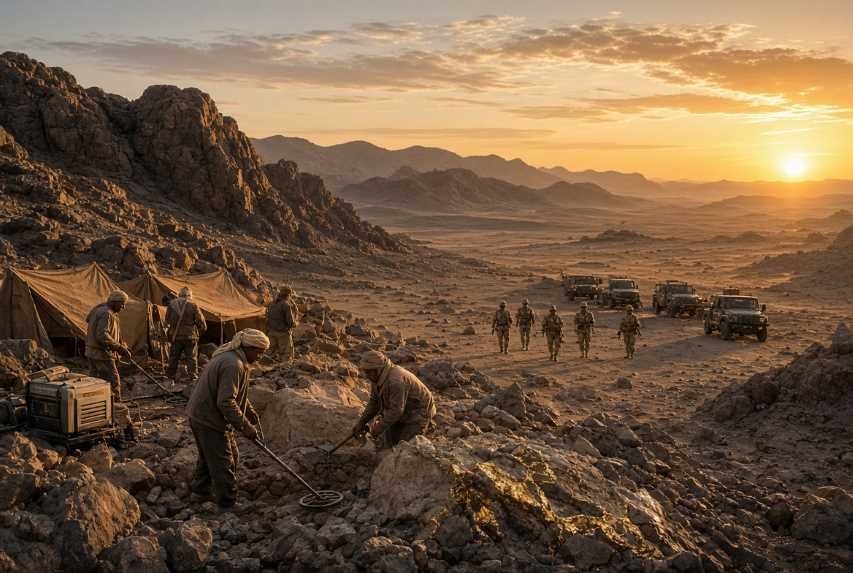
Egypt’s Eastern Desert forms part of the Arabian-Nubian Shield, a geologically complex terrain that has yielded gold for more than six millennia. Formal production is dominated by the Sukari mine, yet a parallel informal economy of prospectors known locally as “Al-Dahaba” operates across remote wadis and mountain ranges. Egyptian military and security forces, particularly Border Guard units of the Southern Military Region, have intensified operations to secure these areas, enforce licensing rules, and address cross-border flows linked to Sudan’s conflict. This expanded analysis examines the historical, economic, legal, security, social, environmental, and technological dimensions as of November 2026, distinguishing documented facts from allegations and speculation.
Egypt’s Hidden Gold Economy
Egypt’s modern gold industry centers on the Sukari mine near Marsa Alam in the Eastern Desert. In 2025 Sukari produced approximately 500,000 ounces, up from 481,000 ounces in 2024. Cumulative output since commercial production began in 2010 exceeds 6.8 million ounces. Government figures indicate total Egyptian gold production of roughly 555,000 ounces in fiscal year 2024/25, with a target of 800,000 ounces annually by 2030. AngloGold Ashanti (after acquiring Centamin in 2024) operates Sukari in a 50/50 joint venture with the Egyptian Mineral Resources Authority (EMRA/MRMIA). In 2025, Egypt’s combined revenues from Sukari—royalties, taxes, and profit share—reached approximately $612 million, a sharp increase driven by higher gold prices and production.
Formal mining involves licensed large-scale operations subject to royalties (typically 3% of net smelter returns at Sukari under the concession framework), taxes, environmental standards, and safety rules. Artisanal and small-scale mining (ASM) is labor-intensive work by individuals or small groups using relatively simple equipment. When conducted without permits, it is classified as informal or illegal. The local term “Al-Dahaba” derives from “dahab” (gold) and has long been used in Red Sea and southern communities to describe those who search for and extract gold outside formal licensing. Its contemporary usage intensified after 2011 amid economic hardship, higher gold prices, and reduced state presence in remote areas.
People enter unauthorized prospecting because of limited formal employment in desert and southern regions, declining pastoral livelihoods, and the potential for high returns when international prices rise. Even modest recoveries can exceed local wage alternatives, though high operating costs (fuel, generators, transport) and risks of detection, injury, or equipment seizure reduce net gains for most participants.
History and Geography of Gold Prospecting in Egypt
Gold extraction in the Eastern Desert dates to Predynastic times (around 3000 BCE or earlier). Surveys have identified roughly 250 ancient production sites across the Egyptian and Nubian Eastern Deserts. Ancient Egyptians targeted auriferous quartz veins using stone hammers, grinding stones, and washing techniques. State-organized expeditions operated during the Old, Middle, and New Kingdoms; activity continued under Ptolemaic, Roman, and early Islamic periods. Modern industrial mining is far more recent. Sukari poured its first gold in June 2009 and entered commercial production in April 2010.
Key gold-bearing zones lie between the Nile and the Red Sea, including areas around Sukari, Barramiya, Fawakheir, Hamash, and farther south toward the Sudanese border (including zones near Halayeb and Shalateen). The geology consists of Neoproterozoic rocks of the Arabian-Nubian Shield, with orogenic gold concentrated in structurally controlled quartz veins associated with shear zones and faults. Weathering and occasional flash floods concentrate gold in wadi sediments, making some deposits accessible to surface prospectors. Remote terrain, extreme temperatures, scarce water, and long distances from infrastructure create major logistical barriers for both formal and informal operators.
Who Are the “Al-Dahaba”?
Many Al-Dahaba belong to or work with Ababda and Beja (Bishari) communities long familiar with desert routes and terrain. Others include Egyptians from other regions and foreign nationals, particularly Sudanese, whose numbers increased as Sudan’s civil war (beginning 2023) disrupted livelihoods and expanded artisanal mining near the border. Operations range from individuals or small family groups using metal detectors and hand tools to larger teams with generators, Hilti machines, crushers, and vehicles. Some networks involve transporters, buyers, and, in documented security cases, links to weapons or other illicit activity.
Motivations center on poverty, limited formal jobs, and gold-price incentives. Working conditions are harsh: temporary camps with limited water and medical access, risk of rockfalls, equipment accidents, and heat exposure. Living arrangements typically consist of tents or makeshift shelters. A practical distinction exists between small-scale local prospectors relying on traditional knowledge and larger, better-capitalized groups that may include cross-border participants and heavier equipment. Court cases, including a July 2026 Red Sea ruling sentencing 450 individuals to one year in prison, and security reports document both categories.
Tribal leaders have publicly described traditional knowledge of gold-bearing areas and noted that some local groups historically worked as desert guides. They have also warned that armed outsiders sometimes target smaller operators. Reliable aggregate numbers of active Al-Dahaba are unavailable; estimates in past reporting have ranged into the thousands, but current figures fluctuate with enforcement intensity.
The Egyptian Military’s Role
The Egyptian Armed Forces, especially Border Guard units under the Southern Military Region, hold primary responsibility for securing remote desert zones, border areas, and strategic resource regions. Documented tasks include surveillance, preventing unauthorized access to restricted or licensed areas, and countering smuggling of weapons, drugs, people, and minerals. Coordination occurs with the Ministry of Interior, police, and mining regulators.
In 2026 the military and law-enforcement forces conducted multi-phase campaigns in the Eastern Desert. Official statements from the Armed Forces spokesperson detail the following for the first three phases (14 June–29 October 2026):
Detention of 691 people (151 Egyptians and 540 foreign nationals).
Voluntary surrender of an additional 6,614 individuals at checkpoints after warnings and a grace period.
Seizure of 34 firearms (including automatic rifles, an RPG launcher, a sniper rifle, and shotguns), 6,307 rounds of ammunition, 317 vehicles, 19 motorcycles, 916 pieces of engineering/technical equipment, 73 metal detectors, 433 power generators, approximately 4,488 tents and shelters, and roughly 860 tons of gold-bearing material.
Phase 1 (14–30 June) targeted areas west of Marsa Alam (including concession zones covering about 1,825 km²) and Jabal Iqat. Phase 2 (31 July–18 August) covered Wadi Dabbur and Barramiya (approximately 2,300 km² encompassing multiple concession sites). Phase 3 (12–29 October) focused on consolidating control. The fourth phase began on 7 November 2026. Two officers—Colonel Ahmed Samir (chief of staff, Southern Region Border Guard Forces) and Lieutenant Colonel Ahmed Gouda (operations chief of a border-guard battalion)—were killed in exchanges of fire during the operations. The military has stated that all operations occurred inside Egyptian territory and involved coordination with Sudanese counterparts.
The Armed Forces frame the campaigns as necessary to assert sovereignty, protect national resources, disrupt criminal networks, and create conditions for licensed investment. Independent reporting and rights groups have raised concerns about intensity and alleged cross-border effects; Egyptian authorities have not confirmed responsibility for specific incidents outside Egyptian territory. The military’s broader economic role in Egypt includes participation in strategic sectors, but available official information centers its gold-related activity on security and enforcement rather than direct commercial mining.
Timeline of major 2026 security actions
Mid-June: Launch of large-scale campaign; initial reports of 223 detentions.
Late June–July: Phase 1 operations and related seizures.
July: Red Sea court sentences 450 individuals to one-year imprisonment.
July–August: Phase 2.
October: Phase 3; reports of alleged airstrikes near the border (allegations not confirmed by Egyptian authorities).
5 November: Military press conference detailing results and announcing Phase 4.
7 November: Phase 4 begins.
The Conflict Between Informal Prospectors and State Authorities
Egyptian law vests mineral ownership in the state and requires licenses for exploration and exploitation. Entry into restricted military zones or licensed concessions without authorization triggers enforcement. Detection relies on patrols, checkpoints, aerial surveillance, and intelligence. Consequences include arrest, equipment confiscation, and prosecution.
The Mineral Resources Law No. 198 of 2014 (as amended by Law 145 of 2019) and its executive regulations form the core framework. Article provisions on unlicensed extraction prescribe imprisonment of not less than one year and a fine of not less than 50,000 Egyptian pounds and not exceeding 5 million pounds (or either penalty), with higher penalties for repeat offenses. Licensees who extract outside authorized boundaries face substantial fines. In all cases, courts order confiscation of seized ore, tools, and machinery, plus repayment of double the value of extracted material. A July 2026 Red Sea court ruling applying these provisions to 450 defendants illustrates practical application.
Authorities have conducted successive waves of operations, with 2026 campaigns representing a significant escalation. Opportunities for formalization exist in principle through smaller-scale licensing or community-linked permits, but implementation has so far prioritized enforcement. Officials have noted parallel tracks of enforcement and efforts to organize legal small-scale activity, though large-scale formalization programs remain limited.
The Economics of Informal and Illegal Gold Mining
Prospectors typically crush ore, use gravity methods or simple washing, and sell recovered gold to local intermediaries or buyers. Recovery rates and grades vary widely; net profits depend on grade, volume processed, operating costs (especially fuel and generators in remote areas), and commissions taken by transporters and traders. High international prices increase incentives. Unlicensed activity represents forgone royalties, taxes, and foreign-exchange earnings while creating security risks that can deter formal investment.
Reliable public estimates of the volume of illegally extracted Egyptian gold are unavailable. Formal production and sales provide a benchmark: gold and silver sales reached approximately $1.5 billion in FY 2024/25, and Sukari alone generated roughly $612 million in government-linked revenues in 2025. Informal activity reduces potential state revenue and can undermine investor confidence in new exploration blocks. The distinction between the gross value of recovered gold and actual profits retained by prospectors is large because of high costs and intermediary shares.
Gold Smuggling and National Security
Unauthorized extraction is linked in official statements to broader criminal networks involving weapons, drugs, and irregular migration. The Egypt-Sudan border is long and porous. Sudan’s civil war has expanded artisanal mining and smuggling; public reporting and expert analyses indicate that significant quantities of Sudanese gold move through informal channels, including into Egypt. Distinguishing purely domestic informal trading from organized cross-border trafficking is difficult with open-source data.
Smuggling reduces government revenues in both countries, complicates border control, and can provide financing for armed groups. Egyptian authorities have emphasized information-sharing and coordination with Sudanese counterparts. Allegations of Egyptian airstrikes on mining sites on the Sudanese side of the border (reported by rights monitors in October 2026, with claims of dozens of casualties) remain unconfirmed by Egyptian military statements, which maintain that operations occur inside Egyptian territory. These claims are presented here as allegations requiring independent verification.
Environmental and Human Costs
Informal mining causes localized land disturbance, soil erosion, and disruption of desert ecosystems. Scientific studies have documented the use of cyanide compounds and mercury amalgamation in some artisanal operations in the Eastern Desert and associated processing sites. Research on sites such as Um Araka and areas near Shalateen/Edfu has identified elevated levels of heavy metals (including arsenic, mercury, lead, and others) in soils and tailings, with associated ecological and health risks. Mercury contamination has been traced in some cases to processing activities that affect surface water, groundwater, and nearby agricultural areas when ore is transported for processing.
Occupational risks include cave-ins, equipment accidents, heat exhaustion, chemical exposure, and limited medical care. Nearby communities may face competition for scarce water or grazing land. Monitoring and rehabilitation in remote desert areas remain challenging for regulators. Military statements have noted environmental consequences including soil and water pollution affecting agriculture and livestock.
Technology: How Modern Gold Mining and Security Are Changing
Formal operators use geological mapping, drilling, remote sensing, and modern processing. Security forces employ aerial surveillance, checkpoints, intelligence, and, according to official descriptions, coordinated monitoring. Satellite imagery and remote sensing can identify anomalous surface disturbance over large areas. Drones and GPS improve real-time monitoring. Artificial intelligence and machine-learning tools for anomaly detection are used in global mining exploration but require substantial data, expertise, and investment; their current application in Egyptian desert security operations is not detailed in public sources. Digital traceability systems could improve formal supply chains but have limited reach in informal activity. These technologies enhance state capacity yet face cost, coverage, terrain, and data limitations in the Eastern Desert.
Egypt Compared with Other Gold-Producing Countries
Sudan’s artisanal sector produces the majority of its gold; much of it is informal or smuggled, and production has expanded amid conflict, with gold serving as a major revenue source for warring parties. Ghana has pursued formalization of small-scale mining for decades under successive legal frameworks (including the 1989 Small-Scale Mining Law). Persistent challenges with “galamsey” include environmental damage, corruption, and incomplete formalization. Recent initiatives such as the Ghana Gold Board (GoldBod) and cooperative registration programs aim to license eligible operators, promote mercury-free methods, and improve traceability, drawing lessons from Colombia, Mongolia, Peru, and Tanzania. South Africa confronts illegal underground mining by organized groups. Peru has faced extensive informal gold extraction in remote Amazonian areas involving mercury use and weak state presence.
Common lessons include the difficulty of pure enforcement in remote zones, the value of realistic and accessible licensing pathways for small-scale operators, the importance of community engagement, and the need to address underlying poverty. Egypt’s military-led approach reflects its desert geography and border dynamics but faces similar trade-offs between rapid control and longer-term formalization.
Social and Political Dimensions
Many Al-Dahaba operate within or with knowledge of local tribal networks that have historically used the desert for grazing and trade. Informal mining functions for some as an economic survival strategy amid limited regional development and high unemployment. Perceptions of state control over strategic resources vary. Some local voices, including tribal representatives, have called for legal small-scale opportunities rather than exclusive reliance on large concessions and enforcement. Transparent rules and community participation could reduce friction, though large-scale implementation remains limited. Public debate has included concerns about both resource loss and the social impacts of intensive security operations.
Legal and Policy Framework
The Mineral Resources Law No. 198 of 2014 (amended 2019) and executive regulations (including updates in 2020 and later) govern the sector. EMRA/MRMIA issues and supervises exploration and exploitation licenses. Exploration licenses are typically valid for two years with possible renewals; exploitation licenses can extend up to 15 years or longer under specific authorization. Large precious-metal concessions generally require specific legal approval. Recent regulatory changes have tightened licensing procedures, prohibited mining in certain sensitive areas without approvals, and advanced digital tools such as the Egypt Mining Portal.
Penalties under the law for unlicensed extraction include the imprisonment and fines noted earlier, plus confiscation and restitution. Effectiveness of enforcement increased with the 2026 campaigns. The gap between the law as written and practical access for small operators persists. Possible reforms include simplified small-scale licensing, transparent state or cooperative gold-purchasing systems, environmental safeguards tailored to artisanal activity, and community development linked to formal mining.
Future Scenarios: What Happens Next?
Optimistic scenario. Effective regulation, expanded exploration investment (AngloGold Ashanti and others have submitted bids for multiple blocks), and carefully designed legal pathways for small-scale prospectors raise formal production toward or beyond the 800,000-ounce target. Additional foreign exchange and local employment are generated, illegal activity declines, environmental monitoring improves, and community benefits increase.
Pessimistic scenario. Illegal extraction and associated smuggling expand, security incidents multiply (including further casualties among security forces or civilians), environmental damage accumulates, investor confidence declines, and potential state revenue is lost. Border tensions with Sudan intensify.
Middle-ground scenario. Surveillance and enforcement improve, reducing the most organized illegal operations, while gradual formalization of some small-scale activity occurs. Structural challenges of poverty, remote geography, and institutional capacity remain, producing mixed economic and social outcomes.
Recommendations and Strategic Solutions
Government and regulators: Develop transparent, accessible small-scale licensing or community concession models; expand digital portals for licensing and geological data; strengthen gold traceability; invest in regional development and alternative livelihoods in the Eastern Desert and south.
Military and security institutions: Maintain border and resource security while coordinating closely with civilian regulators; prioritize intelligence-led operations that minimize civilian harm; support data-sharing for environmental monitoring.
Licensed companies and investors: Engage local communities on employment and supply chains; maintain high environmental, safety, and security standards.
Local communities and prospectors: Participate in any formalization programs; document and share traditional knowledge that can support responsible exploration.
Environmental and civil-society organizations: Conduct independent monitoring where feasible; advocate for rehabilitation standards, safer processing methods (reducing mercury and cyanide use), and community safeguards.
Who Controls Egypt’s Gold Wealth?
Egypt’s gold resources are a strategic national asset with ancient roots and modern economic potential. Protecting them requires effective enforcement against unlicensed extraction and associated criminal activity, credible conditions for formal investment, and practical pathways so that local communities can benefit legally rather than only through informal channels. The military’s security role is essential given the terrain and border dynamics with Sudan, yet long-term success depends on civilian regulatory capacity, transparent rules, environmental safeguards, and attention to the economic realities that drive people into the desert. Balancing national security, revenue generation, private investment, environmental sustainability, and local livelihoods remain the central policy challenge.
 |  |  |