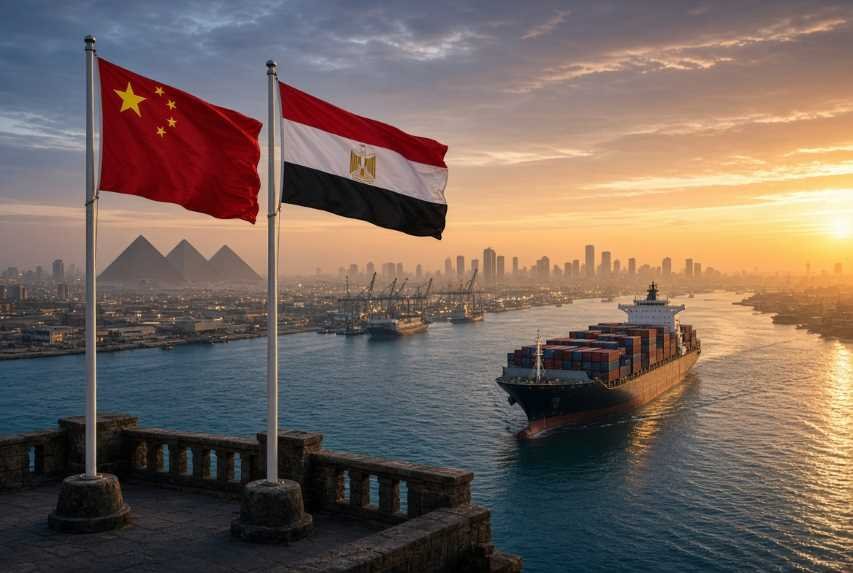
Chinese President Xi Jinping’s state visit to Cairo on 1–2 September 2026 was short, carefully staged, and politically dense. It was his first trip to Egypt in a decade, timed to the 70th anniversary of diplomatic relations, and it produced a joint statement plus a package of cooperation documents rather than a single headline megadeal. The visit matters less as a sudden turning point than as a public upgrade of a partnership already built through factories, ports, trade, and quiet diplomatic coordination.
The central question is not whether China and Egypt are now allies in the Western sense. They are not. The question is whether Cairo can convert Chinese capital, industrial capacity, and diplomatic cover into jobs, exports, and leverage — without locking itself into a lopsided trade relationship or a narrower strategic room for manoeuvre.
Key Takeaways
Xi arrived in Cairo on the evening of 1 September 2026 and held formal talks with President Abdel Fattah El-Sisi on 2 September. The trip followed the Shanghai Cooperation Organization summit in Kyrgyzstan and marked Xi’s first visit to Egypt since 2016.
The two governments issued a joint statement on deepening their comprehensive strategic partnership and signed five formal agreements plus more than 20 additional cooperation documents covering Belt and Road alignment, industry, information technology, and the Suez Canal Economic Zone.
Bilateral merchandise trade reached about $11.3 billion in the first half of 2026, with Egyptian exports to China jumping to $840.8 million and imports from China remaining far larger at $10.4 billion, according to Egypt’s CAPMAS.
Chinese firms are already a major presence in the Suez Canal Economic Zone, especially the TEDA industrial park, which officials say hosts more than 200 companies, more than $4.7 billion in cumulative investment, and more than 10,000 direct jobs.
Politically, Beijing and Cairo aligned on a two-state solution, a Gaza ceasefire, rejection of Palestinian displacement, Egypt’s Nile water concerns, and Egypt’s One-China position. Those are official statements, not proof that either country can impose a settlement.
The relationship is already economic and strategic. The visit did not turn Egypt into a Chinese client state, but it did make Cairo a more visible partner in China’s Middle East and Africa strategy.
What Happened, and Why It Matters
Xi Jinping landed in Cairo on the evening of 1 September 2026 at the invitation of President El-Sisi. Egyptian and Chinese flags lined the airport. El-Sisi and First Lady Entissar El-Sisi received Xi and Peng Liyuan on the tarmac. The next morning, the two presidents held talks at Al-Ittihadiya Palace after a 21-gun salute and honor-guard ceremony. Xi also visited the Grand Egyptian Museum. He left after roughly 48 hours.
The timing was deliberate. Egypt and China established diplomatic relations in 1956. Egypt was the first Arab and African country to recognize the People’s Republic of China. The 2026 visit was framed around that anniversary and around the comprehensive strategic partnership launched in 2014. Before arriving, Xi published a signed article in Egyptian newspapers titled “Celebrating 70 Years of Solidarity, China and Egypt Embark on a New Journey.”
The visit also sat inside a tense regional setting. International reporting placed the trip against the fallout of a US–Iran conflict that had disrupted energy markets and shipping through the Strait of Hormuz and added uncertainty to Red Sea routes. That context helps explain why both leaders talked not only about factories and industrial parks, but also about maritime security, “external interference,” and a more “just and equitable” system of global governance. Those phrases came from official Chinese accounts and should be read as diplomatic messaging, not as a completed policy shift.
Why Egypt matters to China
Egypt offers Beijing several assets that few other countries combine:
Control of the Suez Canal, the shortest sea route between Asia and Europe.
A large domestic market and a manufacturing labor force.
A platform for exporting to Africa, the Arab world, and parts of Europe.
Political weight in the Arab world, the African Union, and the Global South.
A government that wants industrial investment and is willing to host Chinese industrial parks.
For China, Egypt is not merely another Belt and Road stop. It is a logistics hinge, a manufacturing platform, and a diplomatic node connecting Africa, the Middle East, and Europe.
Why China matters to Egypt
Egypt needs foreign currency, factories, technology, and diplomatic options. China is a leading source of industrial imports, a growing investor in the Suez Canal Economic Zone, a financier of infrastructure, and a political partner that does not publicly condition economic cooperation on governance reform. Cairo also wants Beijing’s support on water security, Palestine, and a more multipolar diplomatic environment.
That does not mean China can replace the United States as Egypt’s main security partner. Egypt still receives substantial US military assistance — about $1.3 billion a year, according to reporting around the visit — and remains tied to Western arms, tourism, and financial institutions. The visit is better understood as diversification than as substitution.
Political Impact on Egypt
Diplomatic relations
The visit confirmed, rather than created, a high-level political track. The two sides already called their relationship a comprehensive strategic partnership. The 2026 joint statement said they would deepen that partnership and support each other on “core interests.”
In practice, that language produced a familiar bargain:
Egypt restated the One-China principle and recognized Taiwan as part of China.
China recognized the Nile as Egypt’s “main lifeline” and Egypt’s “legitimate right to protect its water and food security.”
That Nile language is politically valuable to Cairo. Egypt has long sought international recognition of its downstream water rights, especially in disputes linked to upstream Nile projects. China’s statement does not settle those disputes. It does add a major power’s public sympathy to Egypt’s position.
Egypt’s foreign-policy strategy
Cairo’s strategy under El-Sisi has been multi-alignment: keep the US security relationship, court Gulf capital, maintain working ties with Russia, deepen BRICS and Global South diplomacy, and expand economic links with China. The visit fits that pattern. It does not force Egypt to choose a single camp.
Xi’s public language was sharper than Cairo’s usual tone with Washington. Chinese accounts quoted him as calling for opposition to “unilateralism and acts of bullying” and for a “more just and equitable global governance system.” Egypt can welcome that rhetoric without adopting it as official doctrine. For Cairo, the practical gain is optionality: more partners, more financing channels, and more diplomatic cover.
Relations with the United States, the European Union, and Russia
Deeper China ties will not automatically rupture Egypt’s Western relationships, but they will test them.
United States. Washington remains Egypt’s principal military supplier and a key political interlocutor on Gaza, Sinai security, and regional diplomacy. Joint China–Egypt air exercises in 2025 and 2026, including the “Eagles of Civilization 2026” drills, signal that Cairo is willing to expand security contact with Beijing even while US aid continues. That is diversification, not a clean break.
European Union. Europe is important to Egypt as an export market, tourism source, and energy partner, especially on gas and future green hydrogen. Chinese factories in Egypt can help Cairo sell into Europe if rules of origin, labour, and carbon standards are met. They can also create friction if European firms see Chinese producers using Egypt as a back door into EU markets.
Russia. Egypt already balances Russian wheat, tourism, nuclear cooperation, and political contact with Western and Chinese relationships. Closer China ties do not cancel Russia; they add another non-Western pillar.
Global South, BRICS, and coordination
Both countries are BRICS members and present themselves as voices of the Global South. The joint statement emphasized coordination in multilateral forums and support for developing-country interests. That matters for voting patterns, development-bank politics, and diplomatic messaging. It does not mean Egypt will follow China on every international issue.
Security and Egypt’s regional role
The two sides agreed to deepen security cooperation and counterterrorism coordination, according to official accounts. Xi also said China was ready to work with regional countries to safeguard shipping routes. Egypt’s value to Beijing here is geographic: the Suez Canal, the Red Sea approaches, and Cairo’s role as a mediator in Gaza and a political heavyweight in the Arab world.
The visit therefore supports Egypt’s claim to be a diplomatic hub. It does not, by itself, enlarge Egypt’s hard-power capacity.
Economic Impact
The economic story is large, uneven, and easy to exaggerate. Trade is already substantial. Investment is real in specific zones. Many of the newest figures are announcements, memoranda, or planned expansions, not completed factories.
Bilateral trade
CAPMAS data released around the visit showed:
Total Egypt–China trade of $11.3 billion in the first half of 2026, up 21.5% from $9.3 billion a year earlier.
Egyptian exports to China of $840.8 million, up about 200% from $280.5 million in the first half of 2025.
Egyptian imports from China of $10.4 billion, up 14.3%.
Full-year 2025 figures vary by source. Egyptian commercial officials put two-way trade near $20.8 billion, with Chinese exports to Egypt around $19.9 billion and Egyptian exports far smaller. Another official briefing put 2025 merchandise trade at $19.5 billion. The direction is consistent even when the totals differ: China sells much more to Egypt than Egypt sells to China.
The export surge in early 2026 was helped by China’s decision, from 1 May 2026, to grant customs-duty exemptions to exports from 53 African countries. Fuels and mineral oils led Egypt’s sales to China in the first half of 2026 at about $494 million, followed by fruit and vegetables at $150.6 million and cotton and vegetable textile fibers at $76.4 million. Imports from China were led by electrical and mechanical machinery, vehicles, iron and steel, plastics, and chemicals.
Infrastructure, transport, energy, telecoms, and industry
Chinese firms are already embedded in several Egyptian sectors:
Industrial parks and factories in the Suez Canal Economic Zone.
Construction and urban projects, including work linked to the New Administrative Capital.
Light-rail and industrial transport links. Reporting around the visit cited two financing agreements worth about $665 million for light-rail extensions connecting Cairo to new urban developments. Those are financing arrangements, not proof that the lines are finished.
Renewable energy, solar components, tires, fiberglass, pipes, textiles, appliances, and planned electric-vehicle and semiconductor cooperation.
The joint statement and side documents pointed to future work on electric vehicles, shipbuilding, solar panels, wind turbines, desalination, semiconductors, cloud computing, data centres, critical minerals, remote sensing, and artificial intelligence. Those are priority areas, not completed plants.
Jobs, tourism, finance, and growth
Job creation is most visible inside industrial zones, where TEDA officials say more than 90% of employees are Egyptian. Tourism and education exchanges exist but are secondary to trade and manufacturing. Financial cooperation includes Panda bonds, local-currency settlement, and an expanded currency-swap arrangement mentioned in the joint statement.
Could this lift Egypt’s growth? It can help at the margin — through factories, logistics, and some foreign-currency inflows. It cannot, on current evidence, solve Egypt’s broader pressures: a large external debt stock, a persistent trade deficit, currency vulnerability, and the need for private-sector jobs outside a few industrial enclaves. UNCTAD data also show that Egypt’s overall FDI inflows are volatile and that Chinese net FDI in a single year can be modest even when the cumulative stock of Chinese projects looks large. Egyptian reporting put net Chinese direct investment at $226.5 million in 2025, about 1.5% of net FDI that year. That gap between “Chinese presence” and “annual Chinese FDI flow” is essential.
Announced, signed, planned, and completed
Category | What is known | Status |
|---|---|---|
| Joint statement and 5 core agreements | Vision 2030–BRI alignment; economic and technical cooperation; industrial/supply-chain cooperation; IT cooperation; SCZONE–China commerce ministry memorandum | Signed during the visit |
| 20+ additional documents | Digital economy, science, education, transport, finance, media | Signed; full public list not released |
| Third phase of China–Egypt industrial zone | Expansion of the Suez/TEDA industrial area | Agreed; not yet a finished expansion |
| TEDA / China–Egypt industrial zone | 200+ companies; about $4.7 billion cumulative investment; $7.3 billion in recorded sales | Existing, operating |
| ZC Rubber complex | About $500 million tyre project in Sokhna | Company-level / preliminary |
| Other tyre and materials plants | Separate MoUs and contracts reported in 2025–2026, including large tire and polyester projects | Mixed: some signed, some under study |
| Light-rail financing | About $665 million reported | Financing announced, not completion |
The honest distinction is this: the visit locked in political direction and expanded paperwork. The factories already running in Ain Sokhna are the strongest evidence of economic substance.
Chinese Investment in Egypt
Where Chinese capital is concentrating
The main magnet is the Suez Canal Economic Zone, especially the China–Egypt TEDA Suez Economic and Trade Cooperation Zone at Ain Sokhna. Officials and zone managers say the park has grown from a desert plot into an export-oriented industrial cluster producing fiberglass, ductile-iron pipes, tires, photovoltaic modules, battery-storage systems, textiles, and appliances. Jushi Egypt is described as Africa’s largest fiberglass base, with four lines and about 360,000 tons of annual capacity on an investment near $1 billion.
Broader SCZONE figures from late 2025 put investment attracted over three and a half years at $11.6 billion, with Chinese investors accounting for about half. Cooperation with TEDA was put above $3 billion across more than 200 projects; Chinese activity in Qantara West was put above $700 million.
Egyptian ministers have given rising company counts: more than 2,800 Chinese firms and over $8 billion in investments by November 2025; later briefings spoke of a stock near $10 billion and, by mid-2026, nearly 4,000 Chinese-registered companies. Those figures mix operating factories, trading firms, and newly registered vehicles.
Priority sectors named before and during the visit include:
Manufacturing and industrial parks
Electric vehicles and auto components
Solar, wind, and other renewables
Green hydrogen and related chemicals
Ports, logistics, and shipbuilding
Rail and urban transport
Telecommunications, data centers, semiconductors, and AI
Construction and infrastructure
Agriculture and food processing
Why Egypt attracts Chinese firms
Egypt is attractive because of location, labor costs, energy access, industrial-zone incentives, and political sponsorship. The Suez route shortens the trip from Chinese factories to Europe. African and Arab markets are nearby. Egypt offers tax and customs advantages in designated zones, and the government has created China-focused investment support inside GAFI.
Risks and obstacles for Chinese companies
Obstacles are equally real:
Currency instability and profit-repatriation friction.
Bureaucracy, land, utilities, and local-content rules.
Egypt’s debt burden and periodic foreign-exchange shortages.
Competition among Chinese firms themselves.
Geopolitical scrutiny from the United States and Europe.
Skills gaps in advanced manufacturing and after-sales services.
Red Sea security risk, which can raise insurance and logistics costs.
Chinese companies can use Egypt as a regional base. They cannot assume that every announced industrial city or $10 billion metals proposal will be built at the advertised scale. Some 2026 Africa-wide tallies of Chinese “investment announcements” are dominated by a few giant proposals, including large Egypt-linked industrial plans. Announcement value is not the same as money spent.
Suez Canal and Global Trade
The Suez Canal is the strategic core of the relationship.
China depends on the canal for a large share of Asia–Europe container trade and for energy and bulk shipments that would otherwise travel around the Cape of Good Hope. Egypt’s geography — Mediterranean and Red Sea coasts, the canal, and the SCZONE ports — makes it a natural logistics platform. Chinese shipping and logistics firms therefore have a structural interest in Egyptian stability, canal efficiency, and industrial facilities beside the waterway.
Red Sea insecurity already showed how quickly that interest can become a political issue. Houthi attacks on shipping after late 2023 slashed canal traffic. Suez Canal Authority figures put revenues at a record $9.4 billion in 2023, then about $3.9 billion in 2024. In fiscal year 2025/26, revenues recovered to about $4.67 billion, up 23% but still far below the pre-crisis peak. Chairman Osama Rabie said about 13,000 vessels transited that fiscal year, and later comments in early September 2026 pointed to a further rebound, with revenues possibly reaching $5.8–6 billion by the end of calendar 2026 if more lines return. Those later figures are projections.
The 2026 regional war around Iran added another twist. Some reporting said tanker traffic through Suez rose when the Strait of Hormuz was disrupted, giving the canal a temporary energy-route role even as broader security risks remained. Xi’s offer to help safeguard shipping routes should be read against that background: China wants the canal open because Chinese trade needs it.
Alternative routes — the Cape of Good Hope, overland Belt and Road corridors, Arctic experiments, or future Indian Ocean–Mediterranean schemes — can dilute Egypt’s toll revenue if the Red Sea stays risky. They are unlikely to erase the canal’s time and fuel advantage when the route is safe. Chinese industrial investment around Sokhna and Port Said is one way Cairo can earn money from cargo even when transit volumes fluctuate: not only from ships passing through, but from ships stopping to load goods made in Egypt.
Local Impact Inside Egypt
For ordinary Egyptians, the China relationship is felt first as cheaper goods, second as factory jobs in a few industrial belts, and only later as nationwide transformation.
Possible benefits
Jobs in industrial zones. TEDA says more than 10,000 direct jobs and many indirect ones, with more than 90% of employees Egyptian. Cumulative tax payments from the zone were put at $350 million by June 2026.
Consumer products: phones, appliances, cars, fabrics, and machinery at prices many households can afford.
Infrastructure that people use, including rail links and urban construction.
Technical training inside Chinese plants and some scholarships or educational exchanges.
A wider range of digital hardware and telecom equipment.
Possible costs
Egyptian manufacturers in furniture, textiles, steel products, plastics, and light industry can lose domestic market share to Chinese imports.
Small and medium-sized firms may become distributors of Chinese goods rather than producers.
If investment stays inside enclaves, skills transfer will be uneven.
Import dependence can worsen the trade deficit and put pressure on the pound.
Some jobs may be lower-wage assembly work with limited upgrading.
The key local test is simple: does Chinese capital create export-oriented factories that hire Egyptians and buy local inputs, or does it mainly expand a warehouse-and-import model? The TEDA record suggests both can happen at once. Fiberglass, pipes, and tires look like real industrial value. The $10.4 billion in first-half 2026 imports show that the consumer and machinery pipeline remains huge.
Education and skills will decide which side grows. Without stronger vocational training, supplier development, and quality standards, Egypt risks becoming a convenient assembly platform rather than a durable industrial base.
Regional Impact: Middle East and Africa
Egypt wants to be the bridge. China wants access. Those interests overlap, but they are not identical.
In the Arab world, closer China ties add to Egypt’s prestige without replacing Gulf money. Saudi Arabia and the UAE remain essential to Egypt’s financing, tourism, and political room for maneuver. China is also deepening its own ties with Riyadh, Abu Dhabi, Tehran, and other regional capitals. Cairo is therefore a major partner, not China’s only Middle East gateway.
In Africa, Egypt’s pitch is that Chinese factories on the Suez can serve African markets more cheaply than plants in China, while Egypt’s political networks help Beijing deal with African governments. That argument is plausible. It is not yet proven at continental scale. Chinese BRI engagement in Africa remains concentrated in a handful of large markets and megaprojects. Egypt is important in that map, especially as a North African industrial and logistics hub, but it is not the only Chinese gateway into Africa.
Regionally, Chinese-backed ports, industrial parks, power projects, and digital networks can knit trade corridors from the Red Sea to the Mediterranean and south toward East Africa. They can also create parallel dependencies: different Arab and African states competing for the same Chinese capital.
Xi’s call for a new Middle East security architecture, with regional states as “masters of their own destiny,” is a diplomatic bid for influence. It does not give China the military role the United States has long played. It does give Beijing a political narrative that some governments find useful when they want less Western conditionality.
Gaza, Palestine, and Regional Diplomacy
This is an area where official text and analytical interpretation must stay separate.
Official positions after the talks
The joint statement said the Palestinian issue is the core issue in the Middle East. The two sides supported a two-state solution based on the 4 June 1967 borders, with East Jerusalem as the capital of an independent Palestinian state. They called for consolidating the Gaza ceasefire, allowing unhindered humanitarian aid, and enabling the Palestinian Authority to return to Gaza as soon as possible. They rejected displacement of Palestinians “under any pretext or label,” expressed concern about escalation in the West Bank and East Jerusalem, and supported UNRWA’s mandate.
El-Sisi also used the meetings to highlight Egypt’s role in ceasefire arrangements and aid access.
What that does and does not mean
It aligns China with Egypt’s long-standing public position on Palestine.
It gives Cairo a major-power echo at a moment when Egypt is trying to remain central to Gaza diplomacy.
It does not create a Chinese peace plan that the parties must accept.
It does not replace US, European, Gulf, or Israeli agency in the conflict.
Humanitarian language is not the same as funded, delivered aid at scale.
China has tried to present itself as a mediator in Middle East disputes. Egypt has the geography, the border with Gaza, and the diplomatic network. Together they can coordinate talking points and, in some cases, aid or reconstruction concepts. They cannot, on present evidence, impose a settlement. Any claim that the visit will “solve Gaza” would be speculation, not analysis.
Global Geopolitical Impact
The visit sits inside US–China strategic competition, not outside it.
Washington still sees Egypt as a treaty partner, a military-aid recipient, and a pillar of its Middle East posture. Beijing sees Egypt as a Belt and Road node, a Suez insurance policy, and a prestigious Global South partner. Those two views can coexist for years. They become a problem if Washington treats Chinese industrial and telecom projects as security threats, or if Beijing expects political loyalty that Cairo cannot give.
China’s broader map is clear enough:
Belt and Road projects to secure trade routes and industrial footholds.
Expanding economic presence in Africa.
A search for influence in Europe through exports, green-tech supply chains, and shipping.
A Global South and BRICS vocabulary that challenges Western agenda-setting.
Is Egypt becoming more important to Beijing? Yes, relative to a decade ago. The combination of the canal, industrial parks, and Arab-African diplomacy is hard to replace. Is Egypt becoming China’s main regional partner? Not necessarily. Gulf energy relationships and other African markets still matter enormously.
The visit was both an economic and a geopolitical partnership. The contracts are economic. The language about global governance, shipping security, Palestine, Taiwan, and the Nile is geopolitical. Treating it as only one or the other misses the point.
China vs. Western Influence in Egypt
| Field | China | United States / Europe |
|---|---|---|
| Trade | Leading source of many industrial and consumer imports; large bilateral deficit for Egypt | EU is a major export market; US trade is smaller but politically significant |
| Investment style | Industrial parks, construction, manufacturing, some energy and digital projects | Gulf capital is often larger in headline FDI; Western firms cluster in energy, consumer, finance, and some manufacturing |
| Infrastructure | Strong in industrial zones, construction, rail packages, and SCZONE factories | Western role is more fragmented; Europe is important in energy and some transport |
| Financing | Policy banks, contractors, currency swaps, Panda bonds, project finance | IMF program, Western development banks, Eurobond markets, Gulf deposits |
| Technology | Telecoms, solar, EVs, appliances, emerging data-center and AI talk | Western software, aviation, defense electronics, and some industrial tech remain central |
| Political influence | Non-interference rhetoric; support on Palestine and Nile language | Stronger on security, diplomacy with Israel, IMF conditions, and human-rights messaging |
| Military / security | Growing exercises and defense-industrial contact | Still the core of Egypt’s high-end military relationship and annual aid |
| Long-term interest | Secure Suez, export industrial overcapacity, gain Global South legitimacy | Secure the canal and peace treaties, limit migration and militancy, retain a major Arab partner |
Egypt’s best strategy is strategic flexibility: take Chinese factories and financing, keep US security ties, sell to Europe, and use Gulf capital. Over-dependence on any one partner would shrink that flexibility. The risk with China is commercial and technological dependence. The risk with the West is political conditionality and slower industrial deployment. Cairo’s behaviour suggests it understands that balance, even if execution is uneven.
Benefits and Risks for Egypt
Potential benefits
More foreign investment in zones that actually produce goods.
Infrastructure and logistics around the canal and new cities.
Industrialization in tires, fiberglass, solar components, appliances, and possibly EVs.
Employment in factory belts and construction.
Some technology transfer and supplier learning.
Better access to the Chinese market after tariff exemptions, if Egyptian products meet standards.
A stronger claim to be a global logistics hub.
Energy-project options in solar, wind, and hydrogen.
Political leverage with other powers because Egypt has a serious China option.
Extra weight in Arab and African diplomacy.
Potential risks
A structural trade imbalance that drains foreign currency.
Dependence on Chinese imports for machinery, cars, electronics, and industrial inputs.
Debt and financing risk if projects are credit-heavy or poorly priced.
Displacement of Egyptian manufacturers.
Technology dependence in telecoms, cloud, and industrial software.
Strategic dependence if critical infrastructure is concentrated in one partner’s ecosystem.
Environmental pressure from heavy industry and desalination.
Labour-market dualism: a few formal factory jobs beside a large informal economy.
Geopolitical pushback from the United States or Europe if Chinese projects are framed as security threats.
Winners and Losers
Egyptian government. Political winner. It gains investment headlines, diplomatic support on Palestine and the Nile, and more bargaining power with other capitals.
Suez Canal and SCZONE. Structural winners if security holds and factories export. They collect tolls, port fees, rents, and industrial activity.
Chinese companies. Winners where they secure land, incentives, and a base for Africa–Europe sales. They also gain a political umbrella.
Egyptian consumers. Near-term winners through cheaper goods. Long-term effect depends on jobs and the pound.
Egyptian workers. Mixed. Zone employees can gain formal work and training. Workers in competing local factories may lose.
Egyptian manufacturers. Split. Input-using exporters can benefit. Import-competing SMEs can lose.
Egyptian SMEs. At risk of being squeezed into retail and subcontracting unless supplier programs are real.
European companies. Mixed. They may face Chinese rivals producing in Egypt, but they also gain a nearer supply base if they invest themselves.
American companies. Limited commercial loss in the short run; more concern on the strategic and technology side.
Middle Eastern economies. Gulf states remain financially central to Egypt; Chinese industry in Suez can complement or compete with their own logistics and manufacturing plans.
African economies. Potential winners if Egyptian-based Chinese plants supply cheaper goods and create trade links. Potential losers if they only receive finished imports and little local industry of their own.
Short-Term vs. Long-Term Impact
Short term (1–3 years)
Expect more memoranda, zone expansions, and factory openings in familiar sectors: building materials, tires, textiles, solar components, appliances. Trade will remain imbalanced even if Egyptian exports keep rising from a low base. Diplomacy will stay warm. Canal revenues will depend more on Red Sea security than on Chinese speeches.
Medium term (3–5 years)
The test is execution. If the third phase of the industrial zone, EV and component plants, and a few large materials projects are built and staffed, Egypt can look more like a regional manufacturing platform. Currency-swap and yuan settlement arrangements may grow at the edges of trade. Western scrutiny of Chinese telecoms, ports, and data centers will likely increase.
Long term (5–10 years)
Two different Egypts are possible. In one, Suez-based industry is deep enough that Egyptian suppliers, engineers, and exporters capture a real share of value. In the other, Egypt remains a large consumer of Chinese goods with a few successful enclaves and a still-skewed trade account. Geopolitically, Egypt is more likely to remain a balancer than a member of a Chinese bloc.
Key Data and Statistics
Figures below use the most recent official or widely reported numbers and the year attached to each source. They are not invented, and some official totals disagree with one another.
Egypt–China trade, H1 2026: $11.3 billion; Egyptian exports $840.8 million; imports $10.4 billion (CAPMAS).
Egypt–China trade, 2025: about $19.5–20.8 billion, depending on the Egyptian official source; Chinese sales dominate.
Egyptian exports to China, 2025, UN Comtrade-based compilations: about $491 million, illustrating how small the export base was before the 2026 jump.
Cumulative Chinese investment claims: more than $8 billion by November 2025; later official and semi-official figures near $10 billion. Company counts range from about 2,800 to nearly 4,000 registered firms.
Net Chinese FDI into Egypt, 2025: $226.5 million, about 1.5% of net FDI, according to Egyptian economic reporting.
TEDA zone: more than 200 companies, about $4.7 billion cumulative investment, more than $7.3 billion in sales, more than 10,000 direct jobs, $350 million in taxes by June 2026.
SCZONE investment over 3.5 years to late 2025: $11.6 billion, about 50% Chinese.
Suez Canal Authority revenue: $9.4 billion in 2023; about $3.9 billion in 2024; about $4.67 billion in FY 2025/26.
China BRI investment report for 2025 listed Egypt among the largest BRI investment destinations, with about $10.2 billion in recorded BRI investment engagement that year. That is a research compilation of engagement, not a single audited cash transfer.
Egypt’s major trading partners still include the European Union as a crucial export destination, China as a leading import source, and Gulf states as financial and trade partners. China is central, not exclusive.
Expert-Level Analysis
- Why does China need Egypt?
Because the Suez Canal sits on China’s main commercial artery to Europe, and because Egypt can host industry close to Europe, Africa, and the Arab world while lending Beijing diplomatic depth in two regions at once. - Why does Egypt need China?
Because Egypt needs capital, factories, cheap inputs, infrastructure contractors, and a major partner that will say yes on industrial parks without the political conditions that often accompany Western finance. - Is Egypt becoming a major Chinese gateway into Africa?
It is becoming one gateway, especially for manufactured goods and logistics. It is not the only one. East African ports, Gulf hubs, and large sub-Saharan markets still matter. - Could Egypt become an important manufacturing base for Chinese companies?
Yes, in selected sectors already visible in Sokhna. A broad national manufacturing transformation is a larger claim than the current plant list supports. - How important is the Suez Canal to China’s global strategy?
Very important as a time-saving commercial route. It is not irreplaceable in a crisis, as 2024 traffic diversion showed, but it is extremely costly to avoid for long. - Can Chinese investment reduce Egypt’s economic pressures?
It can ease them in industry and logistics. It cannot replace a coherent macroeconomic program, export diversification, and debt management. The trade deficit with China still works against the foreign-currency problem that Chinese factories are supposed to help solve. - Could deeper ties change Egypt’s position among Washington, Beijing, Moscow, and European capitals?
They already have, modestly. Egypt looks more like a multi-aligned middle power. It does not look like a country that has switched blocs. - Does the relationship represent a shift toward a multipolar world?
It is one example of that shift, not the cause of it. Egypt is hedging. China is expanding. The United States still holds security cards. That is multipolarity in practice: more centers of influence, fewer exclusive relationships.
Scenario Analysis for the Next 5–10 Years
Optimistic scenario
Industrial-zone expansions are built on time. Tyre, solar, EV-component, and materials plants export to Europe and Africa. Egyptian suppliers climb into the value chain. Canal traffic recovers toward pre-2024 levels. Local-currency settlement grows enough to reduce some dollar pressure. Cairo keeps US and Gulf ties while using China for industry. Result: more jobs, more exports, and higher political leverage.
Moderate scenario
This is the most likely path. Cooperation expands, but many memoranda stay partial. A few large factories succeed; others stall. The trade deficit narrows only slightly. Canal revenues recover without returning all the way to the 2023 record. Egypt remains multi-aligned, occasionally criticized in Washington, occasionally disappointed that Chinese technology transfer is thinner than advertised.
Negative scenario
Red Sea or regional conflict keeps shipping expensive. Egypt’s currency and debt problems deter actual spending behind announcements. Chinese imports overwhelm local industry. A Western backlash complicates telecom, port, or defense choices. Public discontent grows if factories are seen as enclaves with limited national benefit. The relationship survives, but its economic promise fades into a familiar pattern: high politics, cheap imports, and unfinished projects.
China’s relationship with Egypt is no longer a side story. It is one of the main external pillars of Egypt’s development strategy and an increasingly visible part of China’s approach to the Middle East, Africa, and global trade routes. The September 2026 visit did not invent that relationship. It advertised it, added political commitments on Palestine and the Nile, and pointed Chinese industry toward a deeper presence around the Suez Canal.
For Egypt, the opportunity is industrial and diplomatic. The danger is a wider import bill, shallow local value-added, and reduced room if any single partner becomes too central. For the Middle East and Africa, the visit signals that China will keep buying influence with markets, construction, and official solidarity, while regional states try to take the investment without accepting a new hierarchy. For the global balance of power, Cairo is becoming more valuable to Beijing without disappearing from Washington’s map.
The relationship is not primarily one thing.
It is economic, because trade, factories, and the canal are the hard substance.
It is political, because the joint statement traded support on core issues.
It is strategic, because geography, shipping, and multi-alignment now sit inside US–China competition.
The most accurate verdict is the least dramatic one: China and Egypt are deepening a mixed partnership. Whether that partnership becomes a development success for Egypt will be decided not in palace ceremonies, but in shipping lanes, factory floors, export invoices, and the fine print of projects that still have to be built.
 |  |  |
 |  |  |