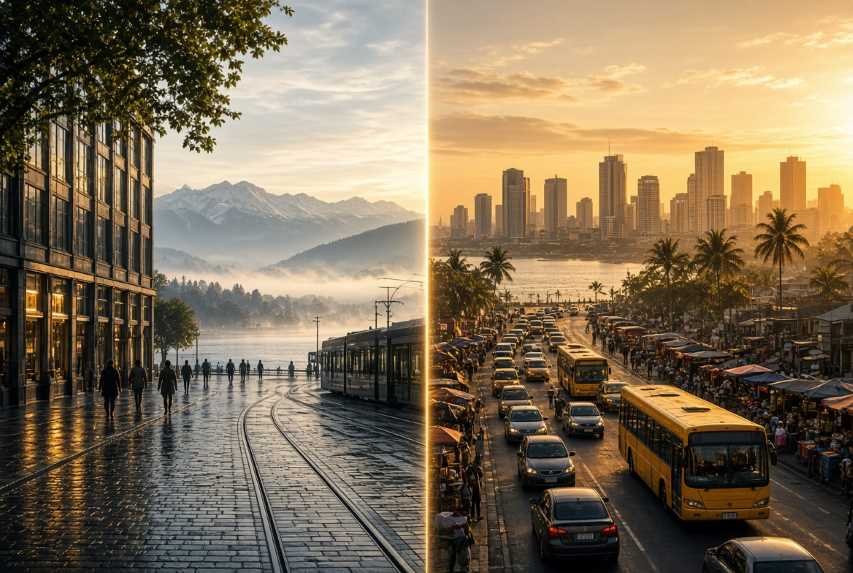
Two Cities, One Planet
On the same Monday morning, two people wake up on the same planet.
In Zurich, a software analyst hears a tram before the alarm. The kitchen tap produces water she does not think about. The train app shows a two-minute delay, treated as news. Health insurance is mandatory and expensive. Rent consumes a large share of a high salary. The air is clean enough that “air quality” is a dashboard, not a daily negotiation.
In Lagos, a logistics coordinator checks whether the generator has fuel before the kettle. The commute may take two to four hours if the traffic on the Lagos–Ibadan or Ikorodu corridor is unkind. Mobile data is the internet. Rent has jumped far faster than wages. Neighbors, markets, and informal networks fill gaps that public systems do not. The city is exhausting and entrepreneurial at the same time.
These are not moral portraits. They are infrastructure portraits.
This article uses Zurich, Switzerland, as a high-income city with unusually strong public systems, and Lagos, Nigeria, as a lower-income megacity that is also one of Africa’s largest economic engines. Other cities—Singapore, Oslo, Tokyo, New York, Dhaka, Nairobi, Mumbai—appear where they clarify the pattern. The point is not that every wealthy city is Zurich or every strained city is Lagos. The point is that city-level wealth is a bundle: income, prices, public goods, time, risk, and the ability to plan.
What “rich city” and “poor city” actually mean
A “rich city” is not simply a place with billionaires. New York and San Francisco rank among the world’s wealthiest metropolitan economies by total GDP and millionaire counts, yet they also contain homelessness, working poverty, and extreme housing costs. Tokyo’s metropolitan economy is among the largest on Earth; that does not make every Tokyo household affluent.
A “poor city” is not a place without wealth. Lagos contributes on the order of one-fifth to one-third of Nigeria’s GDP, depending on the year and method, and hosts banks, tech firms, ports, film, music, and a vast informal market economy. Dhaka and Nairobi likewise contain luxury districts a short drive from informal settlements.
Useful measures, used carefully:
Total city GDP rewards size. Tokyo and New York look richest.
GDP or GNI per person is closer to average living standards, but averages hide distribution.
Purchasing-power parity (PPP) adjusts for local prices. Nigeria’s 2025 GDP per capita is about $1,224 in current U.S. dollars and about $8,145 in PPP terms (World Bank). Switzerland’s 2025 GNI per capita is about $110,330 by the Atlas method and about $101,690 in PPP (World Bank, July 2026 release). The gap shrinks with PPP but remains enormous.
Median income is better than the mean where available.
Access indicators—electricity, safely managed water, internet, clinics, schools—often explain daily life better than headline GDP.
Time costs (commute, queues, outages) are a hidden tax.
Zurich city proper had roughly 453,000 residents in mid-2026, with an agglomeration above one million and a metropolitan region approaching 1.8 million. Density is high by Swiss standards but modest beside megacities. Lagos’s urban agglomeration is estimated around 17 million by UN-style city figures for 2025, while state and local estimates often cite 20–22 million. Density, flooding risk, and service gaps are not side notes; they are the operating system.
Switzerland’s national life expectancy is about 84 years. Nigeria’s is about 54–55 years in recent World Bank and UN compilations. That gap is not “culture.” It is vaccines, maternal care, sanitation, nutrition, road safety, air pollution, and the reliability of emergency response.
The central question is simple:
What would ordinary life feel like if we lived 30 days in each city as a typical resident—not as a tourist, diplomat, or visitor in a gated hotel?
The profiles below are fictional composites, assembled from published statistics and reporting. They are not interviews.
Lea, 34, Zurich: mid-level analyst in financial services, rents a one-bedroom.
Chinedu, 32, Lagos mainland: logistics and gig-plus-formal work, shares a two-room flat.
Amira, 41, Zurich: nurse and mother of two.
Folake, 39, Lagos: small trader and mother of two.
Jonas, 22, Zurich: university student.
Blessing, 21, Lagos: university student who also works.
The 30-Day Lived Comparison
Day 1 — Arrival and first impressions
Zurich. Arrival is a system. Zurich Airport is a machine for transferring people with little friction. Trains, trams, and well-marked roads make the first hour predictable. Streets are maintained. Crossing lights work. Broadband and 5G are assumed. A mid-range hotel or short-stay apartment is expensive even by Western European standards. Accessibility—ramps, elevators, readable signage—is not perfect, but it is designed into public space.
Lagos. Arrival can be efficient or chaotic depending on the terminal, the hour, and whether someone is meeting you. The road from the airport into the city is a first lesson in congestion. Formal taxis, ride-hailing, and informal options all exist. Road quality varies sharply by corridor. Mobile networks are the default internet. Housing on night one ranges from international hotels on the islands to modest mainland rooms. First impressions are energy, commerce, heat, and the sense that the city is being assembled in real time.
Why the difference. Airports and arterial roads are concentrated public and private investment. High-income cities inherited and continually fund dense transport networks. Fast-growing lower-income megacities often expand population faster than paved capacity. Colonial port geography, post-independence urbanization, oil-era migration, and underinvestment in mass transit all shape Lagos’s first hour. Zurich’s first hour is the compound interest of decades of planning, taxation, and political stability.
Day 2 — Housing
Housing is the largest single difference, and the one that structures every other day.
Zurich. A one-bedroom in or near the center commonly rents in the range of CHF 1,700–2,600 a month in recent cost-of-living compilations; three-bedrooms in the center can exceed CHF 4,000. Advertised new leases are higher than long-held contracts. Vacancy is extremely tight. Building quality, insulation, and utilities are generally high. Homeownership in the city and canton is difficult for younger households; Swiss owner-occupancy nationally is only around the mid-30s percent, and Zurich is tighter than the national average. Homelessness exists but is smaller in scale than in many U.S. cities; the more common stress is affordable scarcity, not the absence of roofs.
Lagos. The state faces a housing deficit on the order of 3.3–3.4 million units in 2025 estimates cited by officials and researchers. Rents in many areas rose 80–120% between 2024 and 2026 while wages rose roughly 7–9%, according to 2026 housing-market research. Price-to-income ratios around 19 put formal ownership out of reach for most households. Overcrowding, informal extensions, and shared rooms are common coping strategies. Luxury apartments in Ikoyi, Victoria Island, and parts of Lekki coexist with informal settlements and poorly serviced mainland neighborhoods. Utilities are a separate housing cost: generator fuel, inverter batteries, tanker water.
Deeper reason. Housing supply is slow everywhere. In Zurich, strict planning, high construction standards, limited land, and global demand for a safe financial center push prices up. In Lagos, population growth, land-market complexity, expensive construction finance, infrastructure that capitalizes into land prices, and a mismatch between what is built (often mid-to-high end) and what most people can pay produce a different scarcity. Both cities have a housing crisis. Only one has a crisis of absolute adequacy at massive scale.
Day 3 — Food
Zurich. Groceries are among the world’s most expensive in nominal terms. A simple restaurant meal can cost what a day’s food budget is in many cities. Quality and safety regulation are high. Food insecurity exists at the margins—students, some migrants, people on social assistance—but widespread hunger is not the urban baseline. Much food is imported; Swiss agriculture is high-cost.
Lagos. Street food and open markets can be cheap in local currency and rich in flavor. Imported packaged goods, cooking gas, and restaurant meals in affluent districts are another economy. Food inflation has been a national shock in recent years. Households buy smaller quantities more often, which raises unit prices. Home cooking and shared meals stretch budgets. Food quality varies with storage, power cuts, and supply chains.
Why it matters. Nominal grocery indexes mislead. A Zurich salary can absorb a CHF 8 loaf. A Lagos wage cannot absorb imported inflation the same way. Local markets and informal vendors are not a picturesque extra; they are the food system for millions.
Day 4 — Transportation
Zurich. Public transport is frequent, integrated, and priced as a utility. Walking and cycling are realistic. Average commutes are short by global-city standards. Cars are common in the wider region but not required for a central life. Time is predictable.
Lagos. The city is building BRT corridors and rail (the Blue Line is a real, still-limited piece of a much larger need). Most people still rely on danfos, ride-hailing, motorcycles, and private cars. World Bank and local analyses have described commuters spending up to four hours a day in traffic on bad days; other estimates put average daily transit near two hours. Fuel, time, and informal levies stack. Walking is often necessary and not always safe or shaded.
Economic core. Transport is not only vehicles. It is land use. Zurich is compact relative to its wealth. Lagos sprawled because housing near jobs is unaffordable, planning lagged growth, and the islands/mainland split concentrates high-value work.
Day 5 — Work
Zurich. Formal employment dominates. Salaries are among the world’s highest in net terms; Zurich and Geneva regularly top international net-salary tables. Hours can be long in finance and tech, but contracts, pensions, unemployment insurance, and sick leave are normal. Unemployment is low by international standards. Remote work is feasible because connectivity and housing (if you already have it) support it.
Lagos. Formal wage work is a minority path nationally; one 2025 labor analysis put informal employment around 93% of Nigerian employment, with Lagos doing better on wage jobs (one figure cited about 34% wage earners in Lagos versus much lower shares in many northern states). Underemployment is common. Many people stack jobs: trading, logistics, tech gigs, driving. Benefits are uneven. Job growth exists—fintech, entertainment, trade, construction—but security is thinner.
Chinedu’s composite week is a mix of warehouse coordination, WhatsApp clients, and backup plans when the grid fails. Lea’s composite week is meetings that start on time and a salary that is high until rent and insurance arrive.
Day 6 — Education
Zurich. Public schools are well funded. Vocational tracks are respected. Universities are strong and comparatively affordable by U.S. standards, though living costs are not. Digital tools are standard. Teacher shortages exist in places, but the system is not defined by absence.
Lagos. Demand for education is intense. Public schools can be overcrowded. Private “low-cost” schools fill gaps. Universities face strikes, large classes, and uneven facilities. Mobile phones are the study device. Elite private education exists and is globally connected; it is not the median experience.
Jonas worries about rent near campus. Blessing worries about data, power, and whether the semester will run continuously. Both are ambitious. Only one can treat electricity as a background condition for studying.
Day 7 — Healthcare
Zurich. Universal coverage through mandatory insurance. Premiums for basic insurance were on the order of CHF 380–410 per month in 2025 figures often cited for averages. Care quality and wait times for emergencies are generally strong; elective waits exist. Medicines are regulated and expensive. Life expectancy in the mid-80s is the outcome of this system plus income, housing, and environment.
Lagos. Public hospitals and primary centers exist and are used; private clinics serve those who can pay. Out-of-pocket spending is a major household risk. Medicine quality and availability vary. Emergency response depends on location and traffic. National life expectancy in the mid-50s reflects child mortality, maternal risk, infectious disease, road injuries, and limited critical care—not a lack of skilled Nigerian clinicians, who are numerous and often overstretched or emigrating.
Healthcare inequality is also internal: a private hospital in Victoria Island and a crowded general hospital are not the same city.
Day 8 — Technology and internet
Zurich. Fixed broadband and 5G are normal. Digital government, banking, and payments are mature. Smartphone ownership is near-universal among working-age adults. AI tools are a workplace default for many office workers.
Lagos. Nigeria’s national figure for individuals using the internet was about 39% in 2025 World Bank data—far below Switzerland’s 97%. Urban Lagos is much more connected than the national average, and mobile money, social commerce, and fintech are advanced relative to income. The constraint is often quality and cost: data bundles, outages, device quality, and digital skills.
The digital divide is not “phones versus no phones.” It is reliable bandwidth, devices that can run modern software, and the electricity to charge them.
Day 9 — Electricity and energy
Zurich. The grid is a given. Prices are visible on the bill, not in the sound of a generator. Renewables and efficiency are policy priorities. Energy poverty exists at the edges but is not the urban condition.
Lagos. Nigeria’s national electricity access was about 62.5% in 2024 (World Bank). Lagos is better served than many states, yet reliability is the live issue. A widely cited World Bank diagnostic noted that a large share of residents rely on generators during outages. Diesel is a household and firm tax. It is also an air-pollution source.
Energy poverty here means paying more for worse service.
Day 10 — Water
Zurich. Tap water is drinking water. Sewage is treated. Household water cost is a line item, not a logistics project.
Lagos. Piped water coverage is incomplete. Many households buy from vendors or tankers, store in tanks, and treat water at home. Flooding mixes drainage, waste, and living space in low-lying areas. Sanitation access nationally remains a development gap (safely managed sanitation was about 32% in Nigeria in 2024 World Bank data).
Water is public health, time, and money.
Day 11 — Safety and security
Unsupported crime folklore is worse than silence. What can be said carefully:
Zurich has very low homicide and a high public sense of safety in international livability surveys. Street lighting, emergency response, and trust in institutions are part of that outcome.
Lagos, like many large lower-income cities, has neighborhoods with serious crime problems and neighborhoods that feel commercially busy and relatively managed. Private security, gates, and informal vigilance are common. Official statistics and public perception often diverge. Kidnapping and robbery receive national media attention; they are not the whole city. Lighting, policing quality, youth unemployment, and the design of streets matter more than slogans.
Safety is also traffic deaths and building collapses—risks that rarely appear in “crime rate” comparisons.
Day 12 — Time
Poverty imposes a time tax.
In Zurich, government services are increasingly digital. Clinic waits exist but are bounded. Commutes are short. Shopping is efficient.
In Lagos, time disappears into traffic, queues, cash-out problems, power cuts that pause work, and the need to buy water or fuel. A four-hour round-trip commute is not an anecdote in isolation; it is a labor-market tax that reduces sleep, family time, and second-job capacity.
Economists sometimes call this the poverty of bandwidth: when every day is logistics, long-term planning shrinks.
Day 13 — Environment
Zurich’s advantages include Alpine water sources, strict emissions rules, abundant lake-and-park space, and functioning waste systems. Traffic exists; it is not the city’s defining toxin.
Lagos faces heat, flooding, coastal risk, waste-management strain, and air pollution. A World Bank analysis of 2018 data estimated around 11,200 premature deaths in Lagos from ambient air pollution and an economic cost on the order of $2.1 billion, with PM2.5 far above WHO guideline levels. Generators and vehicles are major sources. Green space is uneven.
Climate risk is not equally distributed inside the city: a house on a drained, elevated plot is not a house in a floodplain settlement.
Day 14 — Children
Amira’s children in Zurich move between school, sports clubs, and public playgrounds. Vaccination and pediatric care are routine. The constraint is childcare cost, which can rival rent.
Folake’s children in Lagos may attend a crowded public school or a modest private school. Play is often the street or a compound. Health shocks are more expensive relative to income. The city’s energy—music, markets, extended family—is real social capital. So is the risk that a child’s talent depends on which side of a lagoon they sleep.
Childhood inequality is future inequality with a longer half-life.
Day 15 — Women
Avoid cultural cartoons. Use constraints.
In Zurich, women have high educational attainment and legal equality; the remaining gaps are familiar rich-country issues: childcare costs, part-time penalties, and leadership under-representation.
In Lagos, women run a large share of market and informal trade. That is economic participation, not a consolation prize. Constraints include unsafe or unreliable transport after dark, unpaid care work, uneven property rights in practice, and access to capital. Lagos has prominent women in business, media, and politics; the median woman is still carrying more of the household’s time tax.
The fair comparison is not “liberated versus traditional.” It is which systems convert women’s work into security.
Day 16 — Digital economy
Zurich plugs into European and global markets by default: banking, SaaS, remote clients, venture networks.
Lagos has one of Africa’s liveliest digital scenes—fintech, content, e-commerce, freelance design and development. Mobile money and social-platform selling lowered entry barriers. The ceiling is payments infrastructure, power, international payment access, and trust. A freelancer in Yaba can serve a London client and still lose an afternoon to an outage.
Day 17 — Shopping and purchasing power
Price is not affordability.
A coffee that costs CHF 6 in Zurich may be a smaller share of Lea’s net pay than a less expensive imported item is of Chinedu’s. PPP exists because a haircut, a plate of food, and a bus ride are locally priced. Imported fuel, electronics, medicines, and building materials track global prices and exchange rates. When the naira weakens, Lagos feels world prices immediately; Zurich’s high wages and strong currency buffer many shocks.
Earning three times as many dollars does not yield three times the life if rent, insurance, and services absorb the difference—or if the cheaper city lacks the services the salary was supposed to buy.
Day 18 — Housing inequality inside the rich city
Zurich is not a cartoon of comfort. Vacancy rates have been extremely low. Young households are often locked out of ownership. Social and cooperative housing help, but demand exceeds supply. Working poverty is less visible than in U.S. cities and still present among some service workers who commute from cheaper municipalities. Wealth concentrates in property and financial assets.
New York, London, and San Francisco make the same point more loudly: a rich city can contain tents and vacant luxury units in one metro area.
Day 19 — Wealthy neighborhoods versus poor neighborhoods
Lagos’s islands and new corridors versus dense mainland settlements is a textbook case of spatial inequality. So is Zurich-West versus more modest outer districts—though the Swiss gap in basic services is narrower.
Spatial inequality means your postcode predicts school quality, flood risk, broadband, police response, and the jobs you hear about. UN-Habitat has long treated this as a core urban problem, not an aesthetic one.
Day 20 — Public spaces
Zurich’s lake edge, forests, libraries, and sports clubs are part of the wage. They are subsidized livability.
Lagos has beaches, markets, churches, mosques, nightlife, and intense public social life. Formal parks and libraries per capita are fewer; commercial and religious spaces do more of the civic work. Public space is not absent. It is differently provisioned and more contested.
Day 21 — Government services
Digital government in Switzerland—tax, registration, transit—reduces the time tax. Social protection is expensive and real.
Lagos State invests heavily in roads, bus reform, rail, and electrification relative to many peers; budgets in the mid-2020s put large shares into infrastructure. Capacity still lags population. Informal rules often govern what formal rules do not reach. The issue is not “no government.” It is scale, coordination, and trust.
Day 22 — Business and entrepreneurship
Starting a formal firm in Zurich is procedurally clear and capital-intensive. Banking is deep. Venture capital exists but is smaller than in the Bay Area. Regulation is heavy and predictable.
In Lagos, informal business formation is fast. Formal registration, power, FX, and credit are the bottlenecks. Lagos accounts for a disproportionate share of Nigeria’s informal firms. That is dynamism and missing insurance at once.
Day 23 — Social mobility
Can a poor person become middle class?
In Zurich, the routes are education, vocational training, and a tight labor market. Inheritance and housing wealth still matter; a generation can work productively and remain renters. Mobility is real and not infinite.
In Lagos, entrepreneurship and migration into the city have always been mobility machines. So have education and the diaspora. The same city can produce a tech founder and a household one illness away from reversal. Mobility exists. The variance is brutal.
Day 24 — The cost of being poor
Low income raises unit costs:
buying food and fuel in small quantities
high effective interest when credit is informal or predatory
generator power instead of grid power
farther housing and longer commutes
worse insulation and higher repair costs
limited insurance, so shocks become catastrophes
time spent substituting for missing services
This is why “just spend less” is not an analysis.
Day 25 — The cost of being rich
Zurich’s costs are not only prices. They include housing stress, social comparison, long skilled-work hours, and the quiet loneliness that high-income cities report in livability research even when safety and health are excellent. Wealth is not happiness. High-income cities can still fail at belonging.
New York and London add another cost: you can earn a rich-world salary and feel poor relative to local housing.
Day 26 — The technology gap
AI, cloud tools, telemedicine, digital banking, and remote work can:
narrow gaps if a nurse in Lagos can consult a specialist, a student can access world-class lectures, and a merchant can reach export customers; or
widen gaps if models, compute, data centers, and high-skill jobs concentrate in a few metro areas while automation erodes routine work elsewhere.
Smart-city sensors without reliable electricity are theater. Remote work without affordable housing near fiber is a privilege.
Day 27 — Climate and future risks
Wealthy cities buy adaptation: flood walls, cooling, insurance, buried power lines, medical surge capacity. They still face heat and storms.
Lower-income coastal megacities face the same physics with thinner buffers. Lagos’s lagoon-and-Atlantic geography makes sea-level rise and extreme rain operational problems. Heat increases energy demand precisely where grids are weakest. Adaptation capacity—finance, engineering, land policy—is the inequality.
Day 28 — A typical monthly budget
Figures are illustrative, income-adjusted, and rounded. Exchange rates move; local prices move faster. This is about structure, not a shopping receipt.
Lea (Zurich, single professional) — monthly, CHF
Item | Illustrative amount | Note |
|---|---|---|
| Rent (1-bed) | 2,000–2,400 | Center/near-center |
| Health insurance | 380–420 | Mandatory basic |
| Food | 500–800 | Mix of groceries and some eating out |
| Transport | 80–150 | Pass; car optional |
| Utilities + internet | 150–250 | Reliable |
| Other | 400–700 | Phone, clothes, modest leisure |
| Savings / pension extras | Remainder | Possible if rent is not higher |
Net pay in many professional roles can support this and still feel tight because rent and insurance are large, fixed, and rising.
Chinedu (Lagos, mixed formal/informal) — monthly, naira, structure
Item | Structural share | Note |
|---|---|---|
| Rent | Often 30–70% of modest incomes in press and market studies | Paid annually in many contracts, which is a cash-flow shock |
| Food | High and volatile | Inflation-sensitive |
| Transport | High in time and cash | Fuel and fares |
| Power (generator/inverter) | Recurring “second utility” | Grid is not the whole bill |
| Data | Essential | Work and school |
| Healthcare | Irregular, lumpy | A single event can erase savings |
| Savings | Thin for the median | Informal rotating savings (esusu/ajo) often substitute |
A Lagos professional in a strong formal job lives a third budget: gated estate, private school, diesel, driver. That person is real and not typical.
Day 29 — Opportunities
Zurich offers predictable careers, globally recognized credentials, physical safety, and public goods that make talent compounding easier. It is hard to enter without skills or a work permit.
Lagos offers speed, large local markets, cultural production with global reach, and lower formal barriers to starting a tiny business. It is hard to compound gains without power, housing, and capital.
International opportunity is asymmetric. A Zurich passport and degree travel. A Lagos talent often travels through the same networks at higher friction.
Day 30 — What did we actually learn?
The largest differences were not the price of a restaurant meal.
They were time, reliability, health risk, housing adequacy, and the ability to plan.
Income explains purchasing power and the option to buy private substitutes (generators, clinics, schools).
Infrastructure explains whether private substitutes are necessary.
Policy explains insurance, schools, transit, and land rules.
Geography explains ports, flooding, and Alpine water.
History explains why some cities industrialized early, attracted capital, and built institutions that survived wars and depressions—and why others urbanized under colonial extraction, structural adjustment, or resource volatility.
Internal inequality means both cities contain multiple worlds.
Lagos is not helpless. Zurich is not paradise. One city converts wealth into boring reliability. The other converts human energy into growth that services have not fully caught.
Comparison tables
Everyday systems
| Category | Zurich | Lagos | Why the difference matters |
|---|---|---|---|
| Housing | Tight, high-quality, very expensive | Severe deficit, split luxury/informal, rents rising faster than wages | Housing sets commute, school, and health |
| Food | High nominal prices, high safety | Markets cheap-to-volatile; import inflation bites | Food is a larger shock absorber when incomes are low |
| Transport | Integrated, punctual, walkable core | Congestion, mixed formal/informal, long commutes | Time is money and health |
| Healthcare | Universal insurance, high capacity | Mixed public/private, high out-of-pocket risk | Life expectancy gap is the long scoreboard |
| Education | Strong public and vocational systems | High demand, uneven quality, private fill-in | Mobility depends on consistency, not slogans |
| Internet | Near-universal quality broadband | Mobile-first, urban-rural and reliability gaps | Digital work needs power plus bandwidth |
| Energy | Reliable grid | Access better than national average; reliability weak | Firms and households pay a reliability tax |
| Water | Safe tap water | Incomplete piped service; storage and vendors | Water is hours and disease risk |
| Employment | Formal, high wage, insured | Large informal share, high hustle, thinner benefits | Risk is individualized |
| Safety | Very low violent crime | Uneven by area; traffic and environmental risks matter too | Fear changes who move and when |
Illustrative 30-day scorecard
Scores are illustrative, not a scientific index. They summarize the lived month for a median-type resident, not a billionaire and not a tourist.
Domain | Zurich | Lagos |
|---|---|---|
Reliability of basics | 9 | 4 |
Affordable housing | 3 | 3 |
Earning potential (typical formal job) | 9 | 5 |
Time sovereignty | 8 | 3 |
Health security | 9 | 4 |
Social energy / informal support | 6 | 8 |
Business entry (tiny firm) | 5 | 8 |
Climate buffer | 8 | 3 |
Child opportunity (median) | 8 | 4 |
Zurich loses on housing affordability and can lose on warmth of everyday social density. Lagos wins on entrepreneurial entry and social intensity and loses on the systems that make effort compound.
Data, not just stories
Selected anchors (years in parentheses; these are estimates, not laboratory constants):
Switzerland GNI per capita, Atlas: about $110,330 (2025); PPP GNI per capita about $101,690 (World Bank, 2026 release).
Nigeria GDP per capita: about $1,224 current USD (2025); PPP about $8,145 (World Bank).
Life expectancy: Switzerland about 84; Nigeria about 54–55.
Electricity access: Switzerland 100%; Nigeria about 62.5% (2024).
Internet use: Switzerland about 97%; Nigeria about 39% (2025 World Bank series).
Zurich population, city proper: about 453,000 (2026 monthly city statistics).
Lagos agglomeration: on the order of 17 million (UN-style 2025 estimate), with higher local estimates.
Lagos housing deficit: about 3.3–3.4 million units (2025).
Global wealth: the World Inequality Report 2026 notes the global top 10% own about three-quarters of wealth and the bottom 50% about 2%; the top 1% about 37%.
City GDP league tables that crown Tokyo or New York measure economic mass. Livability indexes that rank Vienna, Copenhagen, Zurich, or Singapore measure service quality. Both are real. They answer different questions.
Keep the comparison fair
Poorer cities can have:
lower prices for local services
denser family and neighborhood support
faster informal business formation
cultural production that punches above GDP
less sterile public life
Wealthy cities can have:
homelessness beside empty housing
loneliness
overwork
exclusion by rent
political complacency about those who clean the offices
Quality of life is related to wealth. It is not identical to it. Luxembourg, Copenhagen, and Vienna often score extremely high on livability without being the largest GDP machines. Some oil-rich or hyper-expensive cities score lower on livability than their income suggests.
Purchasing power versus income
Nominal income converts salaries at market exchange rates. That is useful for imported laptops and foreign debt. It is a bad measure of a plate of rice, a bus ride, or a haircut.
PPP asks: how many goods does this income buy at local prices? That is why Nigeria’s living-standard gap with Switzerland is smaller in PPP than in raw dollars—and still a chasm.
Practical example: a $3,000 monthly net salary in a high-cost city may be lower-middle after rent and insurance. A $1,000 salary in a cheaper city may buy more local food and domestic help and still fail to buy reliable power, a short commute, or a private hospital stay. Affordability is a basket, not a forex quote.
Taxes change the story again. Switzerland’s high wages come with high prices and mandatory insurance. Some high-income cities have lower headline taxes and worse public services; households then buy those services privately.
Inequality inside cities
The phrase “rich vs. poor cities” can hide the more uncomfortable fact: the planet’s sharpest inequality is often inside one metro area.
Gated waterfronts versus flood-prone settlements
Private hospitals versus general wards
International schools versus triple-shift classrooms
Fiber-to-the-home versus a single shared phone
Driver-only traffic lanes versus two-hour bus waits
This is spatial inequality. It appears in São Paulo, Mumbai, Nairobi, Johannesburg, New York, and Lagos. Zurich’s internal gaps are narrower in basic services and still visible in housing wealth.
A city can be “rich” in the same way a country can be rich: the average is high because the top is very high.
Technology, AI, and the next divide
Automation may raise productivity in ports, banks, and factories. If the gains accrue to owners of models and robots in a few hubs, cities that currently sell routine labor will feel a squeeze. If digital public infrastructure—identity, payments, open educational models, telemedicine—is treated as a utility, smaller cities can leapfrog some legacy systems.
Both futures are already visible. Fintech in Lagos is leapfrogging. AI research clusters in the Bay Area, London, Zurich, Toronto, and a handful of Asian hubs are concentrating talent. Cloud regions and energy for data centers will become a new geography of advantage.
The honest question is not whether AI is “good.” It is who owns the tools, who has the power to run them all day, and who is only a user on a prepaid plan.
The human story
Lea can plan a two-year certification. The risk is burnout and rent.
Chinedu can launch a side logistics page this week. The risk is that a fuel spike, a flood, or a medical bill resets the board.
Amira pays a fortune for childcare and still has a pension.
Folake can feed a network of relatives from market profits and still not have a paper title that a bank likes.
Neither pair is more fully human. One pair lives in a city that socializes risk. The other lives in a city that privatizes it.
Root causes
No single villain explains the gap.
Interacting causes include:
Industrial timing. Cities that captured manufacturing and finance early built tax bases for schools and pipes.
Institutions. Predictable courts, cadasters, and utilities attract long-horizon capital.
Geography. Ports and rivers help; floodplains and landlocked positions constrain.
Demography. Rapid youth-heavy urban growth can be a dividend or a service crunch.
Governance and investment. Not “corruption” as a complete theory—though theft of public resources matters—but the whole machinery of planning, maintenance, and procurement.
Global insertion. Some cities capture design, finance, and IP; others capture assembly, extraction, or cheap services.
Historical extraction and unequal trade. Colonial patterns still echo in infrastructure maps and commodity dependence.
Conflict and instability in some regions, which Zurich has not had to absorb domestically for generations.
Simplistic moral stories fail twice: they insult people who work extremely hard in hard systems, and they excuse systems that could work better.
From cities to the world
Cities now hold a large and rising share of humanity. UN urbanization work in the 2025 revision underscores that city living is the statistical normal, not the exception.
Global wealth is concentrated. Capital, advanced technology, and high-productivity services cluster. A smartphone links a designer in Zurich, a component plant in East Asia, a cobalt supply chain in Central Africa, and a reseller in a Lagos market. The object is global. The returns are not evenly global.
Migration is partly a vote with one’s feet about this map. Remittances then tie poor regions to rich-city labor markets. That is integration and dependence at once.
The future of cities: 2030, 2040, 2050
By 2030, AI tools and digital government will be ordinary in high-income cities. In fast-growing megacities, the fight will still be housing, drainage, and power—plus whether mobile AI helps a nurse or only a marketing team.
By 2040, autonomous transport may reshape labor in cities that can regulate and electrify it. Others will still be adding basic rail. Water stress and heat will be first-order politics.
By 2050, climate adaptation will separate cities as sharply as factories once did. Population will continue to urbanize in Africa and South Asia. Remote work will not abolish geography; it will reprice the cities that combine connectivity with livable housing.
Technological progress will not automatically equalize cities. Electricity did not. Container shipping did not. The internet did not. Tools follow institutions, capital, and power.
Global inequality is not only a story about pay slips.
It is about whether water comes from a tap, whether an ambulance can move, whether a child can study after sunset, whether a woman can travel after dark, whether a worker owns the evening, whether a household can survive a hospital bill, and whether next year is a plan or a rumor.
Zurich shows what happens when high productivity is paired with boring, expensive, high-capacity public goods. Lagos shows what happens when enormous human energy hits systems that have not caught up with the city’s size—and still produces art, firms, and middle-class lives in the gaps.
If two people live on the same planet but experience different realities depending on the city they were born into, how much of our future is determined by personal effort—and how much by geography?
Effort is real. So is the map.
 |  |  |
 |  |  |