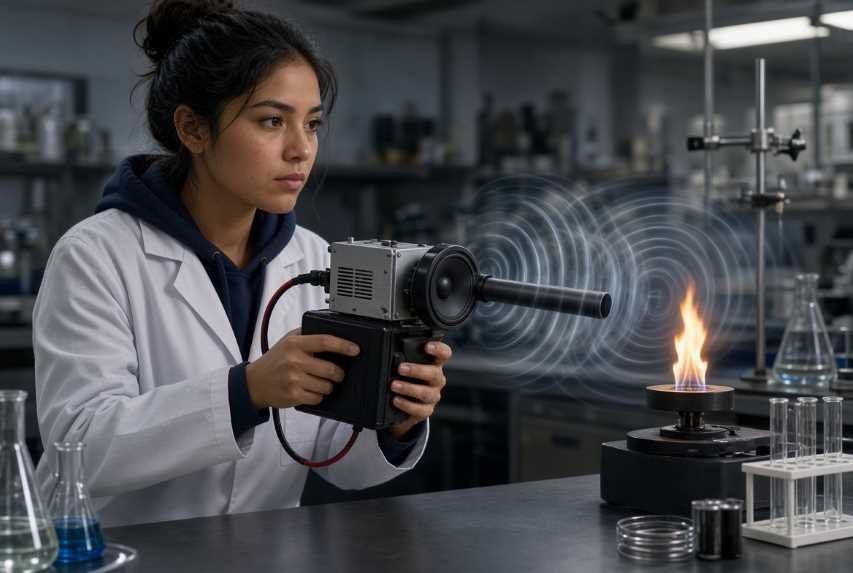
Subtitle: Ángela Karime Venegas Hernández’s experimental Vortex Tech uses approximately 30 Hz sound waves to disrupt small flames in controlled tests, building on established acoustic research.
A 16-year-old student in Altamira, Tamaulipas, Mexico, has built and iteratively refined a portable prototype called Vortex Tech that uses low-frequency acoustic waves to extinguish small, controlled flames in seconds without water or chemical agents. The project has earned awards in Mexican science competitions and a place at an international fair in Indonesia. While the underlying physics is supported by earlier laboratory research, the device is an experimental student prototype limited to small flames under controlled conditions and is not a replacement for certified fire protection systems.
A New Approach to Fighting Fires
Fire remains one of the oldest and most persistent hazards facing human settlements, industry, and critical infrastructure. A grease fire on a stovetop can grow from a small pan to a room-threatening blaze in under a minute. An electrical fault inside a server rack can destroy data and equipment far more valuable than the hardware itself. Industrial process fires, vehicle incidents, and wildland events continue to cause loss of life, property damage measured in billions, and long-term environmental harm. Despite decades of progress in detection, building codes, and suppression technology, the core physical challenge has not changed: combustion must be interrupted quickly, reliably, and with the least possible secondary damage.
Traditional firefighting methods all target the same three requirements of ordinary combustion—heat, fuel, and oxygen. Water removes heat and can dilute the oxygen concentration immediately around the fuel. Foam forms a barrier that excludes air while providing some cooling. Carbon dioxide and other clean agents displace oxygen or interrupt the chemical chain reaction. Dry chemical powders break the reaction at the molecular level. Fire blankets simply smother the fuel. Each method works well in its intended domain, yet each also carries clear drawbacks. Water ruins electronics, paper archives, and certain industrial materials. Foam and powders leave residue that must be cleaned. Some gaseous agents create asphyxiation risks in occupied spaces. No single technology is ideal for every situation.
For more than a decade, researchers have explored a different physical approach: using sound. Acoustic waves can disturb the delicate balance of airflow, heat transfer, and fuel–oxidizer mixing that keeps a flame stable. In 2025 and 2026 this line of inquiry reached a broader public through the work of a Mexican high-school student. Ángela Karime Venegas Hernández developed an experimental portable system she calls Vortex Tech. The device generates low-frequency sound—centered around 30 hertz—and uses the resulting pressure oscillations and induced airflow to extinguish small flames in controlled tests without water or chemical agents.
The central practical question is therefore straightforward. Can sound waves become a useful complement, or in carefully defined cases an alternative, to conventional extinguishers? The evidence available today supports a cautious answer. The physics works on small, controlled flames under favorable laboratory conditions. It has not been shown to work on large, spreading, or structurally dangerous fires. Vortex Tech is a genuine student engineering achievement that illustrates real scientific principles; it is not yet a certified or commercially ready firefighting tool.
Who Is the Mexican Student Behind the Invention?
Ángela Karime Venegas Hernández studies at the Centro de Estudios Tecnológicos Industrial y de Servicios número 78 (CETIS or CETis 78) in Altamira, Tamaulipas, Mexico. She is enrolled in the electronics specialty. Reporting from mid-to-late 2026 consistently describes her as 16 years old at the time the project received national and international attention.
The project began with a deliberately simple goal: to extinguish a candle flame using sound rather than by blowing it out or applying any liquid or powder. Over roughly one year she designed, constructed, and tested five successive prototypes. Throughout the process she worked with the guidance of her school advisor, engineer José Arturo Hernández Muñoz. The formal registered title of the work is “Sistema de supresión de incendios mediante ondas acústicas”; the name Vortex Tech is the public designation used in competitions and media coverage.
The project placed first in the upper-secondary (media superior) category of the Certamen Estatal de Creatividad e Innovación Tecnológica ExpoCiencias Tamaulipas 2025. It subsequently received a silver medal in a national competition that included approximately 270 entries. These results qualified her to represent Mexico at the International Science and Invention Fair (ISIF) 2026 in Indonesia. The fair includes an online phase in early October and an in-person phase scheduled for 12–17 October 2026 in the Depok area.
Available public information comes primarily from the student’s demonstrations, school context, and competition records. No independent peer-reviewed study of this specific prototype has been identified. The combination of sustained personal experimentation, school-level mentorship, and the structured pathway of state and national science fairs appears to have been decisive. Development challenges typical of such projects included achieving repeatable results, managing electrical power from a 12-volt battery, shaping the acoustic output into a directed airflow, and keeping the device portable enough for exhibition and competition. The student expanded testing beyond candles to include wood, flammable liquids, cooking greases and oils, and small electronic equipment, reporting more than 100 trials in total.
How Does a Sound-Wave Fire Extinguisher Work?
Understanding the Fire Triangle
Ordinary combustion is sustained only when three conditions are met simultaneously: sufficient heat to keep the reaction going, a supply of fuel, and an oxidizer—almost always oxygen from the surrounding air. Remove or sufficiently disrupt any one of these elements and the flame extinguishes. Water’s primary action is cooling; it can also dilute the local oxygen concentration. Foam and blankets exclude air. Gaseous agents displace oxygen or chemically interrupt the chain reaction. Acoustic methods do not permanently remove oxygen from a room or volume. They create transient aerodynamic disturbances that prevent the flame from remaining stable in its immediate vicinity.
The Science of Sound Waves
Sound is a longitudinal mechanical wave consisting of alternating regions of higher and lower pressure that travel through air. Several characteristics determine whether those pressure fluctuations can affect a flame.
Frequency, expressed in hertz, is the number of complete cycles per second. Lower frequencies have longer wavelengths and, for a given acoustic energy, produce larger displacements of air particles. Amplitude and sound pressure describe the magnitude of the pressure swings; greater intensity produces stronger induced air movement. Wavelength is inversely proportional to frequency. When intense low-frequency sound is directed through a tube or aperture, it can generate acoustic streaming—a net flow of air—and can form coherent vortex rings that travel away from the source.
Laboratory research has repeatedly shown that low-frequency sound can extinguish small diffusion flames. Work conducted under the U.S. Defense Advanced Research Projects Agency’s Instant Fire Suppression program in the late 2000s and early 2010s, together with university experiments such as the 2015 George Mason University prototype built by Viet Tran and Seth Robertson, established that frequencies in the approximate range of 30–60 Hz (and in some studies lower) are effective against small fires. The dominant mechanisms are aerodynamic rather than chemical. The oscillating flow stretches the flame front, increases the rate of heat loss to the surroundings, and temporarily separates the reaction zone from the fuel source. Popular accounts sometimes emphasize “pushing oxygen away”; more precise descriptions emphasize disruption of the thin mixing layer where fuel and oxidizer meet and an increase in the strain rate across the flame. Lower frequencies tend to be more effective because loudspeaker cones can achieve larger physical displacements, generating higher particle velocities and more vigorous turbulence.
It is important to be precise about what sound cannot do. Ordinary audible sound does not make oxygen disappear. A household speaker, even at high volume, will not extinguish a kitchen fire. Effective suppression requires adequate acoustic intensity, an appropriate frequency, directionality toward the flame, and sufficient proximity. High-intensity low-frequency sound also raises legitimate questions of hearing safety and possible vibration effects on nearby equipment or structures.
How the Vortex Tech Prototype Operates
Descriptions consistent across Mexican media reports and the student’s public presentations indicate that the portable prototype incorporates a 12-volt battery as the power source, a frequency generator set to approximately 30 Hz, a power amplifier, a speaker, and a directing tube or “cannon” that shapes the acoustic output into vortex rings or focused pulses of airflow.
The operating sequence is straightforward. Electrical power from the battery drives the electronics. The generator produces the low-frequency electrical signal. The amplifier and speaker convert that signal into intense pressure oscillations in the air. The tube directs the resulting airflow and vortices toward the target flame. Under the conditions the student tested, the acoustic disturbance destabilizes the small flame, which is reported to extinguish in roughly five to eight seconds. The student has stated that more than 100 tests were conducted on a range of fuels. Secondary reports of the demonstrations indicate effective ranges of up to about two meters for small flames. An automatic variant capable of detecting a flame and activating the acoustic system was mentioned as under development, although details of its sensors and control logic have not been independently documented.
These performance numbers originate primarily from the inventor’s own tests and from secondary reporting of those tests. Independent laboratory measurements of sound-pressure level, exact electrical power consumption, standardized flame sizes, or statistical repeatability under controlled protocols have not been published for this specific device.
What Makes This Invention Different from Traditional Fire Extinguishers?
Acoustic systems offer several potential advantages in carefully chosen settings: they introduce no water that can damage electronics or paper, they leave no chemical residue, they can in principle be reused as long as electrical power is available, and they could eventually be integrated with sensors or robotic platforms. They do not, however, cool the fuel or the surrounding surfaces. If residual heat remains high, reignition is possible once the acoustic disturbance stops. Range and power requirements currently limit them to small or localized flames.
Technology | How It Works | Potential Advantages | Important Limitations | Typical Applications |
Water / sprinklers | Removes heat and dilutes local oxygen | Highly effective, extensively proven, relatively low cost per area | Water damage, unsuitable for some electrical and oil fires, freezing risk in cold climates | Buildings, warehouses, many industrial facilities |
Foam | Blankets fuel, excludes oxygen, provides limited cooling | Effective on flammable-liquid fires | Residue requiring cleanup, limited effectiveness on some solid fuels | Flammable-liquid incidents, selected industrial sites |
CO₂ / clean agents | Displaces oxygen or interrupts chain reaction | Minimal residue, suitable for electronics | Asphyxiation risk in occupied spaces, limited cooling, higher cost | Data centers, electrical rooms, museums with sensitive artifacts |
Dry chemical powder | Interrupts chemical chain reaction | Fast knockdown across many fire classes | Heavy residue, cleanup burden, limited cooling of deep-seated fires | Portable extinguishers, ordinary combustibles |
Acoustic (low-frequency, Vortex Tech-style) | Disrupts flame aerodynamics and mixing layer via pressure oscillations and induced airflow | No water or chemical residue; reusable with power supply | Limited to small flames, short-range, high-power demand, no fuel cooling, experimental status | Laboratory demonstrations, potential niche controlled indoor environments |
The Technology Behind the Prototype
The elements of Vortex Tech that have been publicly described are a 12-volt battery, a frequency generator operating at approximately 30 Hz, a power amplifier, a speaker, and a tube that directs the output and promotes vortex formation. Exact acoustic intensity (sound-pressure level in decibels), precise power consumption in watts, overall weight, and physical dimensions have not been independently published in quantitative detail. The design is portable enough to be carried and demonstrated at school competitions. Directionality is achieved by physically aiming the tube. Full automation and advanced sensing were not part of the primary competition prototype, although an automatic version was referenced as under development.
Translating a laboratory or competition prototype into a practical product requires solving multiple engineering problems. Sufficient acoustic intensity must be maintained at useful distances without consuming excessive electrical power. Performance must remain consistent when ambient air is moving or when flame volumes increase. Speakers and amplifiers must survive repeated high-intensity operation without failure. Battery capacity, thermal management of the electronics, and a simple, reliable user interface all become important. Any commercial version would also need to satisfy applicable standards for noise exposure, electromagnetic compatibility, and fire-protection equipment.
What Do Scientific Experiments Reveal?
The student’s reported testing—more than 100 trials—showed that small flames involving wood, flammable liquids, cooking greases and oils, and electronic equipment could be extinguished in five to eight seconds at distances up to roughly two meters under controlled conditions. These results have not been published in peer-reviewed journals and have not been independently verified by recognized fire-protection laboratories in the sources available.
The broader scientific literature does support the physical principle. Multiple peer-reviewed studies have demonstrated low-frequency acoustic extinction of small laminar diffusion flames, liquid-fuel fires, and other laboratory-scale flames. Effective ranges in these studies are typically measured in tens of centimeters to low meters, and the most effective frequencies often lie between 10 Hz and 80 Hz. A 2022 paper in the journal Fire Technology, for example, reported systematic tests of an acoustic-driven airflow system on gasoline, kerosene, thinner, and LPG flames across dozens of frequencies and distances. Earlier work associated with DARPA’s Instant Fire Suppression program and the 2015 George Mason University student prototype (operating in the 30–60 Hz range) produced comparable qualitative results on small fires. Reviews of the field note that lower frequencies and higher sound pressures generally improve performance against small flames, yet effectiveness declines sharply as flame size, distance, or ambient airflow increases.
The practical difference between extinguishing a candle or a small pan fire in a quiet laboratory and controlling a room fire, a structural fire, or an outdoor blaze is large. Acoustic methods demonstrated to date do not effectively cool deep-seated combustion or large fuel loads, and they remain sensitive to external air movement.
Potential Real-World Applications
Homes and residential buildings. Compact acoustic devices might one day assist with very small, localized fires—such as an early-stage stove-top incident—if they were integrated with reliable detection and if they received appropriate testing and approval. They must not be viewed as replacements for certified extinguishers, smoke alarms, or sprinkler systems. Risks of false activation, insufficient power, or failure to cool residual heat would need to be addressed before any residential use.
Data centers and electronic equipment. Water and certain chemical agents can cause catastrophic damage to servers and other sensitive electronics. A method that leaves no residue could be attractive for small, early-stage electrical or electronic fires, provided it introduces no new electrical or acoustic hazards and meets established fire-protection standards.
Industrial facilities. Localized suppression inside laboratories or tightly controlled process areas is conceivable as a complement to existing fire-protection infrastructure. Adoption would require testing under realistic industrial conditions of airflow, background noise, temperature, and fire load.
Electric vehicles and battery fires. Suppressing visible flames is not the same as interrupting thermal runaway inside lithium-ion cells. Heat can propagate from cell to cell, toxic gases are released, and reignition risk remains high. No credible evidence supports the use of acoustic waves as a reliable means of controlling battery thermal runaway.
Aircraft, drones, and robotics. A lightweight acoustic module could theoretically be carried by a robot or unmanned platform to address small, accessible fires in hazardous locations. Weight, power demand, aiming precision, and regulatory certification remain substantial barriers.
Forest fires and outdoor emergencies. Wind, large flame fronts, distance, competing ambient noise, and the energy required to affect a sizable fire make outdoor wildfire suppression with portable acoustic devices currently impractical. Larger fixed or vehicle-mounted systems remain speculative.
Advantages, Limitations, and Safety Risks
Advantages that have been shown in small-scale controlled tests include the absence of water or chemical residue and rapid extinction of small flames. Potential advantages that remain theoretical include reusability limited only by power supply and compatibility with environments where conventional agents are undesirable. Claims of broad superiority or wide applicability have not been demonstrated at scale.
Technical limitations include restricted effective range, sharply reduced performance against larger flames, sensitivity to wind or turbulent air, high electrical power demand relative to the effect achieved, the requirement for accurate aiming, and the absence of cooling that leaves a reignition risk. Performance against the full range of fire classes outside controlled demonstrations is unknown.
High-intensity low-frequency sound can damage hearing, cause discomfort, or induce vibration in nearby objects. Occupational exposure limits and public-safety considerations would require careful evaluation. Any environmental benefit from avoiding water or certain chemicals must be weighed against electricity consumption and the materials used to build the device. Experimental technology should never replace legally required certified systems, detection equipment, compartmentation, evacuation procedures, or professional emergency response.
How Does This Technology Compare with Other Emerging Firefighting Innovations?
Acoustic suppression is one element within a broader set of emerging tools that includes robotic firefighting platforms, artificial-intelligence-assisted detection, thermal-imaging cameras, drone-based monitoring and mapping, advanced water-mist systems, and automated suppression. Detection, localization, prevention of spread, active flame suppression, and cooling of residual heat are distinct functions. Combining several of them is often more effective than relying on any single technology. Parallel commercial efforts, such as Sonic Fire Tech’s work with infrasound below approximately 20 Hz (sometimes distributed through ducting and triggered by sensors), illustrate growing interest in acoustic approaches, although those systems also face scrutiny regarding the volume of independent performance data and certification status.
Artificial Intelligence and the Future of Smart Firefighting
A hypothetical future system could detect smoke or abnormal temperatures, estimate the location and approximate size of a fire, classify the likely fire type, decide whether an acoustic suppression device is appropriate for that situation, aim or activate the device under predefined safety rules, monitor whether the flame is extinguished, watch for signs of reignition, and notify occupants or emergency services when necessary. This architecture remains a proposed concept rather than a demonstrated system. Reliability of sensors and models, cybersecurity of networked controls, false-alarm rates, and the continuing necessity of human oversight would all be critical design requirements. No fully integrated operational system based on the Mexican student’s prototype has been shown.
Economic Impact: Could This Technology Become Affordable?
At student scale, a prototype assembled from a battery, signal generator, amplifier, and speaker can be built at modest cost. Moving to a certified commercial product would require substantial investment in research and development, independent laboratory testing, regulatory approval processes, quality-controlled manufacturing, installation, user training, and ongoing maintenance. Early potential customers might include laboratories, museums, archives, or specialized electronics facilities where the absence of residue provides clear value. Opportunities exist for student entrepreneurs, university research groups, and technology companies both in Mexico and internationally. Public data do not yet allow a rigorous comparison of lifecycle cost against conventional extinguishers. Assertions that acoustic devices are inherently cheaper should be treated cautiously until such comparisons become available.
What Could This Mean for Mexico and Young Innovators?
The project demonstrates what can occur when personal curiosity, school-level mentorship, iterative hands-on experimentation, and structured science-fair pathways come together. Mexico’s network of technical high schools in the CETIS system, combined with state and national science competitions and opportunities to participate in international events such as ISIF, provides a visible route from an initial idea to a working prototype. Sustained broader impact depends on continued access to laboratory facilities, mentorship, research funding, guidance on intellectual property, and clearer pathways from competition success to independent validation and possible commercialization. A single high-profile student project does not by itself transform a national innovation ecosystem, yet it can inspire peers and underscore the practical value of engineering education.
Global Implications: Could Sound Change the Future of Firefighting?
If acoustic methods eventually prove reliable in defined niche applications after independent testing and certification, they could influence the design of equipment for electronics-intensive environments, certain industrial settings, and concepts for smart buildings. Widespread adoption would require demonstrated performance under realistic conditions, comprehensive safety data, acceptable cost, and inclusion in recognized fire-safety standards. Real-world testing, third-party validation, product reliability, and public confidence will matter more than the novelty of any individual prototype. Applications involving small, controlled indoor flames are the most plausible near-term candidates; outdoor and large-scale uses remain substantially more difficult.
What Challenges Must Be Overcome Before Commercialization?
Several milestones stand between a promising prototype and a dependable commercial product. Experimental results must be reproduced under controlled conditions. A wider range of flame sizes and fuel types must be tested. Clear performance limits and safe operating distances must be established. Energy efficiency must be improved. Repeatability under varied environmental conditions must be demonstrated. Independent laboratory testing is required. Human exposure and equipment compatibility must be evaluated. An intuitive and reliable control system must be developed. Manufacturing quality standards must be defined. Relevant fire-safety testing and regulatory approvals must be obtained. Long-term maintenance and reliability must be assessed. Realistic field trials must be conducted. Success with a candle or small pan fire does not automatically imply effectiveness in homes, factories, or larger buildings. Universities, fire-protection laboratories, manufacturers, standards organizations, and investors each have distinct roles in this evaluation process.
Future Scenarios: What Might Happen in the Next Five to Ten Years?
Scenario 1: Specialized applications. The technology remains useful primarily for carefully controlled small-flame experiments or for highly specific indoor niches in which residue-free suppression is especially valuable and conventional methods present clear drawbacks. This outcome aligns most closely with the evidence available today.
Scenario 2: Integration into smart fire-safety systems. After further engineering development and independent testing, acoustic modules become optional components that work alongside detection and conventional suppression inside selected automated systems. Reaching this stage would require substantial additional validation.
Scenario 3: Limited commercial adoption. Power requirements, range limitations, cost, safety concerns, or competition from mature technologies restrict practical use mainly to research and demonstration settings. This outcome remains plausible if scaling difficulties prove hard to overcome.
No specific timeline or numerical probability can be assigned without additional data.
Questions Readers May Ask
Can sound waves really extinguish fire? Yes, under specific conditions. Laboratory research and student demonstrations have shown that low-frequency sound can extinguish small flames by disrupting airflow and flame stability. It does not work on arbitrary fires when ordinary speakers are used.
What kind of sound is used to suppress a flame? Low-frequency sound, typically in the tens of hertz. Vortex Tech is reported to operate around 30 Hz. This is not ultrasound. Other groups are exploring infrasound below approximately 20 Hz.
Does the sound-wave device use water or chemicals? No. It relies on acoustic energy and the airflow that energy induces.
Can sound extinguish a large building fire? No evidence supports this capability. Demonstrated results are limited to small, controlled flames.
Could this technology work on electrical fires? The student reported tests that included electronic equipment. Suitability for real electrical fires would still require dedicated safety evaluation. Conventional clean-agent or specialized methods remain the established standard.
Can sound waves extinguish lithium-ion battery fires? No credible evidence supports reliable control of thermal runaway. Suppressing visible flames does not address the underlying cell-to-cell heat propagation.
Is the device safe for people and animals nearby? High-intensity sound requires assessment for hearing damage and other effects. The student’s reports indicate that the prototype did not harm operators during tests; broader exposure data are still needed.
How far away can the device extinguish a flame? Reports of the student’s tests indicate effective ranges of up to about two meters for small flames. Performance declines as distance and flame size increase.
Is the Mexican student’s invention already commercially available? No. It remains an experimental student prototype.
Could acoustic fire extinguishers replace conventional fire extinguishers? Not on the basis of current evidence. They may eventually complement conventional systems in narrow applications after appropriate certification.
How much electricity does such a device consume? Specific power figures for Vortex Tech have not been independently published. Acoustic suppression generally requires substantial electrical power relative to the effect achieved on larger flames.
What further research is needed before widespread adoption? Independent laboratory testing, standardized flame trials, quantitative measurements of sound pressure, safety evaluations for human exposure, scaling studies, and formal regulatory review.
An Innovative Idea with Potential and Important Challenges
The use of sound waves to extinguish flames is a compelling illustration of how acoustics and combustion science can be applied to a long-standing practical problem. Ángela Karime Venegas Hernández’s Vortex Tech demonstrates that a motivated student, supported by school mentorship and structured competition pathways, can convert established physical principles into a working portable prototype that performs effectively on small flames under controlled conditions. The awards the project received and its selection for an international science fair are genuine accomplishments.
The long-term value of the work will depend on rigorous independent validation, clearly defined performance boundaries, comprehensive safety data, improvements in energy efficiency, and the ability to function reliably outside a demonstration setting. Experimental success with candles and small fuel sources is encouraging science and engineering; it does not yet constitute a finished firefighting technology.
Could technologies that once seemed unconventional help create a safer and more sustainable future for firefighting? The answer will be determined by careful testing and accumulated evidence, not by the novelty of the concept alone. Readers interested in the future of fire safety can follow ongoing research in acoustic suppression, support evidence-based student innovation, and recognize that promising prototypes become useful tools only after they satisfy the demanding requirements of real-world performance and safety.
 |  |  |
 |  |  |