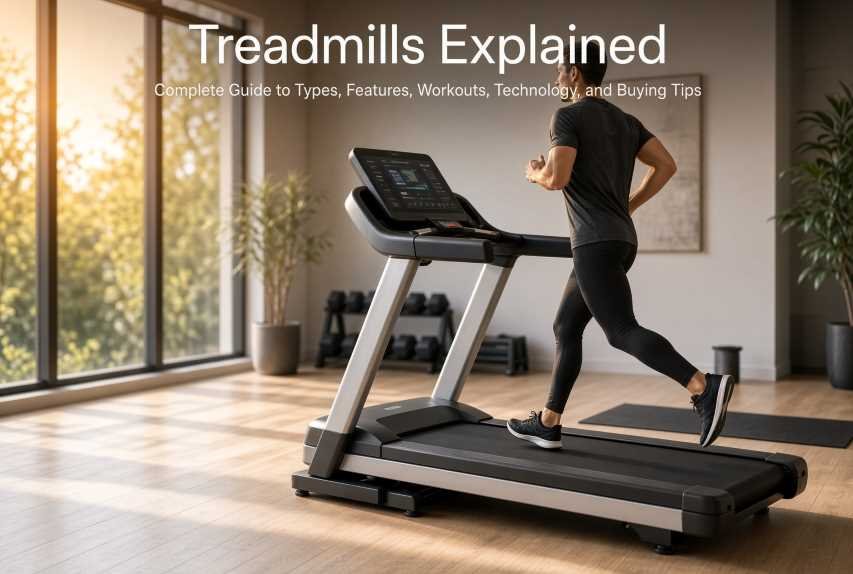
A Treadmill is a stationary exercise machine with a moving belt that lets a person walk, jog, or run in place. It is one of the most widely used pieces of cardiovascular equipment in homes and fitness centers because it offers controllable speed, optional incline, and weather-independent training. Used well, it supports aerobic fitness, muscular endurance, and consistent energy expenditure. Used poorly, it can feel cramped, noisy, or unsafe. This guide explains how treadmills work, how the main types differ, how to train on them, and how to choose and maintain one.
Introduction to Treadmills
A treadmill converts forward motion into a repeating cycle on a belt. On a motorized model, an electric motor drives the belt at a set speed. On a manual model, the user’s own steps turn the belt. Either way, the person stays in roughly the same place while the surface moves beneath the feet.
The idea is older than the modern gym. Roman builders used human-powered treadwheels to lift heavy loads. In 1818, English engineer Sir William Cubitt introduced a penal treadwheel, sometimes called an “everlasting staircase,” to occupy prisoners with hard, repetitive labor. Those machines were punishment devices, not fitness tools, and Britain later abandoned them as cruel. The modern exercise treadmill emerged much later. In the early 1950s, cardiologist Robert Bruce and engineer Wayne Quinton developed a motorized treadmill for clinical heart and lung testing. In the late 1960s, William Staub, inspired by Kenneth Cooper’s aerobics work, built the PaceMaster for home use. From that point the machine moved from laboratory and punishment hall into ordinary training.
Older consumer treadmills were often loud, lightly cushioned, and limited to a few speeds. Modern machines add quieter motors, wider belts, shock-absorbing decks, motorized incline, preset programs, heart-rate inputs, and, on higher-end models, touchscreens and app connectivity. The basic job has not changed: move a belt under the user at a controlled pace.
Treadmills are popular because they remove weather, traffic, darkness, and uneven pavement from the session. A user can set 5 km/h exactly, hold it for 40 minutes, and repeat the same workout next week. That control is useful for beginners, for people returning to exercise, and for runners who want repeatable intervals.
Walking and running on a treadmill are related but not the same skill. Walking keeps one foot in contact with the belt at all times and usually stays below about 6–7 km/h for most adults. Running includes a flight phase, higher impact, and a longer stride. Many people benefit from walking alone: older adults, people new to exercise, and anyone who wants lower joint load. Running suits people who already tolerate impact and want higher speed or race-specific practice.
Almost any ambulatory adult can use a treadmill at an appropriate speed, but important considerations come first. People with chest pain, unexplained breathlessness, recent surgery, unstable balance, or known heart disease should get personal medical advice before starting. The machine needs clear space around it, a working safety key, and shoes that fit. Starting slower than feels necessary is almost always the better first session.
How Does a Treadmill Work?
A motorized treadmill is a coordinated system. Each part has a job, and the feel of the workout depends on how well those parts match.
The electric motor is the power source. Home machines usually use a DC motor. Commercial machines often use a heavier AC motor built for long daily duty. The motor does not spin the belt directly at foot speed. A drive system—typically a motor pulley, a drive belt, and a front roller—reduces speed and multiplies torque so the running belt moves smoothly under load.
The running belt is a continuous loop of reinforced fabric with a textured top surface. It passes over a front roller and a rear roller. The front roller is driven; the rear roller is usually an idler that can be adjusted for tracking and tension. Between the rollers sits the deck, a rigid board the belt slides across. The deck is where cushioning lives: elastomers, leaf springs, or adjustable shock pads under the board reduce some of the impact that would otherwise travel into the frame and the user’s legs.
The frame holds everything in alignment. A light frame can flex and feel unstable at speed. A heavier steel frame resists that flex. Many machines include a flywheel, either as part of the drive or as a weighted roller, to smooth speed changes so the belt does not surge between steps.
The incline mechanism lifts the front of the deck. On basic machines this is a manual pin or knob. On most modern electric treadmills a small incline motor drives a lift mechanism, and the console sets the grade in percent. Some models also decline a few percent below horizontal.
The control board is the electronic brain. It reads the console buttons, drives the motor controller, manages the incline motor, and watches sensors for speed and belt position. The display or console shows speed, time, distance, incline, and estimated calories. Sensors may include speed pickups, incline position switches, and, on some models, optical or grip heart-rate inputs.
The safety key, usually a magnetic clip on a cord, must be in place for the motor to run. Pulling it open-circuits the drive and the belt should stop. Handrails give a place to steady yourself when stepping on or changing speed. They are not meant to carry body weight for an entire workout.
Shock absorption is shared by the belt, deck, cushions, and frame. No treadmill removes impact. It only changes how that impact is distributed.
When you step on and press start, the controller ramps the motor, the drive belt turns the front roller, the running belt moves, and your foot lands, pushes, and recovers while the belt carries the foot backward. If you speed up, the motor must supply more power to keep belt speed constant under a heavier, faster load. If you raise incline, the lift motor changes the deck angle and the drive motor works harder because each step includes a vertical component.
Types of Treadmills
Treadmills split into several practical categories. The right category depends on space, budget, body weight, and whether the goal is walking, running, or athletic work.
Manual treadmills
A manual treadmill has no drive motor. The belt moves only when the user pushes it. Resistance may come from magnets, a flywheel, or the geometry of the deck. Flat manual models feel like pushing a belt against friction. Curved manual models use a concave deck so the user’s position on the curve controls speed: stepping forward speeds the belt up, drifting back slows it.
Advantages are low electricity use, simple mechanics, and, on curved models, a demand that the user generate all the speed. Disadvantages are a less consistent pace, a harder start, and limited use for people who want exact speed control or who cannot generate enough force. Manual machines suit users who want self-powered training and do not need preset programs. Curved versions are more common in athletic gyms. Flat manual versions are less common and often feel awkward compared with a motorized belt.
Motorized or electric treadmills
These are the standard home and gym machines. The motor sets speed. The console sets incline. Programs can change both during a session. Advantages are precise pace, easy starts, and accessibility for walking. Disadvantages are electricity use, more parts to maintain, and, on cheap models, motors that overheat or belts that slip under a heavy runner. This is the right default for most households.
Folding treadmills
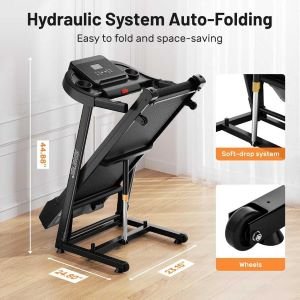
A folding treadmill hinges so the deck lifts and locks upright. The advantage is floor space: a machine that needs roughly two meters of length can occupy a smaller footprint between sessions. Limitations include a lighter frame on many models, a folding joint that must stay rigid during use, and sometimes a shorter belt. Folding suits apartments and multipurpose rooms if the deck length and motor still match the user’s stride and speed. It is a weaker choice for heavy daily running unless the specific model is built to a higher spec.
Commercial treadmills
Commercial machines are built for many users per day. They typically have heavier frames, larger rollers, longer belts, higher continuous-duty motors, and tougher belts and decks. Weight capacity is often higher. They belong in gyms, hotels, and training facilities. They are usually louder in motor character, more expensive, and heavier to move. A home user who runs hard every day may still prefer a commercial or “light commercial” machine if space and budget allow.
Curved treadmills
Most curved treadmills are non-motorized. The curved belt changes running mechanics slightly: the user must drive the belt, and speed is controlled by body position rather than a button. Energy cost is often higher at a given perceived pace because there is no motor assist. Benefits include self-paced sprint work and strong engagement of the posterior chain. Disadvantages include a learning curve, less precise pace control, and poor suitability for easy walking or for users with balance limits. Athletic programs use them for acceleration work and conditioning, not as a universal replacement for a motorized treadmill.
Under-desk and walking treadmills
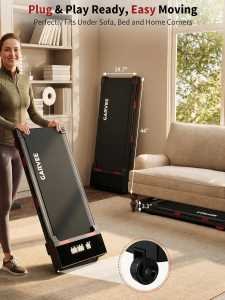
These compact machines, sometimes called walking pads, are built for slow walking while working. Speeds often top out around 4–6 km/h. Belts are shorter and narrower. They fit under a standing desk and store under furniture. They are useful for accumulating steps during desk work. They are not running machines, and their motors and decks are not designed for jogging impact.
Smart treadmills
A smart treadmill adds connectivity. Typical features include Wi-Fi or Bluetooth, app-based classes, virtual routes, streaming video, automatic workout logging, and user profiles. Some adjust speed or incline to follow a class or a target heart rate. Interactive coaching may be a recorded instructor or, on newer platforms, software that changes the workout from performance data. The hardware still has to be sound. A weak motor with a large screen is still a weak treadmill.
Type | Power source | Typical speed control | Best for | Main limitation |
Manual flat | User | Effort and resistance | Simple low-tech walking | Hard to hold a steady pace |
Curved manual | User | Body position on the curve | Athletic conditioning | Learning curve; not ideal for easy walking |
Motorized home | Electric motor | Console, precise | Walking, jogging, general running | Quality varies widely by price |
Folding | Electric motor | Console | Small homes | Often shorter belt and lighter frame |
Commercial | Electric motor, high duty cycle | Console | Gyms and heavy daily use | Cost, size, weight |
Under-desk | Small electric motor | Limited range | Walking while working | Not for running |
Smart | Electric motor plus software | Console and apps | Guided and logged workouts | Subscription features; hardware still decides durability |
Manual versus motorized
Feature | Manual | Motorized |
Pace control | User-driven, less exact | Set in small increments |
Electricity | Display only, or none | Motor draw during use |
Programs | Rare | Common |
Incline | Sometimes fixed or manual | Usually motorized |
Beginner access | Harder start | Easy slow start |
Maintenance | Fewer electrical parts | Belt, deck, motor, electronics |
Treadmill Motor and Power
Motor ratings are the most misunderstood treadmill specification. Peak horsepower is a short-burst marketing figure. Continuous horsepower, often written CHP, is the output the motor can sustain without overheating. CHP is the more useful number because a workout lasts 20 to 60 minutes, not a few seconds.
DC motors dominate home treadmills. They are efficient at variable speed and can be quiet when well built. AC motors are more common in commercial machines because they tolerate long duty cycles and frequent starts under heavy users. A home buyer does not automatically need an AC motor. Duty cycle, cooling, and build quality matter as much as the label.
Practical starting ranges, not rigid laws, look like this. Regular walking and incline walking: about 2.0 CHP and up. Jogging a few times a week: about 2.5 CHP and up. Frequent running: about 3.0 CHP and up. Heavier users, frequent intervals, or long sessions at speed: about 3.5 CHP and up. Commercial floors often use motors around 3.0 to 5.0 CHP or higher because the machine may run for many hours a day.
A heavier user increases belt load. Incline increases load further. A motor that holds 8 km/h easily on the flat may bog down at 8 km/h and 8 percent grade with a 110 kg user. Choosing a stronger motor for frequent running matters because an undersized motor runs hotter, speed drifts, and lifespan shortens.
Motor noise comes from the motor itself, the drive belt, and vibration transferred into the frame. Better cooling fans and larger housings help a motor stay within its thermal limit. Lifespan is not a fixed year count. It depends on hours, user weight, speed, incline, lubrication, and dust. A walker’s 2.5 CHP motor used 30 minutes a day can outlast a small motor used for daily sprints.
Speed and Incline
Treadmill speed is shown in kilometers per hour or miles per hour. To convert, multiply mph by 1.609 to get km/h, or divide km/h by 1.609 to get mph. A setting of 6.0 km/h is about 3.7 mph. A setting of 10 km/h is about 6.2 mph.
Useful ranges for most adults:
Easy walking: 3–4.5 km/h
Brisk walking: 5–6.5 km/h
Jogging: about 7–9 km/h
Steady running: about 9–12 km/h
Faster running and sprint work: above 12 km/h, up to the machine’s maximum, often 16–20 km/h on running-focused models
Maximum speed on the spec sheet only matters if the motor can hold it under the user’s weight. A listed 20 km/h is irrelevant if the user never exceeds 10 km/h.
Incline is expressed as percent grade, not degrees. A 5 percent grade means 5 meters of rise for every 100 meters of horizontal distance. Manual incline is a pin or knob set before the session. Automatic incline is changed from the console while moving. Many home machines offer 0 to 10 or 0 to 12 percent. Some reach 15 percent. Decline, often −2 to −3 percent, appears on fewer models and is useful for downhill-specific practice, not for everyday walking.
Incline raises intensity without requiring a faster cadence. A small grade, around 1 percent, is sometimes used to offset the lack of outdoor wind resistance, though the match is approximate. Grades of 3 to 6 percent make walking clearly harder. Grades of 8 to 12 percent are hill work. Simulated-hill programs raise and lower grade on a timer.
Examples that change the session without changing the person:
5.0 km/h at 0 percent: easy walk
5.0 km/h at 6 percent: moderate incline walk
5.5 km/h at 10 percent: hard incline walk for many adults
8.5 km/h at 1 percent: easy jog
10 km/h at 4 percent: tempo-like effort for recreational runners
12 km/h at 0 percent for 1 minute, then 6 km/h for 2 minutes: a simple interval
Treadmill Running Belt and Deck
Belt size is the usable running surface, length by width. Length matters more for running because stride lengthens with speed and height. Width matters for comfort, arm swing clearance, and users who drift sideways.
Practical guidance from equipment reviewers and sizing guides:
Walking: often adequate at about 16–20 inches wide and 50–55 inches long, or roughly 40–50 cm by 120–140 cm
Jogging: closer to 55 inches, or about 140 cm, of length
Regular running: about 20–22 inches wide and 55–60 inches long, or about 50–56 cm by 150–160 cm
Tall runners and sprint work: 60 inches, about 152 cm, or longer when available
A shorter person with a short stride can run on a slightly shorter belt. A person over about 180 cm, or anyone who overstrides, should prioritize length. Buy for the fastest pace you actually intend to use, not for the warm-up walk.
Deck thickness and cushioning change impact feel. Thicker decks with elastomers feel softer. Very soft decks can feel unstable at speed. Firm decks feel closer to a road and may suit runners who want less “mush.” Neither is universally safer. Shock absorption reduces some peak force; it does not eliminate repetitive load.
Belt texture should grip a dry shoe without being abrasive. Durability depends on the belt compound, alignment, and whether the deck is lubricated on schedule. Larger rollers, often 2.5 inches or more in diameter on better machines, flex the belt less sharply and can reduce wear and noise. Small rollers are common on compact walking pads and are a reason those machines are not for running.
Treadmill Workout Programs
Programs are patterns of speed, incline, and time. The machine may store them, or the user can run them manually. Purpose and user fit matter more than the program name.
Beginner walking program. Purpose: build a habit at low impact. Intensity: easy, conversational. User: new exercisers. Example week: five sessions of 20–30 minutes at 4–5.5 km/h and 0–2 percent, with two rest or easy off-machine days.
Fat-burning program. The useful concept is sustained moderate work plus consistency, not a special fat-only zone. A typical session is 30–45 minutes at a pace where speech is possible in short sentences, optionally with 3–6 percent incline. Suitable for people who can already walk 20 minutes comfortably.
Interval training. Warm up 5–10 minutes. Alternate a faster piece with an easy piece. Cool down 5 minutes. Example: 1 minute at 8 km/h, 2 minutes at 5 km/h, repeated six times. Suitable once a base of easy walking or jogging exists.
HIIT treadmill workout. High-intensity intervals use efforts that feel hard, near the top of what the user can repeat with good form. Example for an experienced jogger: 8 rounds of 30 seconds fast and 90 seconds easy, after a warm-up. Not a starting program.
Incline walking program. Keep speed modest and raise grade. Example: 30 minutes at 5 km/h, grade climbing from 2 to 8 percent. Useful for people who want harder work without running.
Jogging program. Continuous easy jogging, for example 20–40 minutes at 7.5–9 km/h, for users who tolerate impact.
Endurance running program. Longer steady sessions, progressing duration before speed. Suitable for recreational runners.
Hill training program. Repeats at grade, such as 6 × 2 minutes at 6 percent with easy recoveries. Builds strength-endurance.
Sprint training program. Short fast reps with full recoveries, only for users with a running base and a long enough belt.
Heart-rate-based training. Effort is guided by heart-rate zones rather than speed. Useful when heat, fatigue, or fitness changes make a fixed speed misleading.
Distance-based training. The session ends at a set distance, such as 5 km.
Time-based training. The session ends at a set time, which is easier to schedule.
Calorie-based programs. The console ends the session at an estimated calorie target. Treat the number as a rough target, not a measured energy balance.
Treadmill Workout for Beginners
A realistic start is shorter and slower than most people expect.
First day. Five minutes at 3.5–4 km/h and 0 percent. Ten minutes at 4.5–5 km/h if that still feels easy. Five minutes back at 3.5 km/h. Stop if there is chest pain, dizziness, or joint pain that changes the gait.
First week. Four sessions. Each session: 5-minute easy walk, 15 minutes brisk walk, 5-minute easy walk. Rest or do gentle mobility on the other days. Do not add incline yet.
Four-week progression.
Week 1: 20–25 minutes, flat, conversational
Week 2: 25–30 minutes, flat, or 1 percent
Week 3: 30 minutes, optional 2–3 percent for the middle 10 minutes
Week 4: 30–35 minutes, still able to speak in sentences
Increase speed by about 0.3–0.5 km/h only when the current pace feels routine. Increase incline by 1 percent at a time, and not in the same session as a speed jump. Rest days are part of the plan. Common beginner mistakes are starting at a jog, holding the rails the entire time, skipping the cool-down, and adding incline because the display calorie number looks small.
Treadmill for Weight Loss
Treadmill exercise raises energy expenditure. Weight change still depends on the full balance of intake and expenditure over weeks, not on one workout. Walking helps because people can repeat it often. Incline walking raises cost per minute without running. Jogging and running raise cost per minute further but add impact and often shorten what a new exerciser can sustain. Intervals raise average intensity if recovery is honest. Consistency and duration usually beat a single heroic session.
Calorie estimates vary with body weight, speed, incline, duration, fitness, and metabolism. The American College of Sports Medicine metabolic equations estimate oxygen cost from speed and grade, then convert oxygen cost to energy. Walking and running use different equations, and grade adds a vertical component. Console readouts are estimates. Published comparisons have found treadmill displays can overestimate expenditure, sometimes substantially, so they are poor tools for precise diet math.
A heavier person expends more energy at the same speed than a lighter person. A 5 percent grade at a walking pace can raise cost markedly compared with flat walking. None of this guarantees a specific loss of body mass. A sustainable combination of regular sessions and an eating pattern the person can keep is the practical path. This is fitness guidance, not a medical weight-loss treatment.
Treadmill Benefits
Regular treadmill walking or running can improve cardiovascular fitness, muscular endurance of the legs, and aerobic capacity when intensity and progression are appropriate. It can support weight management as one part of energy expenditure. Practical benefits are separate from those physiological effects: indoor access, independence from weather, exact speed, exact incline, repeatable workouts, and logged time and distance.
These are general fitness effects of aerobic exercise, not treatment claims. A treadmill does not diagnose, cure, or manage disease. People with medical conditions need individualized advice before using intensity, incline, or heart-rate targets as a plan.
Treadmill Technology
Displays range from simple LED windows to LCD panels and large touchscreens. Bluetooth can link a phone, headphones, or a heart-rate strap. Wi-Fi can load classes, routes, and firmware updates. Phone holders and tablet shelves are low-tech versions of the same idea.
Fitness apps may show leaderboards, scenic video, or structured classes. Heart-rate monitoring may come from metal grips, a chest strap, or an optical watch. Virtual running plays video that advances with belt speed. Interactive workouts change incline to match a recorded hill. Automatic speed adjustment, where offered, follows a class or a target zone. User profiles store weight, age, and preferred programs. Workout data may stay on the console or sync to a cloud account.
AI-style coaching, where a product offers it, is usually rule-based adjustment from recent pace or heart rate, not a medical assessment. Voice control, where offered, is a convenience layer over the same buttons. Technology changes the experience by reducing boredom and improving logging. It does not replace belt length, motor duty, or frame stiffness.
Heart-Rate Monitoring
Grip sensors in the handrails are convenient and often less accurate, especially if hands are dry, loose, or moving. Chest straps measure electrical signals and are generally the more reliable consumer option during running. Optical sensors in watches or arm bands use light and can lag or misread during interval spikes. Bluetooth monitors send the number to the console or phone.
Training zones are percentages of an estimated or measured maximum. A common simple estimate of maximum is 220 minus age, which is only a population average and can be wrong for an individual. Easy work often sits near 60–70 percent of that estimate. Moderate work sits higher. Hard intervals approach the upper range. Heart rate is a useful intensity guide when the user is healthy and the sensor is trustworthy. It is not a diagnosis. People with heart conditions, medications that alter heart rate, or symptoms during exercise should use targets only with professional advice.
Safety Features
The emergency stop is the safety key or a dedicated stop button. The key should clip to clothing so a stumble pulls it free and cuts the motor. Automatic shutdown on some models stops the belt if the key is removed or a fault is detected. Side rails help with mounting and brief balance checks. A worn, glossy belt is a slip risk. Speed controls should be reachable without leaning off the belt.
Keep children and pets away from a moving belt. Tie shoelaces. Avoid long pants that can catch. Use stable shoes with a secure heel. Leave clear space behind the machine, ideally a meter or more, so a step-off does not hit a wall. Common mistakes include starting the belt before standing on the side rails, draping the safety key over the console instead of clipping it, and letting children press buttons.
How to Use a Treadmill Correctly
Check that the belt tracks straight, the safety key works, and the area is clear.
Wear tied athletic shoes, not socks or dress shoes.
Straddle the belt, clip on the safety key, and start at a slow speed.
Step on once the belt is moving slowly.
Warm up for 5 minutes.
Raise speed in small steps.
Add incline only after posture is stable.
Stand tall, with a slight forward lean from the ankles, eyes forward, shoulders relaxed.
Let the arms swing. Use rails only for balance checks or mounting.
Cool down at an easy walk for 5 minutes.
Stop the belt and step off to the side, not off the back while it is still fast.
Foot strike should land roughly under the body, not far out in front. Breathing should stay rhythmic. If you are repeatedly hitting the front hood or sliding toward the rear roller, the speed is wrong or the stride is unstable. Slow down.
Common Treadmill Mistakes
Starting too fast leads to early fatigue and poor form. Begin in a walk. Excessive incline with a slouched posture loads the lower back and calves. Raise grade only when you can stay tall. Holding the rails constantly reduces the work of balance and can encourage a shortened, leaning stride. Touch the rails to steady, then release them. Skipping the warm-up and cool-down makes the start and finish abrupt. Overtraining is too much speed or frequency before tissues adapt. Pain that changes your gait is a stop signal, not a target. Worn or overly cushioned unstable shoes undermine the session. A dry, misaligned belt is a maintenance failure, not a fitness challenge. Running on the front third of the belt risks a trip on the hood. Phones and screens are fine if they do not steal attention from balance. A bypassed safety key removes the main emergency stop.
Home Treadmill versus Commercial Treadmill
Factor | Typical home | Typical commercial |
Price | Lower to mid | High |
Motor | DC, intermittent duty | AC or heavy DC, long duty cycle |
Frame | Lighter | Heavier, stiffer |
Belt | Often shorter on budget models | Commonly about 60 inches |
User weight rating | Must be checked; often 100–150 kg | Often higher |
Daily users | One person or a family | Many |
Noise | Varies; can be apartment-sensitive | Built for gyms, not always quiet |
Programs | Adequate on mid-range | Extensive, durable consoles |
Maintenance | Owner | Facility staff |
Warranty | Often shorter frame and motor terms | Commercial terms, still read the exclusions |
Occasional home walking can use a basic folding or walking-focused machine if the weight rating is honest. Daily home workouts need a mid-range motor and a stable frame. Serious runners need belt length and continuous power. Families need a weight rating that covers the heaviest user and a safety key children cannot defeat. Fitness centers need commercial duty cycles. Professional athletes need the belt length and speed ceiling of a performance machine, motorized or curved, matched to the session.
How to Choose the Right Treadmill
Decide the job before the brand. Budget sets the ceiling, but an under-spec machine is poor value. Check continuous motor power, not only peak. Match belt length and width to height and intended speed. Confirm maximum speed only if you will use it. Prefer motorized incline if you want hills. Weight capacity should exceed the user’s weight with margin. Cushioning is a preference: test if possible. Folding matters only if the room requires it. Noise matters in apartments. The console should be readable; programs are secondary to hardware. Connectivity is optional. Warranty should cover frame, motor, and parts separately, and the seller should be able to supply a belt and lubricant later.
Floor space includes the machine footprint plus clearance behind and to the sides. A folding deck still needs room to unfold. Recommendations by profile: a walking pad for desk steps; a 2.0–2.5 CHP folding machine for occasional home walking; a 3.0 CHP machine with a roughly 55–60 inch belt for regular home running; a heavier commercial-style unit for multi-user or high-mileage homes.
Treadmill Price and Value
Prices move with region, currency, and year, so a single figure would mislead. The useful split is by what the money buys.
Budget machines typically offer smaller motors, shorter belts, lighter frames, and basic consoles. They can be reasonable for slow walking. Mid-range home machines are where running becomes realistic: stronger continuous power, longer belts, better decks, and longer warranties. Premium home machines add stiffer frames, larger rollers, quieter drives, decline, and larger screens. Commercial machines add duty cycle and serviceability. Paying more should buy thermal headroom, belt length, frame rigidity, and parts support. It should not be spent only on a larger display.
Treadmill Maintenance
After each use: wipe sweat from the console and rails. Sweat is corrosive.
Weekly: vacuum under the machine and around the motor cover vents. Dust is a common cause of heat.
Every 1–3 months, or by the manual’s hours: lubricate the deck if the manufacturer specifies a silicone or wax product. Over-lubricating can be as bad as under-lubricating. Follow the model’s interval.
Monthly: watch the belt. If it drifts, adjust the rear roller bolts in small quarter-turns while the belt runs slowly, per the manual.
As needed: set belt tension so it does not slip underfoot but is not drum-tight.
A few times a year: inspect the deck for worn spots, check rollers for noise, and confirm the safety key catches.
Electrical inspection and motor opening belong to a qualified technician.
Noise that appears suddenly after a quiet history is a maintenance clue, not a reason to add speed.
Common Treadmill Problems and Troubleshooting
Belt slipping. Causes: low tension, dry deck, worn belt. Safe step: check tension and lubrication schedule. If it persists, stop using it.
Belt stopping underfoot. Causes: tension, worn deck, motor or controller fault. Do not keep running on it.
Belt drifting sideways. Causes: uneven floor, unequal roller adjustment. Safe step: level the machine, then small tracking adjustments.
Excessive noise. Causes: dry belt, loose hardware, worn bearings, motor. Tighten visible external hardware only. Internal motor noise needs service.
Motor overheating and shutdown. Causes: blocked vents, undersized motor, long high-load use. Clear vents and reduce grade or duration. Repeated shutdowns need service.
Error codes. Record the code and consult the manual. Do not clear codes by opening the controller.
Incline not working. Causes: calibration drift, incline motor, obstructed lift. Recalibrate only if the manual describes it. Keep hands clear of the lift mechanism.
Console dead. Causes: power cord, switch, safety key, breaker, failed board. Check the outlet and key first.
Speed fluctuations. Causes: slipping drive belt, controller, heavy load. Stop if speed surges.
Burning smell. Stop immediately. Unplug. This can be a belt, deck, or electrical fault. Do not restart.
Do not open motor housings or control boards without the proper expertise. Stored energy and mains voltage are not user-service items.
Treadmill Noise
Motor hum rises with speed and load. Belt hiss often means a dry deck. Roller rumble can be bearings. Deck creaks can be loose cushions. Vibration becomes floor noise when the machine sits on a hollow wooden floor. A thick treadmill mat reduces some transmitted vibration. Placing the machine on a solid floor, away from a shared wall, helps apartments. Loose bolts and a misaligned belt are free fixes. A cheap motor at high speed will not become quiet through software.
Treadmill Electricity Consumption
Nameplate horsepower is not the same as watts drawn at the wall. Energy in kilowatt-hours is watts times hours divided by 1,000. Reported averages for motorized treadmills often fall around several hundred watts in ordinary use, with higher draw at speed and incline. One published measurement on a home machine showed roughly 100 watts at a very slow walk and roughly 700 watts at 10 mph, with walking speeds in between. Other summaries place moderate use near 600–700 watts, and hard running or steep incline can reach well above 1,000 watts on larger motors. Manual machines draw essentially only display power.
Example, labeled as an assumption, not a universal figure: if a session averages 600 watts for 0.5 hours, energy use is 0.3 kWh. At a tariff of 0.20 currency units per kWh, that session costs 0.06 currency units. Speed, incline, user weight, belt condition, and motor efficiency all move the real number. A plug-in meter is the accurate method for a specific machine.
Treadmill versus Outdoor Running
The belt is uniform. Outdoor surfaces vary. Weather is irrelevant indoors and decisive outdoors. Pace is exact on a treadmill and approximate outdoors unless a measured course and a watch are used. Incline is selected indoors. Terrain, wind, and direction changes are outdoor features. Treadmill running lacks air resistance, which is why a slight grade is sometimes added. Joint loading differs with surface, shoes, and speed; a cushioned deck is not automatically gentler than a good path, and it is not automatically harder. The treadmill is better for controlled intervals, dark or extreme weather, and traffic-free sessions. Outdoor running is better for race-specific terrain, heat and wind practice, and for many people, enjoyment. Serious race preparation usually includes some outdoor running if the event is outdoors.
Treadmill Walking versus Running
Factor | Walking | Jogging / running |
Typical speed | Under about 6.5 km/h | About 7 km/h and up |
Energy per minute | Lower | Higher |
Impact | Lower | Higher |
Sustainable duration | Often longer | Often shorter for new users |
Belt length needed | Shorter acceptable | Longer preferred |
Main goal fit | Habit, lower impact, incline work | Speed, race fitness, higher cost per minute |
Walking is the better default for beginners, many older adults, and joint-sensitive users. Running fits users with a base of easy work who want speed. Incline walking can sit between them in energy cost.
Treadmill Training for Different Users
Beginners should walk, progress duration first, and keep effort conversational. Older adults often do well with slower speeds, rails available for mounting, and shorter sessions accumulated across the week, assuming balance is stable and a clinician has not advised otherwise. Busy professionals can use 25–35 minute time-based sessions or a walking pad for steps, rather than waiting for a perfect hour. Weight-management users benefit more from repeatable moderate sessions than from rare maximal ones. Recreational runners can mix easy treadmill miles with one quality session. Serious runners can use the treadmill for precise intervals and bad-weather endurance, while keeping outdoor strides if they race on roads. Athletes may add curved-treadmill accelerations. Home users should match machine spec to the hardest session they actually do. None of these patterns is a medical prescription.
Treadmill Accessories
A chest-strap heart-rate monitor is useful if zones matter. A watch is enough for many people. A treadmill mat protects floors and cuts some vibration. A bottle holder matters for sessions over about 30 minutes. A tablet shelf is optional. Bluetooth headphones reduce cable risk. Silicone lubricant specified by the manufacturer is maintenance, not an accessory fad. A small fan improves comfort in warm rooms. Extra shock pads are optional and can change the feel in ways the frame was not designed for. Skip anything that blocks the safety key or narrows the step-off space.
Future of Treadmill Technology
Current, widely available features include app classes, automatic incline profiles, heart-rate display, and cloud logs. Emerging or still uneven features include richer AI coaching, treadmill-scale virtual reality, denser biometric sensing, and tighter links to watches and health platforms. More efficient motors and better cushioning materials are incremental hardware trends, not a new category. Data-driven training is only as good as the sensor and the user’s willingness to recover. Treat marketing claims of medical-grade insight as product claims unless a given device has been independently validated for that use.
Comparison Tables
Walking, jogging, and running speeds
Mode | Approx. speed | Session priority | Machine need |
Walk | 3–6.5 km/h | Time and posture | Modest motor, shorter belt acceptable |
Jog | 7–9 km/h | Easy continuous work | Mid motor, mid belt |
Run | 9–14 km/h | Endurance or tempo | 3.0 CHP class, 55–60 inch belt |
Sprint reps | 14 km/h and up | Short repeats, full rest | Strong motor, long belt |
Programs at a glance
Program | Main variable | Who it fits |
Beginner walk | Time at easy pace | New users |
Incline walk | Grade | Users avoiding running |
Intervals | Work and rest | Users with a base |
Endurance | Duration | Recreational runners |
Hills | Grade repeats | Strength-endurance |
Heart-rate | Zone | Users with a reliable sensor |
Buying specifications
Spec | What to prefer |
Motor | CHP matched to speed and weight |
Belt | Length for stride, width for comfort |
Incline | Motorized if hills are wanted |
Capacity | Above user weight |
Warranty | Separate frame, motor, parts |
Space | Footprint plus rear clearance |
Problems and first response
Problem | First safe response | Service if |
Slip | Tension and lube check | It continues |
Drift | Level, then track | Adjustment fails |
Heat shutdown | Clear vents, reduce load | It repeats |
Burn smell | Stop and unplug | Always |
Dead console | Outlet, cord, safety key | Those check out |
Frequently Asked Questions
- What is a treadmill?
A stationary machine with a moving belt used for walking, jogging, or running in place. Motorized models set the belt speed. Manual models rely on the user to move the belt. - What are the main types of treadmills?
Manual, curved manual, motorized home, folding, commercial, under-desk walking pads, and connected “smart” models. The motor and belt size matter more than the marketing category. - Is a treadmill good for beginners?
Yes, if the first sessions are walks, the safety key is used, and speed rises slowly. It is a poor beginner tool if the first session is a run. - Is walking on a treadmill effective?
Yes for aerobic base, step volume, and, with incline, higher intensity at low impact. Effectiveness depends on regularity, not on a single long session. - Is running on a treadmill different from outdoor running?
Yes. There is no wind, the surface is uniform, and pace is fixed by the motor. A slight incline is sometimes used to approximate outdoor effort. Race preparation for an outdoor event should include some outdoor running. - What treadmill speed is good for beginners?
Often 4–5.5 km/h. The right speed is the one that stays conversational for the planned duration. - What incline should beginners use?
Zero to 1 percent until walking form is stable. Add 1 percent at a time in later weeks. - How long should you use a treadmill?
A practical start is 20–30 minutes including warm-up and cool-down, several days a week. Longer sessions are reasonable once recovery is normal. Daily use is fine at easy intensity for many walkers. - Can a treadmill help with weight management?
It can increase energy expenditure. It does not override intake, and console calories are estimates. Consistent moderate sessions are more useful than sporadic maximal ones. - How much electricity does a treadmill use?
It depends on speed, incline, weight, and the machine. Ordinary motorized use is often in the hundreds of watts. Energy equals watts times hours divided by 1,000. A wall meter gives the true figure for a given unit. - How often should a treadmill belt be lubricated?
Only as the manufacturer specifies, commonly every few months or after a set number of hours or miles. Some belts are pre-waxed and use a different interval. Too much lubricant attracts dirt. - What treadmill motor power do I need?
Prefer continuous horsepower. About 2.0 CHP and up for walking, 2.5 and up for light jogging, 3.0 and up for regular running, and more for heavy users or hard intervals. Peak horsepower alone is a weak guide. - What belt size should I choose?
Walkers can use shorter belts. Runners should look for about 20 inches of width and 55–60 inches of length, longer if they are tall or sprint. - Are folding treadmills good?
They are good when space is the constraint and the belt and motor still match the workout. They are a compromise if the fold forces a short deck or a light frame. - Are curved treadmills better?
Better for self-powered athletic work. Not better for precise easy walking, beginners who need a slow start, or users who want exact pace. - What is the difference between commercial and home treadmills?
Commercial machines are built for many hours and many users, with heavier frames and higher-duty motors. Home machines are built for intermittent use by one household. A strong home machine can still serve a serious individual runner. - What are the most important treadmill safety features?
A working safety key clipped to clothing, an obvious stop control, stable rails for mounting, a non-slip belt, and clear space behind the deck. - Do treadmill calorie displays measure calories?
No. They estimate from speed, time, and sometimes entered weight. Independent comparisons have found displays can overestimate. Use them for session-to-session comparison, not for exact energy accounting. - Can older adults use a treadmill?
Many can, at walking speeds, with a rail available for getting on and off, if balance is adequate. Medical advice is appropriate when there is cardiovascular disease, recent falls, or medication that affects heart rate or balance. - Why does my treadmill smell hot?
A light warm smell on a new belt can occur during early use. A sharp burning smell means stop, unplug, and have it checked. Do not open the motor housing to investigate.
A treadmill is a controllable surface, not a fitness outcome by itself. The useful machine is the one whose continuous motor power, belt length, weight rating, and frame match the hardest session you will actually repeat. Walkers can choose simpler, shorter machines. Runners should spend on belt length and sustained power before they spend on screen size. Training starts slower than ambition suggests, progresses by minutes and small speed or grade changes, and keeps the safety key in the circuit. Maintenance is mostly cleanliness, correct lubrication, and belt tracking. Electricity use is real but usually modest next with the cost of the machine, and it should be calculated from measured watts rather than from horsepower labels. Outdoor running still has a place when terrain and weather are part of the goal. Selected and used this way, a treadmill is a durable tool for consistent aerobic work in any season. -
 |  |  |