What Is Air Force One?
Few aircraft in the world attract as much attention as the plane that carries the President of the United States. When the blue-and-white Boeing 747 climbs into the sky, it is far more than a mode of transport. It functions as a mobile workplace, a secure communications hub, a symbol of national leadership, and one element of continuity-of-government planning. It is often described as the President’s flying White House because it allows the commander-in-chief to remain connected and operational while traveling anywhere on the planet.
Air Force One is a radio call sign, not the permanent name of one specific airplane. Any U.S. Air Force aircraft carrying the sitting president uses the call sign Air Force One. In everyday usage, however, the name is associated with two specially modified Boeing 747-200B aircraft designated VC-25A, with tail numbers 28000 and 29000. These planes have served presidents since 1990 and are operated by the Presidential Airlift Group of the 89th Airlift Wing at Joint Base Andrews, Maryland. Since 2026 an interim modified Boeing 747-8 aircraft, sometimes called the VC-25B Bridge, has also supported presidential missions while the longer-term VC-25B replacement program continues.
What makes these aircraft different from ordinary passenger airliners is the integration of aviation engineering, secure communications systems, redundant power and flight systems, specialized interiors, and extensive coordination with security and logistics organizations. The plane must keep the president safe, able to communicate, and able to continue official duties while airborne. This article examines the history, technical specifications, publicly documented technology, crew, costs, operational realities, and future of the aircraft that supports the U.S. presidency.
The History of Air Force One
Presidential air travel developed gradually from wartime necessity into a permanent specialized capability.
Before dedicated presidential aircraft, presidents traveled primarily by train or ship. Franklin D. Roosevelt became the first sitting president to fly while in office. Near the end of World War II, the Secret Service modified a Douglas C-54 Skymaster (designated VC-54C) with special features, including a wheelchair lift. Nicknamed the Sacred Cow, the aircraft carried Roosevelt to the Yalta Conference in 1945. Harry S. Truman used the same plane extensively afterward. Truman signed the National Security Act of 1947 aboard the Sacred Cow, formally creating the U.S. Air Force as a separate service.
Truman later received a Douglas VC-118 (based on the DC-6) named Independence after his Missouri hometown. Dwight D. Eisenhower used Lockheed Constellation variants known as Columbine II and Columbine III. The call sign “Air Force One” originated in the early 1950s after a potential radio confusion between Eisenhower’s aircraft and a commercial flight that shared a similar numerical identifier based on the presidential plane’s tail number. The new call sign removed ambiguity for air traffic control.
Eisenhower also became the first president to fly in a jet when he boarded a Boeing 707-based VC-137A in 1959. Under John F. Kennedy, the Air Force received the first jet built specifically for presidential service: the VC-137C Boeing 707 with tail number 26000. Its blue-and-white livery, developed with industrial designer Raymond Loewy, became the visual standard for presidential aircraft. The plane carried Kennedy to Dallas on November 22, 1963; Lyndon B. Johnson took the oath of office aboard it after the assassination. A second VC-137C (tail number 27000) entered service later and served multiple presidents until the introduction of the 747-based aircraft.
By the late 1980s the aging 707s no longer met requirements for range, capacity, and modern systems. The Reagan administration selected the Boeing 747-200B platform. Two heavily modified aircraft, designated VC-25A, were delivered in 1990. The first (tail number 28000) flew as Air Force One on September 6, 1990, carrying President George H. W. Bush. The second (tail number 29000) entered service the following year. These aircraft have served every president since.
Period or Year | Aircraft or Development | President or Historical Context | Importance |
1945 | Douglas VC-54C Sacred Cow | Franklin D. Roosevelt / Harry S. Truman | First dedicated presidential aircraft; used for Yalta; National Security Act signed aboard |
1947–1953 | Douglas VC-118 Independence | Harry S. Truman | Improved range and comfort over Sacred Cow |
1953–1961 | Lockheed VC-121 Columbine II & III | Dwight D. Eisenhower | Last primary piston-engine presidential aircraft; call sign Air Force One introduced |
1959 | Boeing VC-137A (707) | Dwight D. Eisenhower | First presidential jet flight |
1962–1990s | Boeing VC-137C (707) SAM 26000 & 27000 | Kennedy through George H. W. Bush | Iconic blue-and-white livery; carried Kennedy to Dallas; long service life |
1990–present | Boeing VC-25A (747-200B) | George H. W. Bush onward | Current primary aircraft; in-flight refueling, advanced communications |
2026–present (interim) | Modified Boeing 747-8 Bridge aircraft | Recent presidential travel | Temporary capacity while VC-25B program continues |
What Aircraft Are Used as Air Force One Today?
The call sign Air Force One applies to any U.S. Air Force aircraft carrying the president. The primary aircraft for long-range presidential travel are the two VC-25A planes, which are extensively modified Boeing 747-200B airframes. The 747 platform was chosen in the 1980s because it offered greater range, payload, and interior volume than the earlier 707s, along with the structural capacity for extensive mission equipment.
Two aircraft are maintained so that one can be available while the other undergoes maintenance. Supporting aircraft include the C-32 (modified Boeing 757), which is used for shorter flights, airports with shorter runways, or when the vice president travels (the call sign then becomes Air Force Two). The C-32 is not Air Force One unless the president is aboard. Additional support comes from cargo aircraft that preposition vehicles, helicopters, and equipment, and from Marine Corps helicopters (Marine One when the president is aboard).
A modified Boeing 747-8 aircraft gifted by Qatar and converted for interim presidential use entered service in 2026. It is referred to as a Bridge aircraft while the two purpose-built VC-25B aircraft (also based on the 747-8) continue through modification and testing. As of late 2026, the first fully modified VC-25B is projected for delivery in 2028, with the second following later.
Aircraft | Base Platform | Primary Role | Notes |
VC-25A | Boeing 747-200B | Primary presidential transport | Two aircraft (28000, 29000); in service since 1990 |
VC-25B | Boeing 747-8 | Replacement presidential transport | Two aircraft under modification; deliveries delayed to 2028–2029 |
VC-25B Bridge | Modified Boeing 747-8 | Interim presidential support | Converted Qatari VIP aircraft; entered service 2026 |
C-32 | Boeing 757-200 | Secondary / vice-presidential transport | Smaller airfields; Air Force Two when VP aboard |
Air Force One: Technical Specifications and Performance
The VC-25A is based on the commercial Boeing 747-200B but differs significantly in systems and configuration. Official U.S. Air Force figures list the following primary characteristics:
Manufacturer / platform: Boeing (modified 747-200B)
Designation: VC-25A
Length: 231 feet 10 inches (70.7 meters)
Wingspan: 195 feet 8 inches (59.6 meters)
Height: 63 feet 5 inches (19.3 meters)
Engines: Four General Electric CF6-80C2B1 turbofans, each rated at 56,700 pounds of thrust
Maximum takeoff weight: 833,000 pounds (374,850 kilograms)
Speed: 630 miles per hour (Mach 0.92)
Service ceiling: 45,100 feet (13,746 meters)
Range: 7,800 statute miles (6,800 nautical miles / 12,550 kilometers) without refueling
Crew: Approximately 26–30 (flight deck, communications, cabin, maintenance, and security personnel)
Passenger capacity: Up to roughly 70–100 depending on configuration (official figures have listed both 71 passengers with 30 crew and total capacity around 102)
The wingspan requires careful airport planning because many smaller fields cannot accommodate it. High maximum takeoff weight means long runways and careful fuel and payload calculations. Range figures represent typical published values; actual performance varies with payload, winds, altitude, and reserves. In-flight refueling capability extends operational flexibility beyond the published range.
Fuel capacity is not listed in the official fact sheet. Secondary sources place it near 53,600 U.S. gallons for the modified 747-200 airframe, but this should be treated as an estimate. Electrical generation, flight controls, and navigation systems have been extensively upgraded relative to a standard 747-200, though exact configurations remain limited in public detail.
Inside Air Force One: A Flying White House
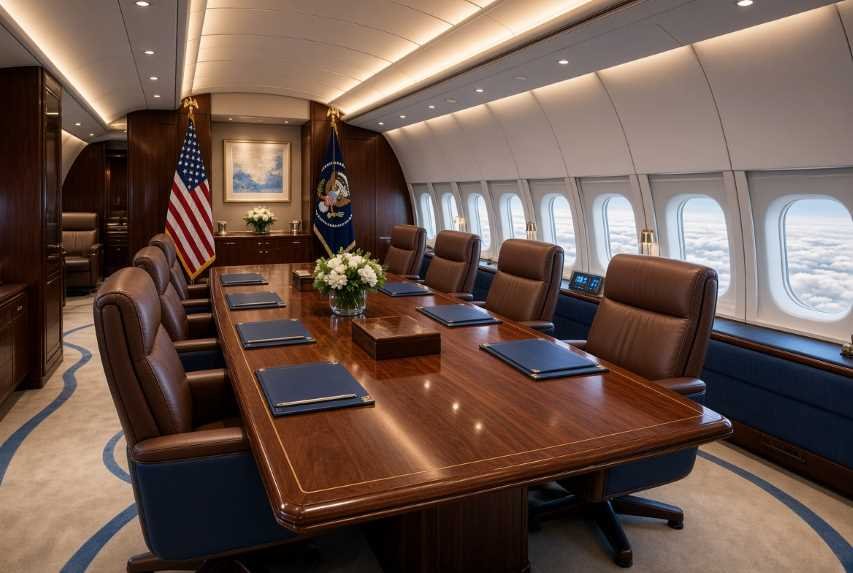
Public descriptions of the VC-25A interior include a presidential suite with a stateroom (dressing room, lavatory, and shower) and office, a conference/dining room, separate areas for senior staff, Secret Service and security personnel, and traveling press. Two galleys can prepare up to 100 meals. Six passenger lavatories, including accessible facilities, are provided, along with a rest area for the aircrew. A medical compartment contains equipment for minor emergencies; a physician typically travels with the presidential party.
These spaces balance work, rest, and security rather than pure luxury. The aircraft is not configured as a private jet with a single large cabin; different sections serve different functions. Exact floor plans and some room details are not publicly released. Commercial depictions in films or media should not be treated as accurate representations of the operational aircraft.
Advanced Aviation and Engineering Technology
The VC-25A retains the basic 747-200 structure but incorporates numerous modifications. Self-contained front and aft airstairs and a baggage loader allow operations at airfields with limited ground equipment. In-flight refueling capability is a major difference from standard commercial 747s. Electrical power systems, environmental controls, and cabin pressurization support long-duration missions.
Redundancy is fundamental. Critical systems such as flight controls, electrical generation, hydraulics, and communications have backups so that a single failure does not end the mission. Integrating modern equipment into an older airframe presents ongoing maintenance and certification challenges. Compared with a modern commercial airliner, the VC-25A trades some efficiency and simplicity for mission-specific systems and durability.
Secure Communications and the President’s Ability to Govern From the Air
One of the most important features is the ability to maintain secure communications with the White House, military command centers, and officials worldwide. Public information confirms the presence of advanced voice, data, and satellite communications systems, along with redundant channels. These capabilities allow the president to receive briefings, consult advisers, and issue decisions while airborne.
Exact frequencies, encryption methods, and network architecture are not public. Connectivity challenges over oceans or in remote areas are addressed through multiple systems, including satellite links. On September 11, 2001, communications limitations and the need for reliable contact influenced decisions about routing and landing sites.
Presidential Security and Defense Systems
Security involves far more than the aircraft itself. Controlled access, personnel screening, threat assessment, flight planning, and coordination with the Secret Service, military units, and local authorities form a layered system. The aircraft itself is equipped with self-defense systems; publicly referenced equipment has included infrared countermeasures. Claims about electromagnetic pulse hardening and other features appear in analytical reporting but should be treated cautiously because detailed configurations are not confirmed in open sources.
The plane does not operate independently. Ground support, escort aircraft when required, intelligence, and contingency planning are essential. Cybersecurity of aircraft systems and communications is an increasing concern for all modern aviation, including presidential aircraft.
Who Works on Air Force One?
A presidential mission involves multiple teams:
Pilots and aircraft commanders selected for experience and reliability
Flight engineers and navigators (still relevant on the VC-25A)
Cabin crew
Communications specialists
Maintenance technicians
Medical personnel
Secret Service and other security professionals
Presidential aides and staff
Traveling press when applicable
Ground support and logistics teams prepare the aircraft and destination. Preflight inspections, weather analysis, fuel planning, and equipment checks are rigorous. Total personnel numbers vary by mission; not everyone travels on the presidential aircraft itself.
How Air Force One Flights Are Planned
Planning begins well in advance. Route selection considers weather, airspace, fuel, and airport suitability. International trips require diplomatic clearances. Support aircraft preposition vehicles, helicopters, and equipment. Contingency airfields are identified. Security coordination occurs at every stage.
For a hypothetical trip from Washington, D.C., to a foreign capital, planners would assess the primary airport, alternate fields, tanker availability if needed, medical support, communications coverage, and local security arrangements. Weather forecasts, aircraft maintenance status, and crew rest requirements are integrated. The process involves aviation specialists, diplomats, security organizations, and local authorities.
How Much Does Air Force One Cost?
There is no single cost figure for presidential travel. Direct aircraft operating costs differ from full mission costs that include support aircraft, security, and logistics.
The U.S. Air Force has reported an average cost per flying hour for the VC-25A of $177,843 in fiscal year 2021. This figure includes fuel, consumables, and overhaul costs. Earlier reported figures were higher. Acquisition and modification costs for the original VC-25A aircraft were substantial; the current VC-25B program was originally a fixed-price contract of roughly $3.9 billion, though Boeing has recorded more than $3 billion in losses and total program costs have risen.
Cost Category | What It Includes | Published Estimate or Cost Figure | Year and Source |
VC-25A cost per flying hour | Fuel, consumables, overhaul | $177,843 | FY2021, U.S. Air Force |
VC-25B original contract | Modification of two 747-8 airframes | ~$3.9 billion (fixed price) | 2018 |
VC-25B cumulative contract value (with modifications) | Development, spares, test support | Exceeds $4.5 billion | 2026 |
Full trip costs | Aircraft + support aircraft + security + logistics | Varies widely; multi-million dollar range for international trips | GAO and other analyses |
Full trip costs are higher because cargo aircraft, helicopters, ground vehicles, and security teams are required. Direct operating costs are only one part of the total.
Air Force One vs. Commercial Passenger Aircraft
The VC-25A shares its basic airframe with the commercial Boeing 747-200B but differs in nearly every operational respect.
Characteristic | VC-25A | Typical Commercial Boeing 747-200 / modern widebody |
Mission | Presidential transport & communications | Passenger or cargo revenue service |
Engines | 4 × GE CF6-80C2B1 (56,700 lbf) | Similar or newer engines |
Range | 7,800 statute miles + refueling | Comparable unrefueled; no standard aerial refueling |
Passenger capacity | ~70–100 configured for work | 300–400+ in high-density |
Communications | Secure multi-channel systems | Standard airline systems |
Self-defense / airstairs | Yes | No |
Crew | Specialized presidential crew | Airline crew |
The presidential aircraft prioritizes reliability, communications, and security over seat-mile economics.
Air Force One and Other Government Aircraft Around the World
Many countries maintain specialized aircraft for their leaders, though scale and requirements differ.
France: Airbus A330 and Dassault Falcon aircraft; call sign Cotam Unité.
Germany: Airbus A350-900s for the chancellor and president.
United Kingdom: Airbus A330 MRTT (capable of dual tanker/transport roles).
Russia: Ilyushin Il-96-300PU variants.
China: Boeing 747-8 aircraft operated in Air China markings for the president.
India: Boeing 777s.
Japan: Boeing 777-300ER aircraft for the emperor, prime minister, and senior officials.
Direct comparison is difficult because of differences in geography, budgets, threat environments, and frequency of long-range travel. The U.S. aircraft are among the most extensively modified for communications and self-sufficiency.
Air Force One During Wars, Emergencies, and National Crises
The aircraft is one component of continuity-of-government planning. It provides a secure location from which the president can communicate and make decisions when ground locations are compromised.
On September 11, 2001, President George W. Bush was in Florida when the attacks began. He boarded a VC-25A, which departed Sarasota and flew to Barksdale Air Force Base in Louisiana for refueling, then to Offutt Air Force Base in Nebraska (home of U.S. Strategic Command) for more robust communications. Fighter escorts were later provided. Decisions were made aboard the aircraft while information remained incomplete. The plane returned to Washington that evening. This episode illustrated both the value of airborne mobility and the limitations of communications and fuel in a fast-moving crisis.
The aircraft does not independently “run the government.” It is one element within a larger system of command, control, and contingency arrangements.
Environmental Impact and Fuel Efficiency
Large four-engine aircraft consume substantial jet fuel. A modified 747-200 burns thousands of gallons per hour depending on weight, altitude, and speed. Carbon dioxide emissions scale with fuel burn. Support aircraft add further emissions. Comparisons with commercial flights are imperfect because presidential missions carry fewer passengers, fly with different payloads, and include extensive support operations.
Future improvements could come from more efficient engines on the VC-25B, sustainable aviation fuels, optimized routing, and predictive maintenance that reduces unnecessary flights. Specialized government aviation faces practical limits on emissions reductions because mission requirements take priority over pure efficiency.
The Next Air Force One: VC-25B and Future Presidential Aviation
The VC-25A fleet, now more than 35 years old, requires replacement. The VC-25B program modifies two Boeing 747-8 Intercontinental airframes. Expected improvements include more efficient engines (GE GEnx-2B), greater range, modern systems, and updated interiors and communications. Dimensions are larger: length approximately 250 feet 2 inches (76.3 meters) and wingspan approximately 224 feet 7 inches (68.4 meters). Maximum takeoff weight is higher at 987,000 pounds.
Original delivery was planned for 2024. As of late 2026, the first aircraft is projected for mid-2028 and the second later. Boeing has recorded significant losses on the fixed-price contract. A Qatari-gifted 747-8 was modified by L3Harris and entered interim service in 2026 as a Bridge aircraft. Program status was verified through 2026 reporting from defense and aviation sources; schedules remain subject to change.
The new aircraft will still require extensive testing, certification, and crew training before full operational use.
Common Myths and Interesting Facts About Air Force One
- Myth: Air Force One is a single permanent aircraft.
Fact: It is a call sign. Two VC-25A aircraft and, recently, an interim 747-8 have served. - Myth: It is simply a luxury Boeing 747.
Fact: It is a heavily modified military aircraft with specialized systems. - Myth: It can remain airborne indefinitely.
Fact: In-flight refueling extends endurance, but practical limits on crew rest, supplies, and maintenance remain. - Myth: Its entire technical configuration is publicly known.
Fact: Many systems and interior details are not released. - Myth: Operating costs can be summarized by one number.
Fact: Aircraft hourly costs differ from full mission costs. - Myth: Every aircraft carrying a senior official uses the Air Force One call sign.
Fact: Only when the president is aboard.
Interesting facts: The blue-and-white livery dates to the Kennedy era. The Sacred Cow was the first dedicated presidential aircraft. In-flight refueling and self-contained airstairs distinguish the VC-25A from commercial 747s.
The Strategic and Diplomatic Importance of Air Force One
Reliable long-range transportation enables presidential travel for summits, state visits, and crisis response. The aircraft’s arrival is itself a form of public diplomacy and media attention. Secure communications support decision-making far from Washington. While the plane is a powerful symbol, its practical value lies in the combination of mobility, connectivity, and security coordination rather than in the aircraft alone.
The Future of Presidential Aviation
Beyond the VC-25B, longer-term trends include improved satellite communications, stronger cybersecurity, greater use of sustainable aviation fuels, digital engineering, and predictive maintenance. Automation and advanced avionics will continue to evolve, but reliability, security, and maintainability will remain primary requirements. Major technical changes must be introduced carefully so that operational readiness is preserved.
More Than an Aircraft
Air Force One is unique because it combines aviation engineering, secure communications, specialized security arrangements, professional crews, and extensive logistics into a single operational system. Its significance does not rest only on size, speed, or interior space. It rests on the ability to keep the president safe, connected, and able to exercise the responsibilities of the office while traveling. As a transportation platform, a mobile workplace, and one element of national crisis preparedness, it illustrates how technology, organization, and national leadership intersect in practice.
 |  |  |