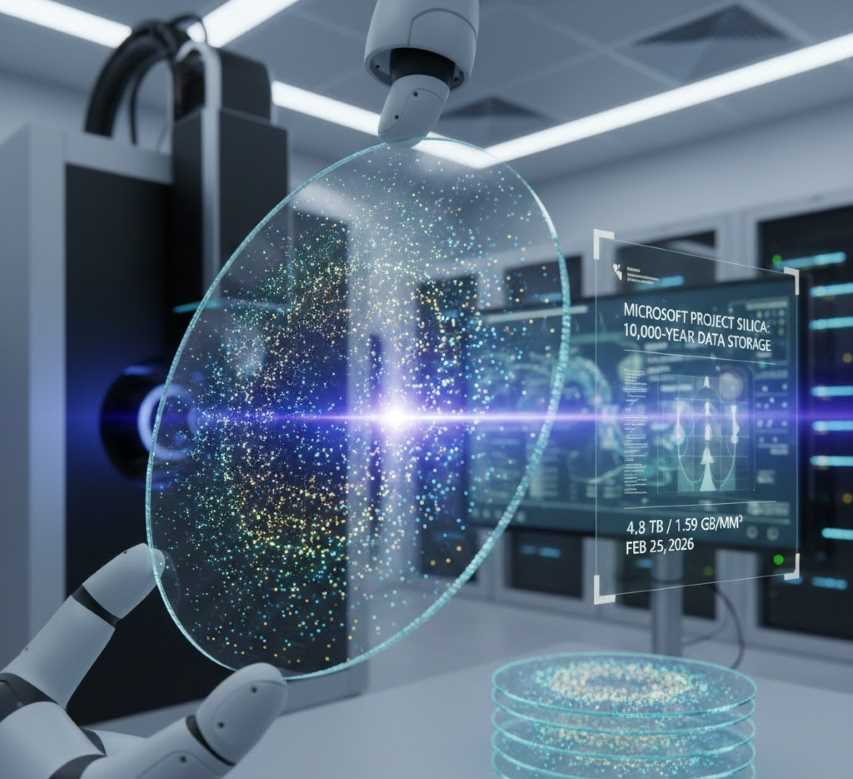
In one of the most exciting advances in archival technology in decades, Microsoft Research has unveiled a groundbreaking method that converts everyday borosilicate glass—the durable, heat-resistant material found in Pyrex cookware and laboratory glassware—into a high-capacity storage medium capable of preserving digital data for at least 10,000 years without degradation.
Published on February 18 in the prestigious journal Nature, the peer-reviewed paper details the latest milestone in Project Silica, Microsoft’s ambitious initiative to develop a sustainable, cloud-native archival storage solution using femtosecond lasers to etch data permanently into glass.
The Growing Crisis of Digital Preservation
Humanity is generating data at an unprecedented rate. Global data volumes are projected to more than double every two years, with hyperscale data centers already consuming vast amounts of electricity just to keep information alive. Traditional storage solutions—hard disk drives, solid-state drives, and magnetic tapes—typically last between five and thirty years before they begin to fail, forcing constant, energy-intensive data migration cycles that create massive electronic waste and carbon emissions.
Microsoft estimates that the cost and environmental impact of repeatedly refreshing archival data could become unsustainable as exabytes of scientific records, cultural heritage, government documents, and personal memories accumulate. Enter a passive, electricity-free medium that requires no maintenance once written: glass.
Project Silica: From Concept to Breakthrough
Launched nearly a decade ago, Project Silica set out to create the world’s first storage technology designed from the ground up for the cloud. Earlier prototypes relied on expensive fused silica (quartz glass), achieving impressive densities but facing barriers in cost and material scalability.
The new breakthrough eliminates those obstacles by successfully encoding data into ordinary borosilicate glass. A single square platter measuring 120 millimeters on each side and just 2 millimeters thick—roughly the size of a large coaster—can now hold 4.8 terabytes of data across 301 densely packed layers. That equates to approximately 1.59 gigabits per cubic millimeter, enough to store the equivalent of two million printed books or roughly 200 high-definition four-kilowatt movies.
How the Technology Works: Precision Lasers and Intelligent Decoding
At the heart of the system is a femtosecond laser—firing pulses just one quadrillionth of a second long—that creates microscopic three-dimensional voxels (volume pixels) deep inside the glass by permanently altering its optical properties. These voxels can be written with a single laser pulse, dramatically simplifying the process compared to previous multi-pulse techniques.
Writing speeds reach 25.6 megabits per second per beam, with researchers demonstrating parallel writing using multiple beams to achieve up to 65.9 megabits per second without thermal damage. Energy efficiency is an impressive 10.1 nanojoules per bit. For reading, an automated microscope equipped with a high-resolution camera (now reduced to a single camera for lower cost and complexity) captures layered images. Sophisticated machine-learning algorithms then decode the patterns, applying advanced error-correcting codes to recover data with perfect fidelity.
The latest improvements also simplify manufacturing: fewer moving parts in the write head make the system easier to calibrate and scale for data-center deployment.
Extraordinary Durability That Defies Time
Borosilicate glass is extraordinarily resilient. It shrugs off water, extreme heat, dust, electromagnetic pulses, and magnetic fields that would instantly destroy conventional drives. To prove longevity, the team developed new accelerated aging tests, heating samples to 290 degrees Celsius (554 degrees Fahrenheit) for extended periods. Extrapolating the results, they confidently project data stability for more than 10,000 years at ambient room temperature—with some models suggesting even longer lifespans.
Once written, the data is immutable—a true Write-Once, Read-Many format ideal for long-term archives where tampering or accidental erasure must be impossible.
Proven in High-Profile Demonstrations
Project Silica has already moved beyond the laboratory. Landmark demonstrations include:
Encoding the entire 1978 Warner Brothers film Superman onto a glass platter.
Collaboration with the Global Music Vault to archive irreplaceable musical heritage deep under the ice in Svalbard, Norway—a vault engineered to survive a millennium.
Student-led “Golden Record 2.0” initiatives preserving humanity’s cultural diversity, echoing the Voyager spacecraft’s famous golden record but with vastly greater capacity.
Microsoft envisions fleets of these glass platters housed in robotic libraries inside Azure data centers. Passive racks would require zero electricity for storage, slashing both operational costs and environmental impact compared to today’s sprawling tape libraries.
Sustainability and Cost Advantages
Beyond longevity, the environmental benefits are compelling. No ongoing power is needed to maintain stored data, and the elimination of frequent media refreshes could dramatically reduce the carbon footprint of large-scale archiving. Switching to cheap, widely available borosilicate glass removes previous cost barriers, bringing commercial deployment within reach.
Richard Black, Partner Research Manager at Microsoft Research, emphasized the significance:
“These advance addresses key barriers to commercialization: cost and availability of storage media. We have unlocked the science for parallel high-speed writing and developed a technique to permit accelerated aging tests… suggesting that the data should remain intact for at least 10,000 years.”
Challenges Ahead and the Road to Commercialization
The technology is not without hurdles. Writing a fully loaded 4.8 terabyte platter still takes significant time—on the order of hours to days depending on configuration—making it unsuitable for primary or frequently accessed “hot” storage. It is strictly archival. Scaling robotic libraries, perfecting multi-beam parallelism, and integrating seamlessly with existing cloud infrastructure will require further engineering.
Nevertheless, the Nature publication marks the completion of core scientific challenges. Microsoft has not announced an exact commercial timeline, but insiders suggest practical Azure archival offerings could appear within the next few years as manufacturing scales.
Preserving Humanity’s Knowledge for Millennia
As our digital footprint explodes—from climate research datasets and medical records to family photos and historical archives—the need for a truly permanent storage solution has never been greater. Microsoft’s glass breakthrough offers a tantalizing vision: knowledge preserved not for decades, but for ten thousand years or more, locked safely inside something as simple, abundant, and timeless as a sheet of glass.
What was once science fiction—data that outlasts civilizations—is now moving from the laboratory toward the data center. In an age of accelerating change, Project Silica promises to give future generations something priceless: an unbroken link to our collective past, sealed forever in glass.
 |  |  |
 |  |  |