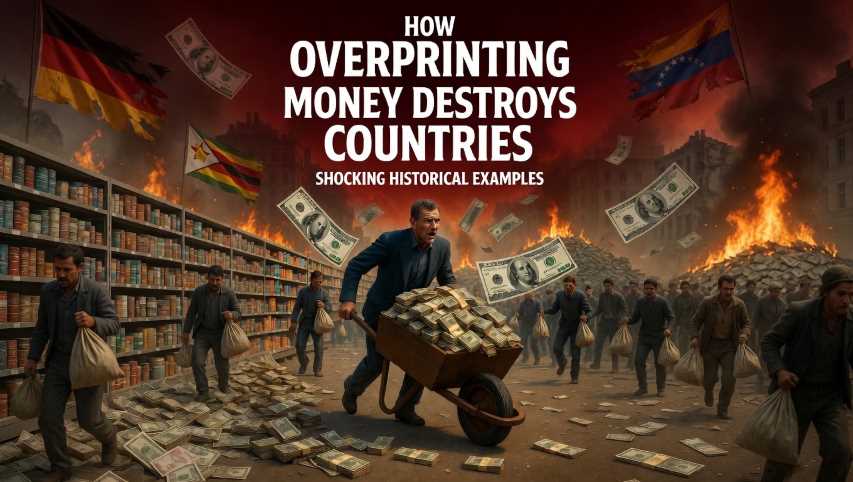
Overprinting money, also known as excessive monetary expansion, occurs when a government or central bank dramatically increases the supply of currency far beyond what the real economy can support. It often begins as a seemingly convenient tool to finance large budget deficits, pay off debts, fund political promises, or stimulate a struggling economy without the immediate pain of raising taxes or cutting spending. In the short term, it creates an illusion of wealth and activity.
However, history repeatedly shows that this policy is one of the most destructive forces any nation can unleash. It leads to hyperinflation, the rapid and uncontrollable rise in prices, which erodes savings, collapses businesses, destroys public trust, and can ultimately tear apart the social and political fabric of an entire country. Far from being a victimless solution, overprinting money acts like a silent poison that slowly undermines every pillar of a stable society.
The Economic Mechanism: Too Much Money Chasing Too Few Goods
At its core, the damage stems from a fundamental economic principle known as the quantity theory of money, often expressed in the equation MV = PY. Here, M represents the total money supply in circulation, V is the velocity of money (how quickly that money changes hands), P stands for the overall price level, and Y is the real output of goods and services produced in the economy. When a government prints vast amounts of new money to cover expenses without a corresponding increase in actual production (Y), the only way the equation can balance is through a sharp rise in prices (P).
This process accelerates because velocity (V) also tends to increase dramatically. As people see prices rising, they rush to spend their money immediately before it loses even more value. This frantic spending pushes prices higher still, creating a self-reinforcing spiral. What starts as moderate inflation can quickly turn into hyperinflation, where prices double every few days or even hours.
Governments often justify printing by claiming it will “boost growth” or “provide liquidity,” but the reality is different. The new money does not create new factories, farms, or innovations. Instead, it simply redistributes existing wealth in a highly unfair way. Those closest to the printing press—usually governments, banks, and politically connected elites—spend the fresh currency first while prices are still relatively low. By the time the money reaches ordinary citizens, its purchasing power has already been diluted. This is known as the “Cantillon effect.”
Savings accounts, pensions, and fixed wages become worthless almost overnight. Businesses struggle to plan or invest because future costs become unpredictable. Contracts break down, loans become impossible to repay in real terms, and foreign investors flee. The local currency loses its role as a reliable store of value, medium of exchange, and unit of account. People turn to barter, foreign currencies, gold, or cryptocurrencies. Public services funded by tax revenue collapse because the taxes collected are worth far less by the time they reach government coffers. In extreme cases, the entire monetary system fails, forcing the country to abandon its own currency.
The Devastating Human and Social Consequences
The economic destruction is only the beginning. The human toll is profound and long-lasting. Families watch their life savings disappear in weeks. Retirees who planned for decades of modest comfort suddenly face starvation. Workers receive paychecks that cannot buy enough food for a single meal. Malnutrition and disease spread as medicine and basic healthcare become unaffordable or unavailable. Crime rates often surge as desperate people turn to illegal activities just to survive.
Social trust evaporates. Neighbors who once cooperated begin hoarding goods and viewing each other with suspicion. Political instability grows as citizens blame leaders, opposition parties, or ethnic groups for the crisis. Extremist movements gain popularity by promising simple solutions. In some cases, this chaos has paved the way for authoritarian regimes or even civil conflict. Children miss years of education, creating a lost generation with lower skills and opportunities. Migration waves empty countries of their most talented and ambitious citizens, further weakening the economy.
Historical Case Studies: Painful Lessons from the Past
Weimar Republic, Germany (1921–1923)
After losing World War I, Germany was burdened with enormous reparations payments demanded by the victorious Allies under the Treaty of Versailles. Instead of implementing painful but necessary fiscal reforms, the government chose to finance these obligations and support striking workers during the 1923 occupation of the Ruhr industrial region by printing vast quantities of paper marks.
The results were staggering. The exchange rate collapsed from roughly 4 marks to the U.S. dollar before the war to an astronomical 4.2 trillion marks per dollar by November 1923. Prices doubled every few days. A loaf of bread that cost 1 mark in 1919 eventually reached 200 billion marks. Families needed wheelbarrows full of banknotes just to buy groceries. Banknotes became so worthless that people literally burned them for heat because they were cheaper than firewood.
Middle-class families who had saved responsibly for generations were completely wiped out. Pensioners starved in the streets while speculators and those with access to foreign currency grew rich. Food riots became common, and farmers refused to sell produce for worthless paper. The hyperinflation destroyed public faith in the fragile Weimar democracy. This economic despair and humiliation created fertile ground for radical political movements, contributing significantly to the eventual rise of Adolf Hitler and the Nazi Party. The crisis was finally halted in late 1923 with the creation of a new currency, the Rentenmark, backed by land and enforced monetary discipline, but the psychological and political scars remained for decades.
Zimbabwe (2000s, peaking in 2008)
Zimbabwe was once one of Africa’s most prosperous nations, known as the “breadbasket of Africa” due to its strong agricultural sector. However, a series of disastrous land redistribution policies under President Robert Mugabe drastically reduced farm output, collapsed exports, and created massive budget deficits. Rather than address the root causes, the government printed Zimbabwean dollars at an accelerating rate to pay war veterans, fund patronage networks, and keep the economy afloat.
Inflation reached truly surreal levels: 79.6 billion percent per month in November 2008, with some estimates placing the annual rate at 89.7 sextillion percent. Prices doubled almost every day. The government printed banknotes up to 100 trillion dollars, yet even these enormous denominations could not buy basic items like a loaf of bread or a bus ticket. Unemployment soared to nearly 80 percent. Schools and hospitals shut down, electricity and clean water became luxuries, and a cholera epidemic killed thousands due to collapsing infrastructure.
Black markets flourished, with people trading in U.S. dollars or South African rand. Farmers slaughtered livestock rather than sell for worthless currency. Millions fell into extreme poverty. In 2009, the government officially abandoned its own currency and adopted the U.S. dollar. While this stopped the immediate hyperinflation, the long-term damage included destroyed institutions, widespread malnutrition, and a generation that grew up knowing only economic chaos.
Venezuela (2010s–2018 and beyond)
Venezuela possessed some of the world’s largest oil reserves and was once among the wealthiest countries in Latin America. However, years of heavy government spending, price controls, corruption, and dependence on oil revenue created deep vulnerabilities. When global oil prices crashed in 2014, government income plummeted. Instead of reforming the economy, the regime under Nicolás Maduro dramatically increased the printing of bolívares to finance deficits and maintain expansive social programs.
Annual inflation exploded to more than 1,700,000 percent in 2018, with monthly rates far exceeding the 50 percent threshold that defines hyperinflation. The economy contracted by approximately 75 percent between 2014 and 2021—one of the largest peacetime collapses in modern history. Supermarket shelves emptied of food and medicine. Hospitals ran out of basic supplies, leading to preventable deaths. Electricity blackouts became routine. Millions of citizens survived through barter systems or by using U.S. dollars obtained on the black market.
More than 7.7 million Venezuelans fled the country in one of the largest refugee crises in Latin American history, placing enormous strain on neighboring nations. Poverty and child malnutrition reached heartbreaking levels. Even partial dollarization and later policy adjustments could not quickly reverse the damage. The crisis turned a resource-rich nation into a symbol of economic mismanagement, with lingering effects on productivity, trust, and governance that will take decades to heal.
Hungary (1945–1946): The Most Extreme Case in Recorded History
For an even more extreme illustration, post-World War II Hungary experienced the worst hyperinflation ever documented. After the war, the government faced massive reconstruction costs and printed pengő notes at an astonishing pace. At its peak in July 1946, prices doubled every 15.6 hours. The exchange rate reached 41.9 quadrillion pengő to one U.S. dollar. The government eventually issued a 100 quintillion pengő note—the highest denomination in history. Daily life became surreal: workers were paid multiple times a day and rushed to spend their wages before they became worthless. This episode ended only when Hungary introduced a completely new currency, the forint, in August 1946, but not before the economy and society had been thoroughly devastated.
Common Patterns and Warning Signs
Across these and many other cases, certain patterns always appear: large fiscal deficits financed directly by the central bank, declining real economic output, loss of confidence in institutions, political denial or short-term thinking, and the eventual abandonment of the national currency. Early warning signs include accelerating inflation, rising black-market premiums for foreign currency, falling bond prices, and government pressure on the central bank to print more money. Once expectations of inflation become entrenched, the spiral becomes extremely difficult to stop without drastic measures.
Paths to Recovery and Enduring Lessons for the Future
Recovery is always painful and requires tough choices: immediately halting the printing press, restoring strict fiscal discipline, often adopting a credible foreign currency (dollarization) or creating a new domestic currency backed by real assets, and implementing structural reforms to boost actual production. International support, independent central banks, and transparent institutions can help restore confidence. However, the social and psychological wounds heal slowly.
The clearest lesson from history is that sound money—currency that maintains stable purchasing power—is not a luxury but a fundamental requirement for a prosperous, stable society. Overprinting money offers tempting short-term relief but delivers long-term catastrophe. Nations that forget this truth inevitably pay an enormous price in destroyed wealth, lost opportunities, and human suffering. Responsible fiscal and monetary policy, grounded in restraint and realism, remains the only reliable path to lasting economic health and social harmony.
 |  |  |
 |  |  |