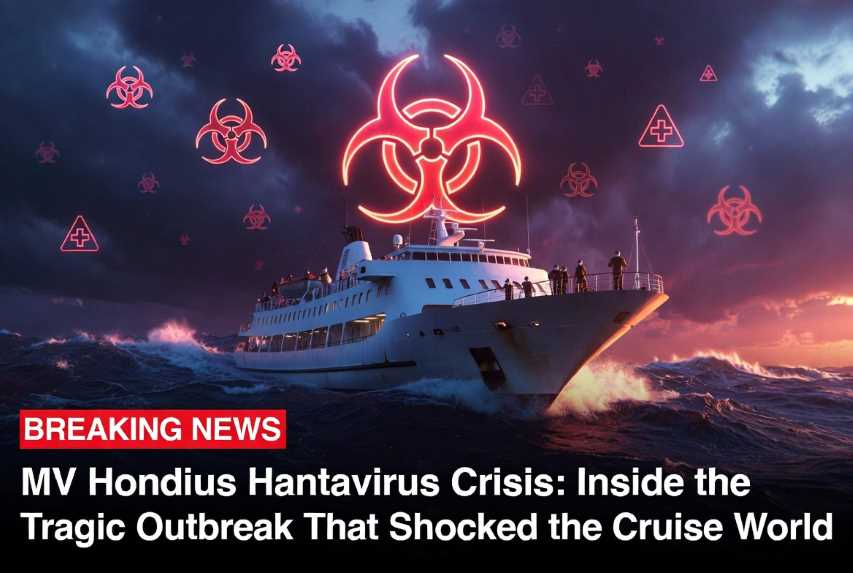
International health authorities launch unprecedented multi-nation contact-tracing operation after first-ever documented hantavirus cluster aboard a passenger vessel
In a dramatic and unprecedented public-health alert that has sent ripples through the global travel industry, a deadly outbreak of hantavirus has struck the ultra-luxury expedition cruise ship MV Hondius, operated by the respected Dutch company Oceanwide Expeditions. As of the latest update on May 10, 2026, eight individuals have been confirmed with the infection—six of them laboratory-verified as carrying the Andes virus strain—with three tragic fatalities already recorded. The virus, typically transmitted through contact with infected rodents rather than person-to-person spread, has nonetheless raised alarms because of its rare but documented limited human transmission in close-quarters environments. Health officials from more than a dozen countries are now working around the clock to trace contacts, monitor symptoms, and prevent any further escalation, marking what experts describe as the first known hantavirus transmission cluster ever recorded on a modern cruise ship.
The incident serves as a sobering reminder that even the most carefully curated, high-end adventures in some of the planet’s most remote regions can carry invisible biological risks. The MV Hondius, a state-of-the-art polar expedition vessel built specifically for intimate wildlife encounters in Antarctica and the South Atlantic, left the southern Argentine port of Ushuaia on April 1, 2026, carrying approximately 175 passengers and crew members from 23 different nationalities. Many guests had paid premium fares ranging from €14,000 to €22,000 for the 33-day itinerary that promised breathtaking views of penguins, seals, and untouched islands. Instead, the voyage turned into a floating medical emergency, forcing rapid evacuations, international coordination, and a complete overhaul of the ship’s final leg. The outbreak was formally reported to the World Health Organization on May 2, triggering immediate global alerts and coordinated response protocols that are still unfolding as the vessel makes its way toward final decontamination in Europe.
The Ship, the Voyage, and the Hidden Danger
The MV Hondius is no ordinary cruise liner. Designed with a maximum capacity of 196 passengers and 72 crew, it features luxurious yet rugged amenities tailored for polar exploration: spacious cabins with panoramic windows, a fleet of Zodiac inflatable boats for shore landings, and an onboard team of naturalists, photographers, and medical staff. The April 2026 sailing was a classic “Antarctic and South Atlantic Odyssey,” with scheduled stops at South Georgia Island, the remote British Overseas Territory of St. Helena, Ascension Island, and several Tristan da Cunha outposts before heading northward toward Cape Verde and eventually Europe. Passengers hailed from Spain, France, the United Kingdom, the United States, Germany, Switzerland, the Netherlands, and beyond, while most crew members were seasoned professionals from the Philippines and other maritime nations.
What began as an idyllic journey quickly soured when subtle symptoms started appearing among a small group of travelers. Because hantaviruses have an incubation period that can stretch from one to eight weeks, the early signs were easy to overlook or attribute to seasickness, fatigue from long flights, or ordinary travel bugs. No rodents were ever sighted aboard the impeccably maintained vessel, leading investigators to believe the index case was exposed either in Argentina prior to boarding or during one of the very first shore excursions in rodent-populated coastal areas of southern South America.
A Detailed Timeline of the Outbreak
The first confirmed victim was a 70-year-old Dutch gentleman who began experiencing fever, severe headache, muscle aches, and diarrhea on April 6 while the ship was en route between South Georgia and St. Helena. His condition deteriorated rapidly; by April 11 he had succumbed to acute respiratory distress while still at sea. At the time, his death was recorded as natural causes linked to underlying health issues, and the ship continued its itinerary. His 69-year-old wife remained by his side, disembarking with his remains at St. Helena on April 24. Tragically, she fell gravely ill during a connecting flight to Johannesburg and passed away in a South African hospital just two days later on April 26.
A third fatality—a German woman in her late sixties—developed similar pneumonia-like symptoms and died around May 2 while the vessel was still navigating the South Atlantic. By early May, additional cases began surfacing. A British passenger required emergency medical evacuation from Ascension Island to a specialized intensive-care unit in South Africa. A Swiss traveler who had left the ship earlier tested positive upon arrival in Zurich and was immediately hospitalized. The ship’s own doctor also fell ill, highlighting how the confined environment may have facilitated limited spread among close contacts.
By May 3 the vessel had reached the waters off Cape Verde, where local health authorities boarded to deliver essential medical supplies and help establish onboard isolation zones. Three symptomatic individuals were airlifted to the Netherlands between May 6 and 7 for advanced treatment. The MV Hondius finally docked at the Port of Granadilla in Tenerife, Canary Islands, in the early hours of May 10. Disembarkation was handled with military precision: 94 passengers were flown home in coordinated charter flights to six European nations and Canada. The remaining crew and one unclaimed body stayed aboard as the ship set sail once more, this time bound for Rotterdam, Netherlands, where a full-scale professional disinfection and deep-clean operation awaits.
Understanding Hantavirus and the Unique Threat of the Andes Strain
Hantaviruses belong to a family of rodent-borne pathogens that cause two primary clinical syndromes depending on the geographic region. In the Americas, they trigger hantavirus cardiopulmonary syndrome (HCPS), a severe respiratory illness that can progress with frightening speed from flu-like symptoms to life-threatening pulmonary edema and shock. Elsewhere in the world, related strains cause hemorrhagic fever with renal syndrome, which primarily affects the kidneys. Transmission occurs almost exclusively through inhalation of tiny aerosolized particles from the urine, droppings, or saliva of infected rodents, or through direct contact with contaminated surfaces. There is no specific antiviral medication or approved vaccine; treatment relies entirely on aggressive supportive care in intensive-care units, including mechanical ventilation and fluid management.
In this outbreak, all six laboratory-confirmed cases involve the Andes virus (ANDV), a South American strain notorious for its relatively higher case-fatality rate—sometimes reaching 40 to 50 percent in vulnerable populations such as older adults or those with pre-existing conditions. What sets ANDV apart from most other hantaviruses is its rare but scientifically documented capacity for limited human-to-human transmission, typically requiring prolonged close contact during the early symptomatic phase. Genetic sequencing is currently underway in specialized laboratories to determine whether the onboard cases share identical viral signatures, which would confirm direct transmission links.
Global statistics underscore the rarity yet seriousness of these infections. In 2025 alone, the Americas recorded 229 hantavirus cases with 59 deaths, yielding an overall case-fatality ratio of approximately 26 percent. The demographics aboard the Hondius—many passengers in their sixties and seventies—placed them squarely in the higher-risk category, explaining the rapid progression observed in several individuals.
Coordinated Global Response and Risk Assessment
The World Health Organization, working hand-in-hand with the European Centre for Disease Prevention and Control and national authorities in Argentina, Cabo Verde, the Netherlands, South Africa, Spain, Switzerland, the United Kingdom, and several other nations, has mobilized an extraordinary response. Full passenger and crew manifests have been shared across borders to enable comprehensive contact tracing. Every individual who was aboard or had close interactions with confirmed cases is now under active symptom monitoring for the full eight-week incubation window. Isolation protocols, enhanced hygiene measures, and clear medical guidance have been issued to all concerned parties.
Four patients remain hospitalized: one in a Johannesburg intensive-care unit, two in specialized Dutch facilities, and one in Zurich. The remainder are recovering in home isolation or stable medical observation. WHO has assessed the risk to the general public as low, while describing the risk to recent travelers and crew as moderate. Officials have repeatedly stressed that this is not the beginning of a pandemic; hantaviruses do not spread efficiently between people, and swift containment efforts appear to have limited the scope of the event.
Oceanwide Expeditions has earned praise for its full cooperation, providing expert medical teams, facilitating evacuations, and keeping passengers informed with daily updates. Guests were instructed to remain in their cabins, practice rigorous hand hygiene, and minimize unnecessary contact during the ship’s final days at sea. The company has also announced it will cover all medical and repatriation costs for affected individuals and is conducting an internal review of pre-boarding health protocols.
Lessons for the Cruise Industry and Travelers
This outbreak, while tragic, offers valuable lessons for an industry that has already weathered multiple high-profile health incidents in recent decades. Expedition cruising in remote regions brings passengers into closer proximity with wildlife and natural environments where rodent populations can thrive. Experts recommend enhanced pre-travel screenings, rodent-control audits at ports of call, and greater emphasis on personal protective measures during shore excursions in endemic areas.
Travelers planning similar adventures are being urged to consult the latest health advisories, pack appropriate medications, and report any flu-like symptoms immediately—especially fever, chills, muscle pain, headache, dizziness, or shortness of breath. Early recognition and rapid transfer to advanced medical care remain the best defense against severe outcomes.
As the MV Hondius steams toward Rotterdam for its thorough cleansing and the international investigation continues, families of the deceased and recovering passengers await further answers. Viral sequencing results and the final contact-tracing reports are expected in the coming weeks, potentially shedding more light on exactly how the virus entered the ship and spread.
Health authorities continue to emphasize vigilance: anyone who sailed on the MV Hondius or came into close contact with confirmed cases should monitor themselves closely and seek immediate professional medical attention at the first sign of illness. The story remains fluid, and this report will be updated as new information from WHO, national health agencies, and the cruise operator becomes available.
 |  |  |
 |  |  |