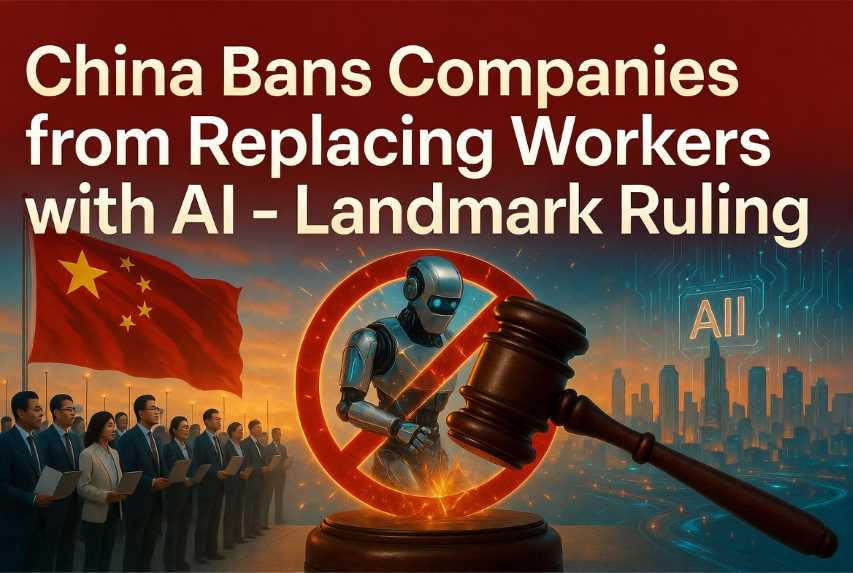
In a groundbreaking judicial decision that is reshaping the future of work in the world’s second-largest economy, Chinese courts have firmly prohibited companies from dismissing employees simply to replace them with artificial intelligence technologies. The ruling, handed down by the Hangzhou Intermediate People’s Court, establishes a powerful legal precedent under China’s Labor Contract Law, sending a clear message that technological advancement must not come at the expense of human livelihoods. This development arrives at a critical moment when AI is transforming industries at an unprecedented pace, forcing businesses, workers, and policymakers alike to confront the human side of automation.
The case that set this precedent involves a senior tech professional surnamed Zhou, who began working at an AI-focused company in November 2022. As a quality assurance supervisor, Zhou earned around 25,000 yuan (approximately $3,640) per month. His role was both demanding and specialized: he meticulously matched complex user queries with outputs from large language models and carefully filtered out content that could violate privacy laws or include illegal material, ensuring the AI systems produced safe, accurate, and compliant results.
As the company’s AI capabilities rapidly improved, managers determined that the technology could now handle Zhou’s responsibilities without human oversight. Rather than supporting his transition, the firm proposed reassigning him to a significantly lower-level position with a drastic 40 percent pay cut, reducing his monthly salary to just 15,000 yuan. When Zhou refused what he viewed as an unfair demotion, the company moved to terminate his employment contract. They offered him severance pay of 311,695 yuan, justifying the move under the umbrella of “organizational restructuring” and a supposed reduction in staffing requirements due to technological upgrades.
Zhou decided to fight back. He took his case through labor arbitration and then through the court system. In a series of unanimous decisions, the arbitration commission, the district court, and ultimately the Hangzhou Intermediate People’s Court all ruled in his favor. The appellate court declared the termination unlawful, ordering the company to provide substantially higher compensation—reportedly well over 260,000 yuan in additional payments. The judgments emphasized that workers cannot be cast aside merely because a business chooses to adopt more efficient AI tools.
Deep Dive into the Legal Foundation: Why AI Adoption Does Not Justify Dismissal
At the heart of the court’s reasoning is Article 40 of China’s Labor Contract Law. This provision allows employers to terminate contracts only under very specific conditions, such as a “major change in objective circumstances” that makes it genuinely impossible to continue the employment relationship. Even then, companies must first engage in good-faith consultations with the employee and explore alternatives like retraining, internal reassignment to comparable roles, or fair severance arrangements.
The judges were unequivocal: implementing AI is a deliberate, voluntary business strategy chosen by the company for its own competitive advantage. It does not qualify as an external, unforeseeable “objective circumstance” like a natural disaster, sudden economic collapse, or government-mandated relocation. In the court’s published opinion, the termination grounds cited by the employer “did not fall under negative circumstances such as business downsizing or operational difficulties, nor did they meet the legal condition that made it ‘impossible to continue the employment contract.’”
Furthermore, the court scrutinized the proposed reassignment and found the 40 percent salary reduction unreasonable. Employers, the ruling stressed, cannot simply shift the financial burden of technological progress onto individual workers. Instead, companies bear the responsibility to manage the costs of innovation responsibly—through investment in employee development, skill upgrading programs, or adequate support during transitions.
This is not a one-off decision. A similar case emerged in late 2025 in Beijing, where courts protected a data collector surnamed Liu after AI automated her role. These twin precedents together form a robust framework that is already being referenced in labor disputes across the country. Legal experts describe the rulings as a proactive step by the judiciary to interpret existing laws in light of rapid technological change, without waiting for entirely new legislation.
The Wider Economic and Social Context: Balancing Innovation with Stability
China’s AI sector has experienced explosive growth, surpassing 1.2 trillion yuan in total value by the end of 2025. Cities like Hangzhou, home to the court that issued this ruling, have become vibrant hubs for AI research, development, and deployment. Major tech giants and startups alike are pouring resources into large language models, automation tools, and intelligent systems designed to boost productivity across manufacturing, services, finance, and customer support.
Yet this technological boom coincides with broader economic challenges, including efforts to stabilize the job market amid fluctuating growth and concerns over youth unemployment. By releasing the full details of the Zhou case just ahead of International Workers’ Day on May 1, the court appears to have deliberately highlighted the government’s commitment to protecting labor rights while still encouraging innovation. Officials have signaled that China aims to lead the world in AI development but refuses to let progress erode the social safety net that has underpinned decades of economic success.
Industry analysts note that the decision does not ban AI implementation—far from it. Companies remain free to adopt cutting-edge technologies to improve efficiency and remain competitive on the global stage. What the ruling prohibits is treating employees as disposable assets in that process. Businesses are now strongly encouraged to create comprehensive transition plans: offering retraining in AI-related skills, creating hybrid human-AI roles, or providing generous severance and outplacement support when genuine redundancies occur.
Practical Implications for Companies, Employees, and the Global Stage
For corporations operating in China, the message is clear and actionable. AI-driven efficiency gains are still highly desirable, but any resulting workforce adjustments must follow strict procedural safeguards. Human resources teams are already consulting legal experts to revise contracts, update termination policies, and invest more heavily in lifelong learning initiatives. Some forward-thinking firms have begun piloting “AI transition funds” to help employees reskill or even launch internal startups leveraging the new technology.
Employees, particularly those in data analysis, content moderation, customer service, and routine technical roles, stand to benefit from stronger job security. The precedents reassure millions of workers that their contributions cannot be erased overnight by an algorithm. Labor unions and worker advocacy groups have welcomed the decisions, calling them a model for responsible technological governance.
Internationally, China’s approach stands in contrast to the more hands-off regulatory environments in parts of the United States and other Western economies, where debates over AI and employment remain largely legislative rather than judicial. While the European Union has introduced comprehensive AI regulations focused on ethics and transparency, few jurisdictions have yet drawn such a firm line on job displacement. Observers suggest that China’s rulings could inspire similar protections elsewhere as automation accelerates worldwide.
One prominent labor law professor at a leading Chinese university commented, “These decisions strike an elegant balance. They protect the dignity of work and the stability of families without stifling the innovation that drives our economy forward. Companies are simply being asked to manage change in a humane and responsible manner.”
As artificial intelligence continues to evolve at lightning speed—potentially reshaping entire industries within the next decade—China’s courts have drawn a bold and unambiguous boundary. Technological progress is welcome, even celebrated, but it must serve people rather than displace them without recourse. This precedent is expected to influence not only future court cases but also potential legislative refinements and corporate best practices across the country.
In an era where headlines often focus on AI breakthroughs and futuristic capabilities, today’s ruling reminds us that the true measure of progress lies in how societies protect and uplift the humans behind the machines. China has taken a decisive step toward ensuring that the AI revolution benefits everyone, not just the bottom line.
 |  |  |
 |  |  |