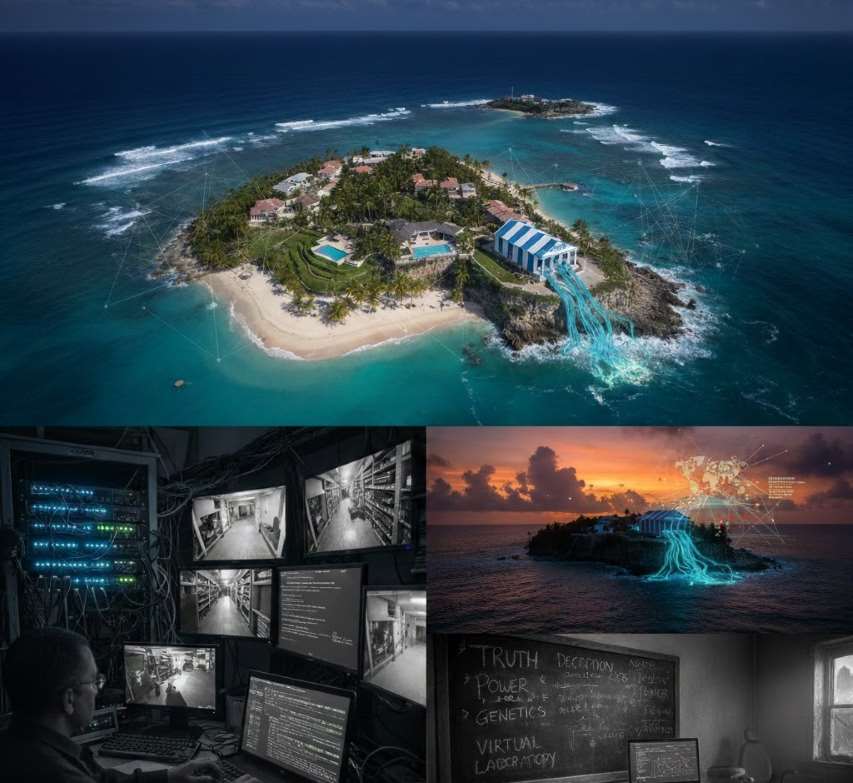
In the turquoise waters of the United States Virgin Islands lies a secluded paradise that became synonymous with horror and scandal: Little Saint James, infamously known as "Epstein Island." Once owned by the late financier and convicted sex offender Jeffrey Epstein, this 72-acre private island served as the backdrop for allegations of widespread child sex trafficking, abuse, and exploitation.
For over two decades, it hosted powerful figures from politics, business, and technology, drawing scrutiny that continues to unravel even years after Epstein's death in 2019. This article delves into the verified facts surrounding the island and explores the pivotal, often overlooked role technology played in enabling Epstein's operations, from surveillance systems to high-tech data infrastructure.
The Island's History and Ownership
Little Saint James, located about two miles southeast of Saint Thomas in the United States Virgin Islands, was purchased by Epstein in 1998 for $7.95 million through his company, L.S.J. Limited Liability Company.
Physical Features and Expansion
The island spans approximately 72 acres and features lush landscapes, pristine beaches, and luxurious structures. Key features included:
Multiple villas and pools.
A helipad and cabanas.
A distinctive blue-striped temple-like building that has fueled endless speculation.
Epstein later expanded his holdings by acquiring the neighboring Great Saint James in 2016 for $22.5 million, bringing his total archipelago footprint to about 165 acres.
A Grim Reputation
Locals dubbed it "Pedophile Island" or "Island of Sin," reflecting the grim reputation it earned under Epstein's ownership. Court documents and survivor testimonies allege that Epstein used the island as a hub for trafficking underage girls, where they were subjected to sexual abuse and forced into encounters with high-profile guests.
Key Allegations: One notable claim involves Virginia Giuffre (formerly Virginia Roberts), who stated she was coerced into sexual activities with Britain's Prince Andrew on the island as part of an orgy when she was seventeen.
Other Visitors: Visitors reportedly included scientists like Stephen Hawking, who attended a 2006 conference there, though allegations of his involvement in illicit activities remain unsubstantiated.
Legal Outcomes and Sale
Epstein, a multimillionaire with ties to Wall Street and elite circles, registered as a sex offender in the Virgin Islands in 2010 following his 2008 Florida conviction for procuring a minor for prostitution. Despite this, he continued to host gatherings on the island until his arrest in July 2019 on federal sex-trafficking charges. Epstein died by suicide in a Manhattan jail cell on August 10, 2019, while awaiting trial.
In 2022, the United States Virgin Islands attorney general settled a lawsuit against Epstein's estate for over $105 million, alleging that dozens of young women and children were trafficked and assaulted on the islands. The islands were sold in 2023 to billionaire Stephen Deckoff for $60 million, with plans to transform them into a luxury resort by 2025.
However, newly released images from 2020 by the House Oversight Committee—showing empty bedrooms, a dental chair, and a chalkboard scrawled with words like "truth," "deception," and "power"—serve as eerie reminders of the site's dark past.
Allegations of Abuse and High-Profile Connections
Survivors' accounts paint a picture of systematic exploitation. Epstein allegedly flew young girls to the island via his private jet, the "Lolita Express," where they were groomed and abused. The island's isolation made escape nearly impossible, and authorities have accused Epstein of evading oversight for years despite local complaints.
Notable figures linked to visits include:
Former United States President Bill Clinton.
United States President Donald Trump (though neither has been charged with wrongdoing related to the island).
Comedian Woody Allen.
Technology moguls like Bill Gates.
In 2025, never-before-seen photos and video footage released by Democrats on the House Oversight Committee provided a walkthrough of the property, highlighting its opulent yet ominous features. These revelations underscore the island's role as a private enclave for the powerful, where boundaries of law and morality were allegedly blurred.
Technology's Shadowy Role: Surveillance, Data, and Elite Networks
Beyond its physical isolation, technology was instrumental in Epstein's alleged schemes, providing tools for surveillance, communication, and even scientific pursuits that masked darker intentions. Epstein's island was equipped with an advanced infrastructure that far exceeded the needs of a private retreat, suggesting purposes tied to data collection, blackmail, and high-stakes networking.
Infrastructure and Capacity
From 1999 to 2005, Information Technology contractor Steve Scully installed telecommunication systems, data networks, phone lines, and server rooms across the island.
The Fiber-Optic Cable: In 2005, Epstein funded a $1.2 million undersea fiber-optic cable and high-voltage power line connecting Little Saint James to Saint Thomas.
Capabilities: This granted the island the data-processing capacity of a small city—ideal for handling massive datasets or secure communications. This setup included enterprise-grade networks capable of supporting hundreds of devices, far beyond typical residential needs.
Surveillance Systems
Surveillance was a cornerstone of the operation. Hidden cameras were reportedly installed in residences, including the Manhattan townhouse, though their full purpose on the island remains unclear. Ubiquiti equipment—Wireless Fidelity routers, network switches, and security cameras—was integral to the island's communications and monitoring systems from 2017 to 2019. Experts estimate this could support 800 to 1,000 devices, suitable for large gatherings or operations requiring real-time data handling.
Data Tracking and Leaks
A 2024 WIRED investigation revealed data from nearly 200 mobile devices tracked to the island between 2016 and 2019, pinpointing visitors' movements with centimeter precision and tracing back to their homes and offices. This leak, from data broker Near Intelligence, exposed routes from Saint Thomas docks to Epstein's property, highlighting how technology could document—and potentially compromise—elite visitors.
Silicon Valley Ties and "Virtual Laboratory"
Epstein's technology ties extended deep into Silicon Valley.
Funding: He funded the Massachusetts Institute of Technology's Media Lab, directing anonymous donations from Bill Gates ($2 million) and Leon Black ($5.5 million), while concealing his involvement.
Correspondence: Emails show Elon Musk inquiring about "wildest parties" on the island in 2012, and Reid Hoffman visiting in 2014.
Scientific Interests: Epstein hosted scientists like Marvin Minsky and hosted Artificial Intelligence conferences, expressing interest in eugenics and "superior humans."
In sworn testimony, Epstein outlined a five-to-ten-year plan for a "virtual laboratory" on the islands, involving servers, high-speed fiber, algorithms, and datasets for algorithmic trading and genetic analysis. He also brokered deals for Israeli intelligence, using technology as a fixer in global affairs.
Lingering Questions and Implications
As of 2026, Epstein's estate, once valued at nearly $600 million, has distributed funds to victims, but the full extent of technology's role—whether for blackmail, data mining, or scientific experimentation—remains partially shrouded.
The island's transformation into a resort may erase physical traces, but digital footprints and survivor voices ensure the story endures. Technology, meant to connect and innovate, here amplified isolation and control, raising ethical questions about privacy, power, and accountability in the digital age.
 |  |  |
 |  |  |