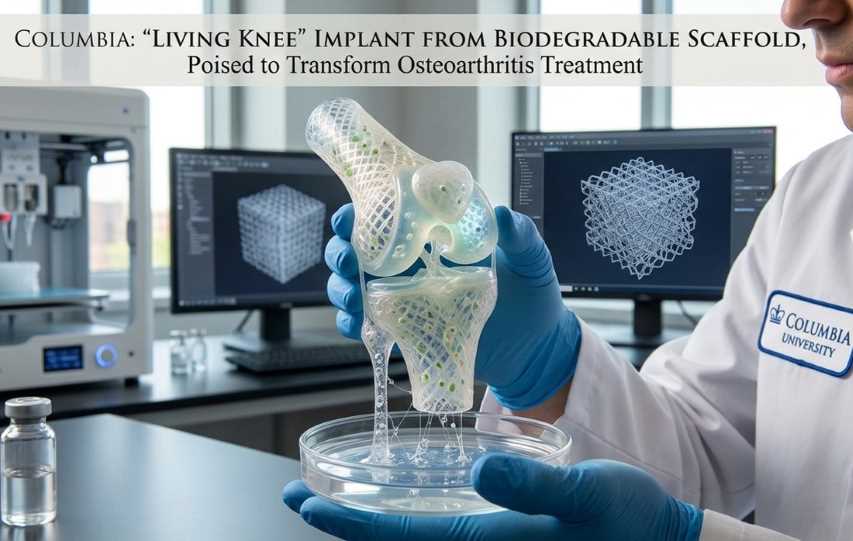
In a landmark development that could reshape orthopedic surgery and offer lasting relief to millions suffering from joint degeneration, researchers at Columbia University have made significant strides toward creating a revolutionary “living knee” replacement. This innovative biological implant, known as NOVAKnee, is constructed from a three-dimensional printed biodegradable scaffold that is carefully seeded with the patient’s own stem cells. Over time, the scaffold dissolves completely while the patient’s cells regenerate natural cartilage and bone tissue, resulting in a fully biological, living joint that integrates seamlessly with the body and functions like an original knee.
This breakthrough addresses one of the most pressing challenges in modern medicine: the limitations of conventional knee replacements. Traditional artificial joints, typically made from metal alloys and plastic components, provide temporary relief but often wear out after 15 to 20 years. For younger or highly active patients, this means facing multiple revision surgeries over a lifetime, along with risks of infection, inflammation, loosening, or reduced mobility. In contrast, Columbia’s living knee promises a permanent solution—one that not only restores full pain-free movement but also adapts and strengthens naturally as the body heals itself.
The Urgent Challenge of Osteoarthritis
Osteoarthritis remains a leading cause of disability worldwide, affecting more than 32 million Americans alone and accounting for the majority of the nearly 800,000 knee replacement procedures performed annually in the United States. This degenerative condition erodes cartilage and bone in the joints, leading to chronic pain, stiffness, swelling, and a progressive loss of function that can severely limit daily activities, from walking and climbing stairs to participating in sports or simply enjoying an independent lifestyle.
Current treatments, including pain medications, physical therapy, injections, and ultimately prosthetic implants, offer only partial or temporary solutions. Metal and plastic replacements, while effective for many older patients, are not ideal for everyone. They do not regenerate or repair surrounding tissues, and their finite lifespan often necessitates additional surgeries, which carry higher complication rates and longer recovery times. Younger patients in particular have few good options, as surgeons hesitate to perform replacements that may need replacing again decades later. Columbia’s NOVAKnee project aims to change this paradigm by engineering a joint that lasts a lifetime, making advanced knee surgery accessible and beneficial for people of all ages.
How the Living Knee Implant Works: A Biological Marvel
At the heart of this innovation is a sophisticated combination of advanced biomaterials, precise three-dimensional printing technology, and cutting-edge stem cell biology. The process begins with detailed patient-specific imaging, such as Magnetic Resonance Imaging or Computed Tomography scans, which allow engineers to design a custom scaffold that perfectly matches the individual’s knee anatomy. This scaffold is fabricated using state-of-the-art three-dimensional printing from specially engineered biodegradable polymers. These materials are chosen for their unique properties: they provide immediate load-bearing strength to support the body’s weight right after implantation, while also being ductile enough to withstand daily stresses and manufacturable at scale.
Once printed, the scaffold is infused with adult stem cells—either harvested directly from the patient’s own body (such as through a simple lipoaspirate procedure from abdominal fat) or derived from induced pluripotent stem cells. These cells are carefully placed throughout the structure to promote rapid integration. Upon surgical implantation, using techniques familiar to orthopedic surgeons, the living implant immediately begins its transformative work. The stem cells differentiate into cartilage-producing chondrocytes and bone-forming osteoblasts, gradually rebuilding the joint’s natural tissues. Blood vessels grow into the structure, ensuring proper nutrition and oxygen supply. Meanwhile, the biodegradable scaffold slowly breaks down through natural metabolic processes, disappearing entirely over approximately one year as it is replaced by the patient’s own regenerated cartilage and bone.
The end result is a fully biological knee joint that feels, moves, and responds exactly like a healthy, native one. Unlike synthetic implants, it has no risk of metal wear debris or plastic degradation products. It can even continue to remodel and improve over time in response to the patient’s activity levels, potentially becoming stronger and more resilient with use. This regenerative approach not only eliminates the need for future revisions but also reduces inflammation and promotes long-term joint health.
World-Class Team Drives the Innovation
The NOVAKnee project represents a true multidisciplinary collaboration at Columbia University, drawing on expertise from across its top-ranked institutions. Leading the effort are Professors Nadeen Chahine and Clark Hung from the Department of Biomedical Engineering at Columbia Engineering. Their work is supported by key contributors including Doctor Chang Lee, Doctor of Philosophy, and Doctor Mildred Embree, Doctor of Dental Medicine, from the College of Dental Medicine, as well as orthopedic surgeons and researchers from Columbia University Irving Medical Center and the Department of Orthopedic Surgery.
This team brings together decades of experience in biomechanics, tissue engineering, stem cell research, biomaterials science, and clinical orthopedics. Their combined knowledge has enabled rapid progress, turning what was once a high-risk concept into a tangible prototype ready for advanced testing. The project’s success highlights Columbia’s position as a global leader in regenerative medicine, where engineers and physicians work side by side to solve complex health problems.
Historic Funding and Rapid Progress Toward Clinical Trials
The initiative received a major boost in March 2024 when the Advanced Research Projects Agency for Health awarded the Columbia team up to $38.95 million through its Novel Innovations for Tissue Regeneration in Osteoarthritis program—one of only a handful of nationwide grants aimed at revolutionizing osteoarthritis care. The Advanced Research Projects Agency for Health, a federal agency focused on high-impact biomedical breakthroughs, selected the project for its potential to deliver transformative results quickly.
Just two years later, on April 6, 2026, the Advanced Research Projects Agency for Health announced that the team had successfully met all aggressive preclinical milestones. This green light advances the project into its second phase, which includes comprehensive preclinical testing in large animal models. If these tests confirm safety and efficacy, the first human clinical trials could begin as early as 2028—well ahead of the original five-year timeline. To accelerate the path from laboratory to patients, the researchers have established NOVAJoint Orthopedics, an independent company dedicated to commercializing the technology while ensuring it remains accessible and affordable for those in need.
Patient-Centered Benefits and Broader Impact
For individuals living with severe osteoarthritis, the living knee could be life-changing. Imagine regaining full mobility without the fear of implant failure or repeated operations. Patients could return to active lifestyles—hiking, playing with grandchildren, or pursuing careers that demand physical endurance—knowing their new joint is truly their own. The implant’s design mirrors existing surgical approaches, allowing doctors to adopt it with minimal additional training, which could speed up widespread clinical use once approved.
Beyond individual benefits, the technology holds enormous societal promise. By reducing the need for revision surgeries and long-term pain management, it could lower healthcare costs dramatically and decrease the overall burden of disability. Researchers envision future applications extending to other joints, such as hips or shoulders, and even broader regenerative therapies for cartilage damage in earlier stages of osteoarthritis. The project also emphasizes using a patient’s own cells whenever possible, minimizing immune rejection risks and making the treatment highly personalized.
Of course, as with any pioneering medical advance, challenges remain. The technology is described by its developers as a “high-risk, high-reward” endeavor, requiring meticulous safety validation in preclinical stages. Ensuring consistent cell integration, perfect scaffold degradation timing, and long-term durability in diverse patient populations will be critical. Yet the team’s recent milestones demonstrate that these hurdles are being overcome at an impressive pace.
A New Era in Joint Care on the Horizon
As Columbia’s NOVAKnee project moves forward, it stands as a beacon of hope in the fight against osteoarthritis. What began as an ambitious vision to build a living replacement knee is now on the cusp of entering human testing, bringing the dream of permanent, regenerative joint solutions closer to reality for millions around the globe. This living implant not only represents a triumph of biomedical engineering but also a profound step toward medicine that works with the body’s own healing powers rather than against them.
While the technology is still in development and not yet available for clinical use, its progress signals an exciting new chapter in orthopedic care—one where degraded joints can be truly rebuilt, restoring not just movement but quality of life for patients of every generation. The medical community and patients alike will be watching closely as Columbia continues to push the boundaries of what is possible in regenerative medicine.
 |  |  |
 |  |  |