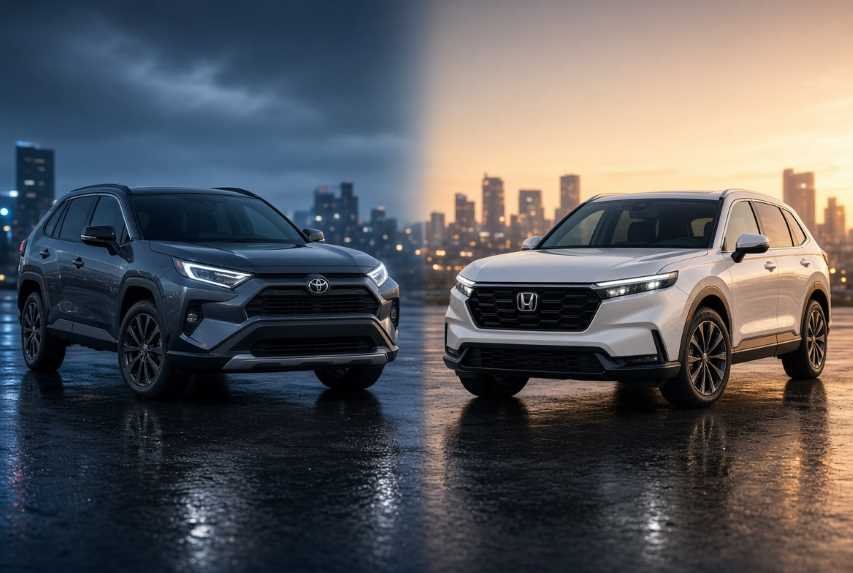
The compact SUV class is still the center of the American new-vehicle market, and two nameplates have defined it for more than two decades: the Toyota RAV4 and the Honda CR-V. Both seat five, both are daily drivers first and weekend tools second, and both now lean heavily on hybrid technology. They do not, however, offer the same product.
This comparison covers the 2026 model year in the United States. The 2026 RAV4 is an all-new sixth-generation vehicle and is hybrid-only (standard hybrid or plug-in hybrid). The 2026 CR-V is a refreshed sixth-generation model that still offers a turbocharged gasoline engine on lower trims and a two-motor hybrid on higher trims. Specifications, prices, and ratings below are U.S. figures unless noted. Destination charges, options, and dealer pricing are separate from MSRP.
Key differences at a glance
RAV4: Redesigned for 2026, hybrid-only lineup, stronger hybrid output, available plug-in hybrid with up to 52 miles of manufacturer-estimated electric range, higher towing on most AWD trims, sportier/rugged trim families.
CR-V: Mature platform with a 2026 refresh, still offers a gasoline 1.5-liter turbo entry point, class-leading rear-seat and cargo space on gas models, generally quieter and more comfort-oriented cabin, new TrailSport Hybrid.
Neither is universally “better.” The RAV4 wins on electrification breadth and towing. The CR-V wins on passenger space, cargo volume, and having a lower-priced non-hybrid option.
The RAV4 and CR-V are the two most recognizable compact crossovers in North America because they solved the same problem early: a raised driving position, all-weather traction, and enough cargo space for family life without the size or fuel use of a midsize SUV.
Toyota’s 2026 RAV4 is a ground-up redesign. Every U.S. model is electrified. Toyota grouped the lineup into three design families—Core (LE, XLE Premium, Limited), Rugged (Woodland), and Sport (SE, XSE, GR Sport)—and added a more powerful plug-in hybrid. The target buyer is someone who wants efficiency as standard equipment, plus a choice among practical, trail-styled, or sport-styled bodies.
Honda’s 2026 CR-V keeps the formula that made the current generation popular: a roomy cabin, a composed ride, and a choice between a 190-horsepower turbo four and a 204-horsepower two-motor hybrid. For 2026 Honda made a 9-inch touchscreen and wireless smartphone integration standard, added a TrailSport Hybrid, and kept the gasoline LX/EX/EX-L path open for buyers who do not want a hybrid.
Both vehicles are aimed at commuters, small families, and long-term owners who care about running costs. The RAV4 now speaks more directly to efficiency-first and adventure-styled buyers. The CR-V still speaks more directly to comfort- and space-first buyers.
Quick Comparison Table
Figures are 2026 U.S. models. Many items vary by trim, drivetrain, and powertrain. MSRP figures exclude destination, tax, title, and options. Honda’s published destination charge for 2026 is $1,450. Toyota quotes a separate dealer processing and handling fee (commonly around $1,450 in current U.S. listings; confirm locally).
Specification | 2026 Toyota RAV4 | 2026 Honda CR-V |
Model year compared | 2026 (all-new generation) | 2026 (refresh of 2023 generation) |
Starting MSRP (excl. dest.) | $31,900 Hybrid LE FWD | $30,920 LX FWD gas |
Starting hybrid MSRP | $31,900 (hybrid is standard) | $35,630 Sport Hybrid FWD |
Available trims | Hybrid: LE, SE, XLE Premium, Woodland, XSE, Limited. PHEV: SE, Woodland, XSE, GR Sport | Gas: LX, EX, EX-L. Hybrid: Sport, TrailSport, Sport-L, Sport Touring |
Engine options | 2.5L hybrid I-4; 2.5L PHEV I-4 | 1.5L turbo I-4; 2.0L hybrid I-4 |
Hybrid availability | Standard on every trim | Sport, TrailSport, Sport-L, Sport Touring |
Plug-in hybrid | Yes (AWD only) | No U.S. PHEV (limited e:FCEV is a separate, niche model) |
Horsepower | Hybrid FWD 226; Hybrid AWD 236; PHEV 324 combined | Gas 190; Hybrid 204 combined |
Torque | Engine: 163 lb-ft hybrid / 172 lb-ft PHEV; Toyota does not publish a single combined hybrid torque figure | Gas 179 lb-ft; Hybrid system 247 lb-ft |
Transmission | Electronically controlled CVT (eCVT) | Gas: CVT. Hybrid: e-CVT / single-speed with engine lock-up |
FWD / AWD | Hybrid FWD or electronic on-demand AWD; PHEV AWD standard | FWD standard on most; AWD optional or standard (TrailSport and Sport Touring AWD standard) |
Fuel economy (EPA / mfr. est.) | Hybrid FWD up to 47/40/43; AWD typically 41–45 / 31–39 / 38–42 by trim; PHEV up to 43/36/40 plus EV miles | Gas FWD 28/33/30; Gas AWD 27/31/29; Hybrid FWD 43/36/40; Hybrid AWD 40/34/37; TrailSport 38/33/35 |
Electric-only range | PHEV up to 52 miles (SE/XSE); 49 Woodland; 48 GR Sport (mfr. est.) | Hybrid: short EV-mode bursts at low speed, not a published all-electric range |
Passenger capacity | 5 | 5 |
Cargo behind rear seats | Hybrid about 37.8 cu ft; PHEV about 33.5 cu ft | Gas 39.3 cu ft; Hybrid 36.3 cu ft (Sport Touring slightly less in some listings) |
Max cargo, seats folded | Hybrid about 70.4 cu ft; PHEV about 63.5 cu ft | Gas 76.5 cu ft; Hybrid about 71.8 cu ft |
Towing | 1,750 lb FWD and Hybrid LE AWD; 3,500 lb most other AWD hybrid and PHEV trims when properly equipped | Gas 1,500 lb; Hybrid 1,000 lb |
Length | About 180.9–182.7 in by style | 184.8 in |
Width (excl. mirrors) | About 73.0–74.0 in | 73.5 in |
Height | About 66.7–69.1 in by trim | 66.2 in FWD / 66.5 in AWD |
Ground clearance | 8.1 in most; 8.5 in Woodland; 7.5 in GR Sport | 7.8 in FWD / 8.2 in AWD |
Infotainment screen | 10.5 in standard; 12.9 in on higher grades | 9.0 in standard |
Digital instrument display | 12.3 in standard | Analog/digital mix on lower trims; 10.2 in digital cluster on EX-L and most hybrids |
Apple CarPlay / Android Auto | Wireless, standard | Wireless, standard |
Driver-assistance suite | Toyota Safety Sense 4.0 standard | Honda Sensing standard |
Warranty (U.S.) | 3 yr/36k basic; 5 yr/60k powertrain; hybrid battery 10 yr/150k | 3 yr/36k basic; 5 yr/60k powertrain; hybrid battery typically 8 yr/100k (confirm on window sticker) |
Exterior Design
Design philosophy
The 2026 RAV4 is more squared-off and graphic than the previous generation. Toyota’s “hammerhead” face, C-shaped daytime running lights, and stronger body cladding give it a more rugged stance. The CR-V remains smoother and more conservative: a wide grille, slim lighting, and a longer, lower-looking profile.
Front end, grille, and lighting
RAV4 lighting is a signature of the redesign. Core, Rugged, and Sport families use different grille textures, bumper shapes, and lower valances so the same body can look practical, trail-ready, or athletic. The CR-V’s 2026 refresh tightens the front fascia and lighting but does not change the vehicle’s character. It still reads as a refined family crossover rather than an off-road toy.
Proportions and wheels
The CR-V is longer (184.8 inches vs. roughly 181 inches for most RAV4s), which helps rear-seat and cargo space. The RAV4 sits taller in several trims and uses more visual mass in the fenders and cladding. Wheel sizes generally run 17–20 inches on the RAV4 depending on grade; the CR-V uses 17-inch steel wheels on the LX, 18-inch alloys on most trims, 19-inch wheels on Sport Touring, and all-terrain rubber on TrailSport.
Sporty vs. practical appearance
RAV4 SE / XSE / GR Sport: darker trim, tighter stance (GR Sport is about 15 mm lower and an inch wider at the fenders).
RAV4 Woodland: higher ride height, all-terrain tires, adventure cues.
CR-V TrailSport Hybrid: blacked-out trim, orange badging, all-terrain tires—Honda’s first hybrid TrailSport treatment on this model.
CR-V LX–EX-L: the most understated, practical look in this pairing.
Neither design is objectively better. Buyers who want the vehicle to look capable tend to prefer the RAV4’s new body language. Buyers who want a quieter visual presence usually prefer the CR-V.
Interior and Cabin
Dashboard and materials
The redesigned RAV4 cabin is more angular, with a standard 12.3-inch digital cluster and a wide center display. Climate functions are more screen-integrated than before, with a row of physical buttons retained for drive modes and key functions. Reviews of early 2026 examples generally describe improved fit and a more modern layout than the outgoing RAV4, though some testers still find Honda’s physical climate knobs easier in daily use.
The CR-V keeps a more traditional Honda layout: a 9-inch screen, real climate knobs, and a cabin that reviewers consistently describe as quieter and more consistently assembled. Soft-touch surfaces and seat comfort are frequent CR-V strengths in independent tests.
Space
This is one of the clearest differences.
Interior measure (typical U.S. figures) | 2026 RAV4 | 2026 CR-V |
Front legroom | 41.0 in | 41.3 in |
Rear legroom | 37.8 in | 41.0 in |
Front headroom | about 37.9–39.0 in (roof/sunroof dependent) | up to 40.0 in |
Rear headroom | about 39.5–40.0 in | 38.2 in |
Passenger volume | about 99 cu ft | about 106 cu ft |
The CR-V’s extra rear legroom is noticeable for adults on long trips. The RAV4 is adequate for children and average-height adults, but it is not the roomier second row.
Visibility, storage, climate
Both have good forward visibility and a high seating position. The RAV4’s more upright greenhouse and available digital camera aids help in parking. Cabin storage is competitive in both; Honda often wins on door-pocket and console usefulness, while Toyota added more USB-C ports and available dual wireless chargers on higher grades.
Dual-zone climate control is available or standard as you move up each lineup. The CR-V’s physical knobs remain a practical advantage in winter gloves or while driving.
Daily use: both work well as commuters. Families: the CR-V’s rear seat is the easier choice for car seats and taller passengers. Long trips: CR-V comfort and quietness are frequently praised; RAV4 wins if the trip is also about fuel stops and available EV miles.
Technology and Infotainment
Screens and software
RAV4: 12.3-inch digital cluster standard. Infotainment is 10.5 inches on LE and 12.9 inches on higher grades. New Toyota Audio Multimedia interface, faster voice assistant on the larger system, available head-up display (Limited hybrid and PHEV XSE).
CR-V: 9.0-inch touchscreen standard across the line for 2026. A 10.2-inch digital instrument display is used on EX-L, TrailSport Hybrid, Sport-L Hybrid, and Sport Touring Hybrid. There is still no fully digital cluster on every trim.
Smartphone and charging
Wireless Apple CarPlay and wireless Android Auto are standard on both. Wireless phone charging is standard on the 2026 CR-V. The RAV4 offers Qi charging on select grades and up to five USB-C ports plus an available 1,500-watt / 120-volt outlet in the cargo area—useful for camping or job-site tools.
Navigation, voice, connected services
Both offer cloud/connected navigation on higher trims or via smartphone projection. Toyota’s Drive Connect, Remote Connect, Safety Connect, and Service Connect trials are widely packaged; some features require a subscription after the trial. Honda offers connected services and Google built-in on the Sport Touring Hybrid.
Audio and updates
RAV4: 6-speaker standard, available 9-speaker JBL. CR-V: 4 speakers on LX, 6 on EX, 8 on EX-L, Bose 12-speaker on Sport Touring Hybrid. Over-the-air software capability is more clearly part of Toyota’s newer architecture; Honda’s 2026 refresh improved the interface but is not a full software-platform change.
Base vs. high trim: the technology gap inside the RAV4 lineup is larger because the 12.9-inch screen, HUD, Advanced Park, and cargo power outlet sit on upper grades. The CR-V’s jump is smaller: the 9-inch screen is already standard, and upper trims mainly add the 10.2-inch cluster, better audio, and Google built-in.
Engine and Performance
Gasoline (CR-V only)
The CR-V LX, EX, and EX-L use a 1.5-liter turbocharged four-cylinder rated at 190 hp and 179 lb-ft, paired with a CVT. It is adequate in town and on the highway, but it is the least efficient and least punchy powertrain in this comparison. Independent testers typically put gas CR-V 0–60 mph times in the mid-8-second range.
Standard hybrids
RAV4 Hybrid (5th-generation Toyota Hybrid System)
2.5-liter Atkinson-cycle four plus electric motors. Combined output: 226 hp FWD, 236 hp AWD (rear electric motor). eCVT. MotorTrend recorded about 7.0 seconds to 60 mph for an AWD hybrid.
CR-V Hybrid (two-motor Honda system)
2.0-liter Atkinson-cycle four plus a traction motor and a generator motor. Combined output: 204 hp and 247 lb-ft. The hybrid often drives on electric power at low speed and uses a lock-up path so the engine can drive the wheels more directly at higher speed. Car and Driver recorded about 7.6 seconds to 60 mph for an AWD hybrid; a TrailSport test was around 7.3 seconds in one published result.
Plug-in hybrid (RAV4 only)
The 2026 RAV4 PHEV uses Toyota’s 6th-generation plug-in system: 324 hp combined, AWD standard. Car and Driver recorded 5.2 seconds to 60 mph in a Woodland PHEV. That is in a different performance class from either standard hybrid.
Character on the road
RAV4 Hybrid: more total horsepower than the CR-V Hybrid, stronger highway passing on AWD models, a more mechanical, slightly busier hybrid soundtrack under hard throttle.
RAV4 PHEV: the quickest vehicle here by a wide margin when the battery has charge.
CR-V Hybrid: less peak power, but immediate electric torque (247 lb-ft) makes it feel eager from a stop. Reviewers often call it smoother and quieter than the Toyota in ordinary driving.
CR-V gas: fine for buyers who want simplicity; it will feel slower and thirstier next to any hybrid in this pair.
Handling and ride are covered in next sections. Neither is a sports SUV. The GR Sport RAV4 is the most handling-oriented variant; the CR-V remains the more comfort-tuned default.
Hybrid and Electrified Models
RAV4 Hybrid
Toyota’s system uses a 2.5-liter engine, a planetary eCVT, and—on AWD models—a dedicated rear motor rather than a driveshaft. FWD hybrid availability is new for this generation. Combined ratings reach the low-to-mid 40s mpg depending on wheels and grade. There is no meaningful all-electric commuting range; EV operation is intermittent.
RAV4 Plug-in Hybrid
Manufacturer-estimated EV range is up to 52 miles on SE and XSE, 49 on Woodland, and 48 on GR Sport. Combined hybrid mpg after the battery is depleted is up to about 40 mpg on SE/XSE. Higher trims (XSE, Woodland) can include an 11 kW onboard charger and CCS DC fast charging (about 10–80% in roughly 30 minutes under ideal conditions). SE and GR Sport use a 7 kW onboard charger and J1772 AC charging. All PHEVs include a dual-voltage charge cable.
This is the version for drivers with a Level 2 home charger and a commute that often stays inside 40–50 miles.
CR-V Hybrid
Honda’s two-motor layout is refined and proven on this generation. It does not offer a published multi-dozen-mile EV range. City efficiency is excellent (43 mpg EPA city on FWD hybrids) because the electric motor does much of the low-speed work. AWD uses Honda’s Real Time AWD with a mechanical rear-drive path, unlike Toyota’s rear-motor AWD.
Who benefits from electrified versions?
Short, repeatable commutes + home charging: RAV4 PHEV.
Maximum mpg without plugging in: RAV4 Hybrid FWD, then RAV4 Hybrid AWD, then CR-V Hybrid FWD.
Want hybrid smoothness but prefer Honda’s cabin: CR-V Hybrid.
Want the lowest purchase price and do not care about mpg: CR-V gas LX/EX—not an electrified model.
Fuel Economy and Running Costs
Official figures (U.S.)
2026 RAV4 Hybrid (Toyota manufacturer estimates; confirm EPA label on the specific vehicle)
FWD: up to 47 city / 40 highway / 43 combined
AWD LE/SE: 45/39/42
AWD XLE Premium: 45/38/41
Woodland Hybrid: 41/35/38
XSE/Limited AWD: 43/31/42 (highway rating drops on some sport-oriented wheel/tire packages)
2026 RAV4 PHEV: up to 43/36/40 plus EV miles; MPGe when operating as a plug-in is much higher (published figures in the ~98–107 MPGe combined range depending on grade).
2026 CR-V (EPA, Honda newsroom)
Gas FWD: 28/33/30
Gas AWD: 27/31/29
Hybrid FWD: 43/36/40
Hybrid AWD: 40/34/37
TrailSport Hybrid: 38/33/35
Example annual fuel cost
Assumption stated clearly: 12,000 miles per year, $3.50 per gallon, combined EPA/mfr. rating, mixed driving.
Vehicle | Combined mpg used | Gallons / year | Fuel cost / year |
RAV4 Hybrid FWD | 43 | 279 | $977 |
RAV4 Hybrid AWD (typical 42) | 42 | 286 | $1,000 |
CR-V Hybrid FWD | 40 | 300 | $1,050 |
CR-V Hybrid AWD | 37 | 324 | $1,135 |
CR-V gas FWD | 30 | 400 | $1,400 |
A RAV4 PHEV used mostly on electricity can undercut all of these fuel totals, but only if most miles are charged at home. Electricity cost then replaces gasoline cost.
Other running-cost notes
Hybrids reduce brake wear because of regenerative braking.
Larger wheels and all-terrain tires (Woodland, TrailSport, GR Sport) raise tire prices and can reduce mpg.
Both brands have straightforward maintenance schedules. Toyota includes limited complimentary scheduled maintenance on many new vehicles (commonly 2 years/25,000 miles in current U.S. coverage language; confirm the in-service program). Honda often includes 1 year/12,000 miles complimentary maintenance.
Do not assume identical insurance premiums; insurer rating symbols, local theft data, and driver profile matter more than the nameplate.
Safety
Standard assistance systems
Toyota Safety Sense 4.0 (all 2026 RAV4s) includes pre-collision braking with pedestrian detection, full-speed adaptive/dynamic radar cruise, lane-departure alert with steering assist, lane tracing, automatic high beams, road-sign assist, and Proactive Driving Assist. Blind-spot monitoring and rear cross-traffic alert are widely standard. Available: front/rear parking assist with automatic braking, 3D panoramic view, Advanced Park, front cross-traffic alert, lane-change assist, and traffic-jam assist (some features need a connected-services subscription).
Honda Sensing (all 2026 CR-Vs) includes collision-mitigation braking, forward-collision warning, lane-departure warning, road-departure mitigation, adaptive cruise with low-speed follow, lane-keeping assist, traffic-jam assist, traffic-sign recognition, and a driver-attention monitor. Blind-spot information and rear cross-traffic monitor are standard on all but the base LX in Honda’s 2026 feature split. Front/rear parking sensors appear on higher trims.
Crash-test status (important)
Ratings must be tied to the exact test and model year.
2026 Honda CR-V (current generation structure): NHTSA has published a 5-star overall rating for recent CR-V SUVs, with frontal typically 4 stars, side 5, rollover 4 in published summaries. IIHS results for this generation include Good small-overlap front and Good updated side, but a Poor result in the updated moderate-overlap front test that now measures the rear passenger. That Poor score has kept the current CR-V from the newest Top Safety Pick awards even when other scores are strong. Headlights and front crash prevention have been rated Good or Acceptable depending on the specific IIHS scorecard.
2026 Toyota RAV4 (new generation): this is a redesigned vehicle. NHTSA selected the 2026 RAV4 Hybrid and Plug-in Hybrid for testing; a complete official 5-star label was not universally published at the time of this writing. IIHS has reported mixed early results in secondary compilations (Good small overlap, weaker updated moderate-overlap and side scores in some listings). Do not carry over 2023–2025 RAV4 crash awards to the 2026 body. Verify the specific VIN-year page on NHTSA and IIHS before purchase.
Both vehicles have comprehensive airbag suites, stability control, and standard automatic emergency braking. Assistance systems reduce crash likelihood; crash-test scores describe structure and restraint performance after a crash. They answer different questions.
Cargo Space and Practicality
Cargo | 2026 RAV4 Hybrid | 2026 RAV4 PHEV | 2026 CR-V gas | 2026 CR-V Hybrid |
Behind rear seats | ~37.8 cu ft | ~33.5 cu ft | 39.3 cu ft | 36.3 cu ft |
Seats folded | ~70.4 cu ft | ~63.5 cu ft | 76.5 cu ft | ~71.8 cu ft |
The CR-V gas model is the cargo champion. The hybrid battery trims some CR-V volume; the RAV4 PHEV battery trims more. The RAV4’s 2026 rear seatbacks fold flatter than before, which helps loading long items.
Family practicality favors the CR-V for luggage, strollers, and grocery runs because of the longer body and larger maximum volume. The RAV4 counters with available roof rails, a 1,500-watt cargo outlet on select grades, and (on Woodland) a more utility-oriented specification. Both have 60/40 split rear seats, multiple cupholders, and under-floor or two-level cargo tricks depending on trim. Neither is a three-row vehicle in the U.S. five-seat configuration discussed here.
AWD, Towing, and Adventure Capability
AWD systems
RAV4 Hybrid AWD: electronic on-demand system with a rear electric motor. No conventional driveshaft. Traction response can be quick on slick surfaces.
RAV4 PHEV: AWD standard, same rear-motor idea with more power.
CR-V AWD: Honda Real Time AWD with Intelligent Control—hydraulic/mechanical rear-drive engagement. Familiar, effective in snow and rain, not a low-range off-road system.
Ground clearance and trail trims
RAV4 Woodland: 8.5 inches, all-terrain tires, adventure styling. RAV4 GR Sport: 7.5 inches—less clearance, more road focus. CR-V TrailSport: 8.2 inches AWD with all-terrain tires. These are light-duty soft-roaders. Neither replaces a body-on-frame SUV for rocks, deep ruts, or serious towing.
Towing
This is a RAV4 advantage when you need it.
RAV4: 1,750 lb on FWD and Hybrid LE AWD; 3,500 lb on most other AWD hybrids and PHEVs when properly equipped.
CR-V: 1,500 lb gas; 1,000 lb hybrid.
A small utility trailer or pair of jet skis is realistic on the higher-rated RAV4s. A travel trailer is not what either vehicle is for. Confirm hitch, wiring, transmission cooler, and owner’s-manual limits for the exact trim.
Driving Experience
Reputable instrumented tests and first-drive reports (Car and Driver, MotorTrend, Edmunds, U.S. News) describe a consistent pattern:
City: Both are easy to place. The CR-V Hybrid’s instant torque is pleasant in traffic. The RAV4 Hybrid is also easy; the PHEV can feel almost EV-like at low speed.
Highway: Both cruise stably. The RAV4 Hybrid AWD has more reserve for passing. The CR-V is often described as calmer. Sport-oriented RAV4 wheel/tire packages can feel busier.
Curvy roads: Competent, not sporty, except the GR Sport’s firmer tuning. The CR-V’s steering is light and predictable.
Rough roads: Woodland and TrailSport trade some on-road isolation for tire noise and a taller ride. Standard comfort tunings favor the CR-V.
Rain and snow: AWD versions of both are appropriate for typical winter commuting. Neither is a mountain-rescue vehicle.
Long distance / stop-and-go: Adaptive cruise and lane centering on both reduce fatigue. Honda’s hybrid calibration is frequently called the more relaxed companion in traffic.
These are review observations, not laboratory facts. A test drive on your actual commute remains essential.
Comfort and Noise
Independent testers generally give the CR-V the comfort and noise edge: better seat cushioning, less road roar on ordinary all-season tires, and a more isolated hybrid powertrain at modest speeds.
The 2026 RAV4 improved cabin quality versus the previous generation, and the standard digital cluster plus available larger screen make the driver’s environment feel more current. It can still transmit more tire and wind noise on 18- to 20-inch wheels. Woodland all-terrain tires add rumble. The PHEV is quiet in EV mode and more urgent when the engine and motors deliver 324 hp.
Highway cruising comfort: CR-V for most people. RAV4 Limited and XSE with the right tires close the gap. Seat comfort is subjective; Honda’s front chairs are a common praise point.
Trim Levels and Pricing
Prices below are U.S. MSRP excluding destination unless noted. Honda destination: $1,450. Toyota destination/processing is extra and should be confirmed on the buyer’s order.
2026 Toyota RAV4 Hybrid (representative U.S. MSRPs)
Trim | Drivetrain | Approx. MSRP | What you get, in brief |
LE | FWD or AWD | $31,900 FWD / $33,300 AWD | Base hybrid, 10.5-in screen, 12.3-in cluster, TSS 4.0, cloth, 1,750-lb tow on AWD |
SE | FWD or AWD | about $34,700 / $36,100 | Sport styling, firmer visual identity |
XLE Premium | FWD or AWD | about $36,100 / $37,500 | More convenience, larger screen path, 3,500-lb tow when AWD/properly equipped |
Woodland | AWD | about $39,900 | Rugged design, 8.5-in clearance, A/T tires, lower mpg |
XSE | AWD | about $41,300 | Sport-luxury blend |
Limited | AWD | about $43,300 | Top hybrid comfort spec, available HUD and Advanced Park |
2026 Toyota RAV4 PHEV (AWD only)
Published starting points have settled around $41,500 SE, $45,300 Woodland, $47,200 XSE, $48,500 GR Sport (verify current Toyota order guide; early-year figures moved as PHEV pricing was finalized). PHEV adds the larger battery, 324 hp, and up to ~52 miles of EV range.
2026 Honda CR-V (Honda newsroom MSRP, dest. extra)
Trim | Powertrain | MSRP | With $1,450 dest. | Notes |
LX FWD / AWD | 1.5T | $30,920 / $32,420 | $32,370 / $33,870 | Lowest price in this comparison |
EX FWD / AWD | 1.5T | $33,150 / $34,650 | $34,600 / $36,100 | Moonroof, heated seats, dual-zone |
EX-L FWD / AWD | 1.5T | $35,400 / $36,900 | $36,850 / $38,350 | Leather, power liftgate, 10.2-in cluster |
Sport Hybrid FWD / AWD | Hybrid | $35,630 / $37,130 | $37,080 / $38,580 | Entry hybrid |
TrailSport Hybrid | Hybrid AWD | $38,800 | $40,250 | A/T tires, trail styling |
Sport-L Hybrid FWD / AWD | Hybrid | $38,725 / $40,225 | $40,175 / $41,675 | Leather hybrid |
Sport Touring Hybrid | Hybrid AWD | $42,550 | $44,000 | Bose, Google built-in, top spec |
Incentives, dealer discounts, and inventory change monthly. Never treat MSRP as the transaction price.
Reliability and Ownership
Both brands have long records of above-average reliability in this segment. That history is useful context. It is not a guarantee for a specific new vehicle.
CR-V: The current generation launched for 2023 and was refreshed for 2026. Powertrains and structure are known quantities. That maturity is an ownership advantage in year-one comparison shopping.
RAV4: 2026 is a new generation with a new interior architecture and an all-hybrid U.S. lineup. Toyota’s hybrid systems have a strong multi-generation record, but first-year redesigns can surface early electronic or trim issues that later years fix. Treat 2026 RAV4 reliability data as incomplete.
Warranty (U.S., typical): both 3 years/36,000 miles basic and 5 years/60,000 miles powertrain. Toyota’s hybrid battery coverage of 10 years/150,000 miles is a meaningful ownership point. Honda hybrid-component coverage is commonly 8 years/100,000 miles—read the specific warranty booklet.
Maintenance is conventional: oil, cabin filter, brake fluid, coolant, inspections. Hybrids still need engine oil. Check for open recalls by VIN on official safety databases before buying new or used.
Resale Value and Depreciation
Compact hybrids from Toyota and Honda have historically held value better than the segment average because demand stays high on the used market. Valuation services have long ranked both nameplates near the top of compact-SUV resale charts.
Practical caveats for 2026:
A new-generation RAV4 can depreciate a bit faster in its first year simply because it is plentiful and unproven as a used car. Over a five- to seven-year hold, Toyota hybrids often recover that gap.
A gas CR-V may be easier to sell to used buyers who do not want a hybrid, but it will be less efficient to own.
PHEV residual values depend on battery health narratives and tax-credit rules at resale time.
Mileage, service records, accident history, and local demand dominate any brand-level prediction.
Use a current appraisal tool on the exact trim when you are ready to buy or sell. Do not treat a five-year-old residual percentage as a contract.
Toyota RAV4: Key Advantages and Considerations
Advantages
Hybrid efficiency from the least expensive trim.
Stronger hybrid output; a genuinely quick PHEV.
Higher towing on most AWD models.
Distinct Core / Rugged / Sport personalities.
Standard 12.3-inch cluster and modern multimedia options.
Long hybrid-battery warranty.
Considerations
First year of a redesign.
Less rear legroom and less maximum cargo than the CR-V.
PHEV cargo penalty.
Highway mpg can fall on large-wheel sport trims.
No gasoline engine if you specifically want one.
Ideal buyer: someone who will keep the vehicle a long time, values fuel economy every day, may tow a small trailer, or wants plug-in capability.
Honda CR-V: Key Advantages and Considerations
Advantages
Best rear-seat space in this pairing.
Best cargo volume (especially gas models).
Mature, well-sorted generation.
Quiet, comfort-biased ride.
Lower entry price with the gas LX.
Physical climate controls and a simple daily interface.
Considerations
Hybrid starts several thousand dollars above the RAV4’s base hybrid.
No plug-in hybrid in the regular U.S. lineup.
Less towing, especially as a hybrid.
IIHS updated moderate-overlap rear-passenger result is a Poor.
Less power than RAV4 hybrids and far less than the RAV4 PHEV.
Ideal buyer: families who live in the second row, drivers who prize refinement, and shoppers who want the option of a non-hybrid powertrain.
RAV4 vs. CR-V by Buyer Type
Daily commuter: RAV4 Hybrid FWD for mpg; CR-V Hybrid if smoothness matters more than a few mpg.
Family buyer: CR-V, primarily for rear legroom and cargo.
Highway traveler: CR-V for quiet comfort; RAV4 Hybrid AWD if passing power and range between fill-ups matter.
Fuel-economy-focused driver: RAV4 Hybrid FWD, then RAV4 PHEV if you can charge.
Technology-focused buyer: upper-trim RAV4 (12.9-inch screen, HUD, Advanced Park, cargo AC outlet).
Outdoor enthusiast: RAV4 Woodland or CR-V TrailSport; Woodland tows more.
First-time SUV buyer: either base hybrid (RAV4 LE or CR-V Sport Hybrid); sit in the CR-V rear seat before deciding.
Long-term owner: both are rational; Toyota’s hybrid battery term is longer; Honda’s current generation has more years of field data.
Buyer seeking a hybrid: RAV4 makes hybrid the default; CR-V Hybrid is the nicer cabin.
Buyer prioritizing cargo: CR-V gas, then CR-V Hybrid, then RAV4 Hybrid, then RAV4 PHEV.
Buyer prioritizing comfort: CR-V, especially EX-L or Sport-L / Sport Touring.
Total Cost Considerations
Ownership cost is purchasing price + fuel + insurance + maintenance + tires + repairs + financing + depreciation, minus resale.
Illustrative five-year fuel-only picture using the same $3.50/gallon and 12,000 miles/year assumptions (60,000 miles):
RAV4 Hybrid FWD at 43 mpg: about $4,880
CR-V Hybrid FWD at 40 mpg: about $5,250
CR-V gas FWD at 30 mpg: about $7,000
That gap can exceed the monthly payment difference between some trims. It does not include electricity for a PHEV, insurance variance, or the higher tire cost of 19- and 20-inch or all-terrain packages.
Financing: a lower-priced CR-V LX can win the payment contest and lose the fuel contest. A well-equipped RAV4 PHEV can look expensive on the window sticker and cheap per mile if most driving is electric.
Depreciation will likely be the largest single cost for either vehicle. Strong used demand for both nameplates is the main reason these two remain rational long-hold purchases compared with less established rivals.
Pros and Cons
2026 Toyota RAV4
Pros
Hybrid (or PHEV) on every U.S. vehicle
Higher combined output than the CR-V Hybrid
Available 52-mile-class plug-in range
3,500-lb towing on many AWD trims
Modern standard driver display and available 12.9-inch screen
10-year/150,000-mile hybrid battery coverage
Considerations
New generation with incomplete long-term data
Tighter second row
PHEV loses cargo volume
Some sport wheel packages hurt highway mpg
Destination, options, and high trims climb quickly
2026 Honda CR-V
Pros
Roomier rear seat and larger cargo hold
Refined ride and quieter cabin in most tests
Gasoline entry price below the RAV4’s hybrid base
Proven current-generation mechanicals
Standard wireless phone integration and charging
Thoughtful everyday controls
Considerations
Hybrid costs more than Toyota’s base hybrid
No mainstream PHEV
Hybrid towing is only 1,000 lb
IIHS updated moderate-overlap Poor for rear passenger
Less power than RAV4 hybrids
Buyer’s Checklist
Verify these items on the specific vehicle before you sign:
Model year and powertrain on the window sticker (2026 Hybrid vs. PHEV vs. CR-V gas vs. hybrid).
MSRP vs. destination vs. add-ons (paint, all-weather package, door-edge film, nitrogen, accessories).
EPA label mpg for that exact drivetrain and wheel/tire package.
PHEV charge port and onboard charger rate (7 kW vs. 11 kW / DC fast charge) if you want a plug-in RAV4.
Towing package and owner’s-manual rating if you plan to tow.
Rear-seat fit with your tallest regular passenger and a rear-facing child seat if relevant.
Cargo with the seats up—measure a stroller or golf bag rather than trusting brochure cubic feet.
Driver-assistance behavior (adaptive cruise and lane centering) on a real highway.
Tire type (all-season vs. all-terrain) and replacement cost.
Warranty booklet for hybrid-battery term and any complimentary maintenance.
VIN recall and service campaign check.
Latest NHTSA and IIHS results for that model year, especially because the 2026 RAV4 is newly designed and the CR-V’s updated moderate-overlap score is a known weak point.
Home charging plan before you pay PHEV money.
Insurance quotes on the exact trim, not a generic “RAV4” or “CR-V.”
A back-to-back test drive—these two are close enough that personal comfort usually decides it.
Final Comparison
What distinguishes the RAV4 in 2026 is electrification as a default, not an upgrade: more hybrid power, a real plug-in option, better towing, and a redesign that finally gives Toyota’s bestseller distinct rugged and sport identities.
What distinguishes the CR-V is the thing families feel every day: rear-seat space, cargo volume, ride comfort, and a cabin that has had years to be sorted. Honda also still sells a conventional turbo four for buyers who do not want a hybrid.
Features that matter most depend on use:
Commute + charging at home → RAV4 PHEV
Lowest fuel use without a plug → RAV4 Hybrid FWD
Kids, luggage, quiet highways → CR-V Hybrid or EX-L
Occasional trailer → RAV4 AWD with the 3,500-lb rating
Tightest budget to get into a new compact SUV → CR-V LX
Trims worth extra attention: RAV4 LE Hybrid (value), RAV4 XLE Premium AWD (features + towing), RAV4 PHEV XSE (charge speed + range), RAV4 Woodland (clearance), CR-V EX-L (gas comfort), CR-V Sport Hybrid (Honda hybrid entry), CR-V Sport Touring (complete Honda spec), CR-V TrailSport only if you actually want all-terrain tires.
Before you buy, test-drive both on the same route, sit behind your own driving position in the second row, fold the seats around the cargo you actually carry, and read the Monroney label on the exact vehicle—mpg, options, and destination are printed there, not in a brochure average.
 |  |  |
 |  |  |