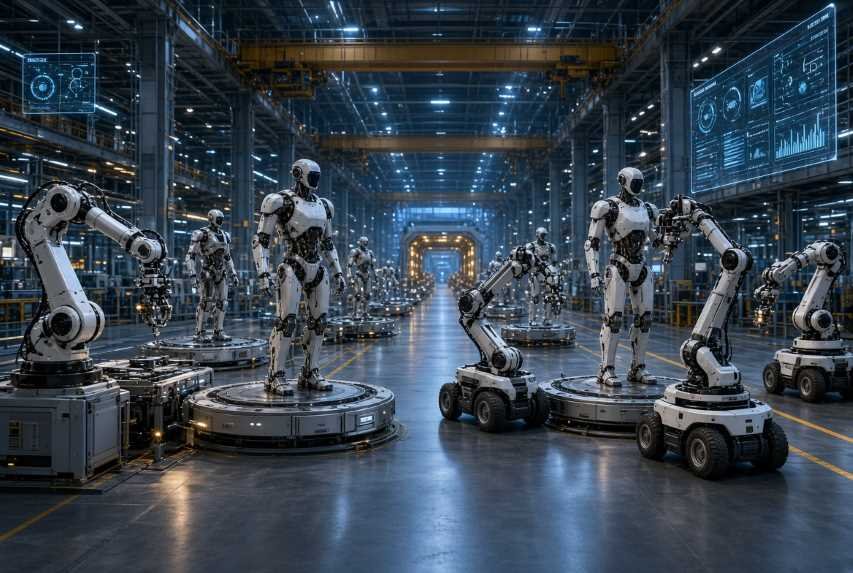
A factory that builds robots is no longer a novelty. Car plants have used industrial arms for decades. Electronics factories already rely on pick-and-place machines, inspection cameras, and automated guided vehicles. What changed in September 2026 is more specific: a dedicated plant whose products are humanoid and wheeled “embodied” robots, and whose own material handling, fastening, inspection, and warehousing systems are themselves robotic.
That plant is UBTECH Robotics’ Industrial Humanoid Robot Super Smart Factory in Liuzhou, Guangxi. The company says the building is designed for more than 10,000 industrial humanoid robots a year and engineered so that one finished machine can leave the line every ten minutes. Company statements and Chinese state media called it the world’s first intelligent manufacturing facility built for that scale. The phrase attached to the opening was almost irresistible: robots building robots.
The phrase is useful only if it is kept honest. The factory is real. The digital systems are real. Robots on the floor do real work. The 10,000-unit figure and the 10-minute cycle are design targets, not a completed year of independently audited output. People still design the machines, write the process, handle exceptions, and take legal responsibility when a robot fails a test or bumps a coworker. The importance of Liuzhou is not that humanity has been removed from manufacturing. It is that China is trying to industrialize humanoids the same way it industrialized electric vehicles and smartphones: by moving them out of laboratories, putting them on a takt-time line, and using a dense domestic supply chain to drive cost down.
That is a manufacturing story as much as a robotics story. It is also an economic experiment. If the loop works—automated plants building machines that then work in other plants—the cost of physical automation could fall in a way that specialized robot arms never quite achieved. If the loop fails, the industry will have expensive buildings full of impressive prototypes that customers will not keep running.
Inside the Liuzhou Factory
The facility stands in the Northern Ecological New Area of Liuzhou, in South China’s Guangxi Zhuang Autonomous Region. UBTECH, a Shenzhen-headquartered robotics company listed in Hong Kong, operates it. Siemens Digital Industries Software helped build the digital manufacturing layer: simulation, scheduling, and the closed-loop data system UBTECH calls a “smart brain.”
UBTECH commissioned the plant over the weekend of September 12–13, 2026, and publicly described operations in the days that followed. Company materials, amplified by Global Times and later international reports, list these specifications:
About 14,000 square meters of floor area
A hall height of 13.8 meters
Designed annual capacity above 10,000 units
A planned takt time of one industrial humanoid every 10 minutes
Mixed-model production of the bipedal Walker S series and the wheeled Cruzr series
Full-process serial-number traceability for each robot
An automated high-bay warehouse of 65 square meters holding 112 finished robots
Those numbers should be read as company disclosures. A takt time is an engineering cadence. It answers the question: if parts arrive on time, stations are staffed, software loads correctly, and test bays are free, how often can a completed unit roll off? It does not answer how many robots customers will order, how many will pass first-time quality checks, or how many days the line will run at that pace in year one. Several careful industry write-ups made that distinction explicit. Capacity is not the same thing as shipments.
Liuzhou was not a blank page. UBTECH already assembled Walker robots in the city. The company said the 1,000th Walker S2 left a Liuzhou line in late December 2025, after mass production and first deliveries were announced in November 2025. In its own words, the new plant was a jump “from 1,000 to 10,000 units” in less than nine months. That claim describes a capacity ramp, not a guarantee that 2026 calendar-year deliveries will hit five figures.
The product mix is part of the design. The Walker S family, including the industrial Walker S2, is a full-size bipedal humanoid aimed at factories, logistics, and inspection. Public spec sheets commonly describe it as roughly 176 centimeters tall, with on the order of 50 degrees of freedom in later versions, a payload around 15 kilograms, walking speed near 2 meters per second, and a pack runtime around two hours. A signature advertised feature is autonomous battery swapping in about three minutes, which is meant to turn a short pack life into multi-shift operation. Exact mass figures vary across secondary listings, which is a reminder that marketing pages are not engineering drawings.
Cruzr robots are different. The Cruzr Y1 and Cruzr S2 are wheeled embodied platforms. They do not have to solve dynamic walking every time a floor is slightly uneven. That makes them more practical for depalletizing, tote movement, and line-side replenishment—the jobs they also perform inside the Liuzhou plant. Building walkers and wheeled machines on one flexible line is closer to automotive mixed-model assembly than to a traditional robot-arm cell that makes one part forever.
UBTECH is not the only Chinese firm talking about 10,000-unit humanoid capacity. ENGINEAI opened a Shenzhen factory in 2026 and said it could complete a T800 humanoid every 15 minutes after dozens of inspections and simulation tests. A Leju Robotics partnership with Dongfang Precision described a Guangdong line earlier in 2026 with a 10,000-unit annual target and a 30-minute cycle. LY iTECH opened a Beijing contract-manufacturing plant in May 2026 with a first-phase target of 10,000 units and much larger long-term ambitions. UBTECH’s “world’s first” language is therefore a company and media framing: first dedicated smart factory, in its telling, engineered specifically for 10,000-unit industrial humanoid and wheeled-platform output with a Siemens digital backbone. Other plants are chasing similar scale. The race itself is the news.
The local industrial context matters. Liuzhou is an automotive city, home to producers such as SAIC-GM-Wuling and Dongfeng Liuzhou Motor. Walker robots have already been tested in that cluster. A humanoid plant next to car factories can hire technicians who already understand torque tools, work-order discipline, and the difference between a designed cycle time and a real one. Guangxi also sits on a land corridor toward Southeast Asia, which company-facing reports have described as a possible export route. That is strategy, not completed customs data.
How Robots Help Build Robots
A humanoid is a poor candidate for the kind of hard automation that stamps a door panel. It is a dense bundle of actuators, sensors, harnesses, computers, covers, and batteries. Most of those parts are not born in the Liuzhou Hall. Motors, harmonic or cycloidal reducers, cameras, inertial sensors, chips, and cells come from China’s broader supplier network. The factory’s job is to receive, kit, assemble, fasten, wire, flash, calibrate, test, and store.
The process described by UBTECH and by reporting based on company briefings can be broken into stages. Some stages are highly automated. Others are only partly automated. A few remain stubbornly human.
Component manufacturing, mostly off-site. Actuator modules, structural castings or stampings, battery packs, camera assemblies, and compute boards are produced by suppliers or in other UBTECH operations. This is where China’s cost advantage is decided. If a reducer that once cost several thousand yuan can be bought for half that price at volume, the whole robot becomes cheaper. If a motor batch drifts out of tolerance, the assembly line inherits the defect.
Incoming inspection and kitting. Parts arrive on pallets and in totes. Automated guided vehicles, unmanned forklifts—UBTECH has referred to logistics machines with names such as Wali and Chitu in detailed industry accounts—and wheeled Cruzr robots move material from dock to line. Cruzr units with 3D vision handle depalletizing, palletizing, loading, and bin replenishment. This is the most literal version of robots building robots: earlier or parallel products feeding the line that builds new ones. It is also the easiest layer to automate, because warehouses already use similar vehicles.
Sub-assembly of modules. Legs, arms, torso frames, and wiring harnesses are built in cells. UBTECH says it avoided a rigid overhead conveyor so different models can share the floor. Workpieces sit on self-docking, rotating mobile dollies. A walker chassis and a wheeled Cruzr base can therefore move through related stations without a complete line changeover.
Mechanical assembly and fastening. Company briefings say a humanoid requires more than 2,000 fastening operations across about 50 screw specifications. Automated torque stations record depth, torque, and angle. If a screw is short, cross-threaded, or under-torqued, the system is supposed to flag it before the cover goes on. Fastening is one of the best-understood automation problems in the building. It is repetitive, measurable, and already standard in automotive plants.
Actuator and joint installation. Each major joint receives a motor, a gearbox, bearings, seals, and often a force or torque sensor. Alignment is unforgiving. A small angular error in a hip can become a walking defect. Collaborative robot arms can present modules and hold parts. Final seating and connector lock often still need a technician or a power-assist manipulator.
Sensor installation. Cameras, depth sensors, inertial measurement units, joint encoders, and tactile sensors in the hands must be mounted in known positions. Perception software assumes that geometry. A camera that is two millimeters off can make grasping unreliable. This work is partly automated and partly skilled labor.
Wiring and electronics. Cable routing through limbs is one of the least glamorous bottlenecks in humanoid manufacturing. Harnesses must flex with joints, survive millions of cycles, and still fit behind cosmetic covers. Fully automatic wiring of a walking robot remains rare. People still do a large share of this work, sometimes with fixtures and vision assistance.
Battery and power electronics. Packs, contactors, and battery-management boards go in late enough that the machine can be powered for software load. Thermal interfaces matter. A pack that runs hot in a closed torso will limit both factory tests and later field life. Walker S2’s self-swap feature is a product function: the finished robot is designed to replace its own battery at a station. That is different from how the factory itself is powered.
AI-computing hardware. Onboard computers, motor drivers, and network switches turn a mechanical puppet into a controllable machine. These boards must be cooled, grounded, and reachable for service. Edge compute is not optional. A factory robot cannot wait on a distant cloud server every time a box has moved.
Software installation. Operating systems, motion stacks, perception models, safety layers, and fleet software are loaded against the robot’s unique serial number. UBTECH says one-item-one-code traceability ties work orders, materials, and quality records to that identity. If a later field failure occurs, the company wants to know which torque station, which batch of actuators, and which software build were involved.
Calibration. Joint zeros, camera extrinsics, force-sensor offsets, and gait parameters are measured and stored. Calibration is where a robot stops being a collection of parts and starts being a coordinated body. It is also where quiet manufacturing variation becomes visible.
Testing and quality control. Each complete robot is said to undergo more than four hours of whole-machine testing: actuator stress, mobility or gait checks, payload stability, and functional sequences. Units then pass through an automotive-style lighting tunnel for 360-degree inspection of seams, covers, and finishes. That combination copies car-plant logic. Appearance tunnels catch panel gaps. Dynamic tests catch machines that look fine while standing still.
Storage and deployment. Finished robots go into the 65-square-meter automated stereoscopic warehouse. From there they ship to industrial customers, integration partners, or UBTECH’s own next logistics fleet.
The division of labor is therefore uneven. Robots excel at moving totes, driving recorded fasteners, transferring chassis, and scanning surfaces. Humans still dominate exception handling, complex harness work, process engineering, software bring-up, and the decision to scrap or rework a unit. Calling the site a robots-building-robots factory is fair as a description of logistics and selected assembly tasks. Calling it a human-free factory is not supported by the company’s own description of collaborative arms, power-assist tools, and rotating tables used with operators.
The Technologies Inside a Humanoid Robot
A humanoid is not one technology. It is a stack that fails if any layer is weak.
Artificial intelligence. High-level planning—what to pick up, where to walk, when to stop and ask for help—increasingly uses large models and task planners. Lower-level control remains classical robotics: inverse kinematics, trajectory generation, impedance control, and hard safety limits. In earlier multi-robot factory trials, UBTECH described a layered setup in which a central planner assigned work and smaller onboard controllers handled vision and motion. That split is practical. A giant model can reason about a messy scene. It should not be the only thing standing between a swinging arm and a person.
Computer vision. Cameras estimate object pose, read labels, find pallets that were set down carelessly, and check whether a cover sits flush. Depth cameras help in clutter. Lighting changes, reflections on metal, and dust still break naive vision systems. That is why factories invest in controlled illumination at inspection tunnels and still keep human quality staff nearby.
Force and torque sensing. Once a gripper touches a part, cameras are no longer enough. Wrist and joint sensors tell the robot how hard it is pushing. Without that, a machine either drops fragile objects or crushes them. Force control is also what makes contact with a human less catastrophic, though it does not make a falling 70-kilogram body safe.
LiDAR and other perception. Some mobile robots map aisles with LiDAR or similar ranging sensors. Humanoids may use a mix of stereo vision, depth cameras, ultrasonic sensors, and proprioception from joint encoders. The exact sensor suite varies by model and generation. The requirement does not: the robot must know where it is and what is about to hit it.
Actuators, motors, and gears. This is the expensive heart of the machine. Each major joint needs a compact motor and a high-ratio reducer. Harmonic drives have been common because they are compact and precise. They are also costly and can wear. As Chinese suppliers increased volume, public industry notes described reducer prices falling from roughly 3,000–5,000 yuan toward 1,500–2,000 yuan per unit. Those are market observations, not UBTECH’s official bill of materials. They explain why scale matters. A robot with dozens of actuated joints multiplies every price cut—and every reliability problem.
Hands and manipulation. A walking body that cannot grasp is only a moving mannequin. Industrial humanoids now advertise multi-degree-of-freedom hands, sometimes more than ten joints per hand in later Walker versions. Stage dexterity is not factory dexterity. Fingertips wear. Cables fatigue. Slippery parts rotate. A hand that can hold a teacup on video may still be poor at seating a connector 2,000 times a week.
Batteries and energy management. Two hours is a common advertised runtime. That is too short for a full industrial shift unless the robot can swap packs or dock itself. Walker S2’s self-swap system is an attempt to solve operations rather than physics. Energy density, charge speed, low-temperature performance, and fire safety remain constraints shared with electric vehicles, except the pack must fit inside a torso that also holds computers and harnesses.
Edge computing. Perception and balance loops run on the robot. Cloud links can update models, collect fleet data, and push new skills. They cannot be in the loop for every footstep. Heat is the hidden enemy. Compute boards in a closed limb or chest have little airflow. Thermal throttling can make a robot sluggish in the last hour of a test.
Machine learning and large models. Learning helps with perception, grasp selection, and adapting to slightly moved parts. It does not abolish the need for conservative motion limits. A model that generalizes in a lab can still fail on a part it has never seen under factory lighting. Training data from real plants is therefore valuable, which is one reason companies want robots in actual factories rather than only in showrooms.
Motion planning, balance, and locomotion. Planning a collision-free arm path is mature compared with planning a day’s worth of walking among carts, cable covers, and wet patches. Bipedal balance uses a mix of model-based control and learned policies. Wheeled Cruzr platforms skip the hardest part of that problem. That is why a “humanoid factory” that also builds wheeled robots is making an economic concession to physics.
Human-robot interaction. In a showroom, interaction means speech and gestures. In a plant, it means predictable speed, visible status, standard lockout procedures, and an emergency stop that cuts power. Workers need to know what the machine will do next. Surprise is a safety defect.
Why Build a Human-Shaped Machine?
The industrial robot already exists. It welds, paints, palettizes, and assembles with a reliability humanoids do not yet match. So why spend money on a machine that looks like a person?
The answer is infrastructure. Factories, warehouses, hospitals, and shops were built for human bodies. Benches are at hand height. Carts have handles. Doors have latches. Tools have grips. Stairs and mezzanines exist. A specialized robot cell often requires a redesigned station, fences, custom fixtures, and a long integration project. A humanoid, in theory, can walk up to the old station and use the old tool.
That theory has force in a few places:
High-mix factories that change products too often to justify a custom cell
Logistics sites with human-scale totes, shelves, and cages
Inspection rounds that follow human routes
Dangerous or repetitive jobs employers struggle to staff
Service settings where a human-like form is easier for people to interpret
It also has hard limits. A six-axis arm on a rail will beat a humanoid at a single high-speed task. A forklift or an autonomous mobile robot will beat a walker at moving pallets. Legs waste energy. Hands are fragile. The human shape is a compromise: more general than a single-purpose machine, less efficient than a purpose-built one.
Household use sits at the far end of that compromise. Homes are unique, cluttered, and socially demanding. A factory at least repeats the same tote. A kitchen does not. In 2026, the serious money still goes first to controlled workplaces. Home assistance remains a research and marketing horizon, not the business case that justifies a 10,000-unit industrial plant.
China’s Humanoid Robot Industry
Liuzhou is one building in a national industrial campaign.
China is already the world’s largest market and producer of conventional industrial robots. National Bureau of Statistics figures said the country produced 98,677 industrial robots in July 2026, up 30.2 percent from a year earlier. Output from January through July reached 635,056 units, up 28.5 percent. Those machines are mostly arms and related industrial robots, not humanoids. They still matter. The same supplier culture, integrator workforce, and factory discipline feed the humanoid push.
Policy has been explicit. Embodied intelligence and humanoid robots have been treated as a strategic emerging industry. Cities have opened parks, demonstration lines, and procurement programs. The Ministry of Industry and Information Technology has said China has developed more than 400 complete humanoid models—more than half the global total in that official count. Model count is not the same as commercial quality. It does show how many teams were funded to try.
The company map is crowded.
Unitree, based in Hangzhou, built a global brand on robot dogs and then on comparatively inexpensive humanoids. It listed on Shanghai’s STAR Market on August 19, 2026. Smaller Unitree models have published prices in the low thousands to low tens of thousands of dollars, which pulled “humanoid” from a research word into a product category students and labs could order.
AgiBot, also known internationally from shipment trackers, has been credited in 2026 research notes with the highest unit volumes in some half-year tallies. One Counterpoint-linked summary put global humanoid shipments above 22,000 units in the first half of 2026, with Chinese firms in the top five positions and AgiBot around 9,700 units. Other houses publish different numbers. Shipment definitions vary. A small education robot and a factory Walker are both counted as humanoids in some datasets and should not be treated as interchangeable products.
Fourier Intelligence came from rehabilitation robotics and has aimed GR-series machines at research, care, and general-purpose pilots. Galbot, Leju, EngineAI, Noetix, Booster, and vehicle makers such as XPeng have added bodies, hands, or factory experiments. UBTECH’s own path is distinctive because it is a listed company that has published humanoid delivery figures and now a dedicated industrial plant.
Competition is therefore not a two-horse race. It is a price-and-volume contest layered on top of a reliability contest. Cheap robots that break do not win factories. Expensive robots that work may still lose if a rival can deliver “good enough” at half the cost.
Domestic supply chains are the structural advantage. UBTECH vice president Pang Jianxin told Global Times that mass-producing complex components would be extremely difficult without the Chinese supplier base unless cost advantages were abandoned. The company has claimed more than 90 percent localization. Morgan Stanley and Chinese industry press have similarly described high localization for motors and controllers and sharp price declines for reducers. Batteries ride the electric-vehicle industry. The weaker links are advanced AI accelerators and some high-end sensors, where export controls and specialized fabrication still constrain supply.
AI development in China is tied to the same industrial bet. Factories generate data. Data trains models. Models make robots more useful in factories. That loop only closes if robots stay deployed long enough to produce clean operational data rather than demo clips.
Manufacturing scale is the other advantage. A country that already pours castings, winds motors, packs cells, and runs automotive quality systems can treat a humanoid as another electromechanical product. That does not make the product easy. It makes the attempt cheaper than it would be in a market that has to import every reducer.
A Smart Factory in Practice
Industry 4.0 is a slogan until it becomes a set of working loops.
In Liuzhou, the advertised loop is this. A digital twin of the 14,000-square-meter hall was built in Siemens plant-simulation software before the physical line had to hit a 10-minute cadence. Engineers could watch virtual AGVs jam, virtual totes pile up, and virtual buffers overflow. They could then change aisle widths, vehicle counts, or station timing. That is the point of a twin: spend compute on mistakes that have not yet dented metal.
A manufacturing operations system—UBTECH has described a jointly developed MOM platform as the factory’s smart brain, with detailed reports also naming a Yanshee MOM layer tied into Siemens architecture—then schedules real work orders. It decides what model to build, which kit to dispatch, and which quality gate a chassis has passed. Serial numbers make each robot a data object, not only a physical object.
Industrial Internet of Things devices close the measurement loop. Torque tools stream angle and force. Vision systems stream images. Vehicles report location. Predictive maintenance is the intended next use of that data: a motor that draws slightly more current each week can be replaced before it fails on a customer’s line. Whether that analytics layer is mature on day one is a separate question from whether the sensors exist.
Machine vision does two jobs. On the line, it helps mobile robots find pallets and bins. At the end of the line, the lighting tunnel inspects cosmetics the way a car plant inspects paint. AI-powered inspection can flag scratches and misaligned panels. It still needs thresholds set by people who know which defect is cosmetic and which defect will leak oil.
Automated material handling is the visible choreography: AGVs, unmanned forklifts, Cruzr manipulators, rotating dollies. Cloud systems keep the long-term record. Edge systems keep the line moving if a wide-area link drops. Human-machine collaboration is designed in. Collaborative arms assume a person may be in the cell. That is modern automotive practice, not science fiction.
The technologies matter because they work together. A digital twin with no real telemetry is a video game. Telemetry with no scheduling brain is a pile of dashboards. Robots with no quality tunnel are fast ways to ship defects. The smart factory idea is a closed loop from plan to part to measurement back to plan. Liuzhou is an attempt to install that loop around a product that is much less standardized than a wheel hub.
The Feedback Loop of Automation
The economic idea behind the plant is a circle.
Humans design robots and the process that builds them. Automated suppliers make motors, reducers, boards, and packs. Robots and automated cells assemble more robots. Finished machines go to work in factories, warehouses, and inspection routes. Some of those machines, or their wheeled cousins, come back into robot plants as logistics and assembly helpers. Each turn of the circle is supposed to lower cost and raise the amount of real-world training data.
The potential benefits are straightforward. Labor per unit falls as fastening and towing automate. Cycle times become more predictable. Night shifts become easier. Data from the assembly of robot A improves the design of robot B. Customers who already trust a vendor’s machines may buy the next generation faster.
The limitations are just as straightforward. A robot that can unload a tote cannot automatically assemble another robot’s dexterous hand. Hands, harnesses, and calibration still resist full automation. Software that works in Liuzhou may fail in a humid electronics plant. A feedback loop also amplifies mistakes. If a defective actuator design is built into thousands of units quickly, the recall is industrial, not academic.
There is a second-order effect. The more robots work in factories, the more those factories teach robots. The more robots are built in automated plants, the cheaper that teaching fleet becomes. That is the optimistic reading. The pessimistic reading is that the industry is using automation theater to disguise a product that is not yet robust enough to justify the buildings.
Reality in 2026 sits between those poles. Robots help build robots. They do not independently invent, certify, insure, or maintain them.
Economics and Production Costs
Money is the test that demos cannot fake.
UBTECH does not publish a consumer list price for Walker S2. The robot is sold through enterprise contracts and public tenders, often with software, docking or swap equipment, training, and integration. Unofficial websites have posted figures anywhere from the mid five figures to well over $100,000. Those pages are not manufacturer quotes.
Better signals come from company results and broker notes, which still must be labeled as such. Reports on first-half 2026 performance said UBTECH sold 921 full-size humanoids. Revenue from full-size humanoid products and solutions was put at about 590 million yuan, up 1,445 percent year on year, and became a much larger share of company revenue than a year earlier. One widely circulated analysis said Walker S2 gross margin exceeded 70 percent, bill-of-materials cost had fallen from about 350,000 yuan to about 180,000 yuan, and average selling price had moved from 700,000–800,000 yuan toward about 600,000 yuan. Treat those as reported figures, not a public price tag on a factory gate.
For 2025 as a whole, filings-based summaries said UBTECH delivered 1,079 full-size humanoids, up from a negligible base the year before, with most going into industrial settings. Order headlines in the same period included large contracts measured in the hundreds of millions of yuan, among them a reported 264 million yuan project in Fangchenggang. First-half 2026 commentary also described new industrial orders involving automakers and a first batch of Walker S2 units for Airbus assembly work. Orders are not the same as installed, fully utilized fleets.
The Liuzhou plant exists to change those unit economics. UBTECH has talked about cutting manufacturing cost 20 to 30 percent a year and reaching a production cost below $20,000 by 2030. That is a target dated to the end of the decade. It is not the 2026 selling price.
Component costs will decide whether the target is fantasy. Actuators and reducers dominate the bill of materials. Batteries are significant but benefit from EV scale. Compute is significant and may not fall as smoothly if the robot needs more onboard inference. Labor per unit should drop as logistics and fastening automate, then flatten when the remaining work is skilled rework. Maintenance is the sleeper cost. A robot that needs a specialist visit every two weeks can erase a handsome hardware margin.
For industrial buyers, return on investment is a plant-floor calculation. Compare the all-in cost of a robot—purchase or lease, integration, guards, training, power, spare actuators, downtime—with the cost of the human shifts it might replace or the output it might add. A machine priced like a luxury car only pays off if it runs extra hours, reduces injuries, or fills a job the employer cannot staff. Utilization is therefore more important than the press-release cycle time in Guangxi.
The wider market adds context. Unitree’s average selling prices have fallen sharply over two years in company and press accounts, and consumer-adjacent models now sell in the low thousands of dollars. Those machines are not Walker S2. They show the direction of travel: volume pulls prices down, then vendors discover whether cheap robots can do work that customers will pay for again.
Where Humanoid Robots Are Used
Applications should be sorted by evidence, not by brochure.
Automotive factories. This is the most developed industrial case. UBTECH has publicized Walker activity with automakers and mobility manufacturers including Zeekr, BYD, Geely-related plants, NIO-related projects, Dongfeng, and others named in company and broker summaries. Reported tasks include feeding and unloading, sorting, inspection, and collaborative handling. In 2025, UBTECH described Walker robots on a Liuzhou automotive line as a local loop: robots made in Liuzhou helping make Liuzhou cars. That is a pilot-to-production story, still far from a plant whose humanoid count rivals its conventional robot-arm count.
Electronics manufacturing. Foxconn and other electronics names have appeared in partner lists. AgiBot separately reported a live inspection trial at Longcheer in Nanchang, where Genie G2 robots inspected more than 17,000 tablets over six days with a very high reported success rate after an early communications fault. That trial is not a UBTECH Liuzhou story, but it shows the kind of repetitive inspection work humanoids are being asked to do. Electronics lines are precise and unforgiving. A robot that drops a board is not cute.
Warehouses and logistics. Tote handling, pallet work, and internal transport fit wheeled platforms especially well. SF Express has been named among partners. Specialized autonomous mobile robots and automated storage systems already own much of this market. Humanoids win only where the environment stays too human-shaped to redesign.
Aviation manufacturing. Reporting in 2026 described Airbus purchasing an initial batch of Walker S2 units for aircraft assembly support. If those deployments succeed, they matter because aerospace tolerances are stricter than many automotive handling jobs. If they remain small and ceremonial, they will join a long list of showcase orders.
Construction. Walking over rubble and handling irregular materials is a research goal. It is not a stable commercial market in 2026. Dust, weather, and liability are brutal.
Healthcare. Fourier and others have explored care and rehabilitation settings. A hospital is a high-safety, high-regulation environment. Fetching linens is imaginable. Patient handling is a much higher bar.
Hospitality and retail. Lobbies and shops like a humanoid that can greet guests. That is closer to marketing and concierge work than to mass labor substitution.
Agriculture. Fields are seasonal, outdoor, and irregular. Purpose-built farm machines still make more sense for most tasks.
Home assistance. This is the image that sells videos. It is the last setting that will tolerate a machine that falls, pinches, or misunderstands a command. Limited home pilots may appear before 2030. General household labor as a normal consumer product remains unproven.
The clean summary: commercially visible uses are industrial handling, some inspection, logistics trials, and manufacturer-specific line support. Future possibilities include care, construction, retail, and homes. Mixing those categories is how hype is made.
Workers, Jobs, and New Skills
Automation anxiety arrives on schedule with every new machine. Humanoids make the anxiety more vivid because the machine has a head.
Jobs most exposed are repetitive physical tasks in structured spaces: moving totes, loading racks, walking inspection routes, presenting parts to a fixture. Those tasks can shrink where robots actually stay online. Jobs least exposed in the near term are work that mixes judgment, fine improvisation, and responsibility for other people.
New work appears in the same breath. A 10,000-unit plant needs assembly technicians, quality engineers, robot maintenance staff, field service networks, process programmers, safety engineers, and people who label data or supervise fleets. When a robot stops in a customer plant at midnight, someone has to know whether the fault is a sensor, a reducer, a network packet, or a dropped software update.
Human-robot collaboration is the everyday reality. Collaborative arms and walking machines will share aisles with people long before they replace entire shifts. That requires new shop-floor skills: when to enter a cell, how to reset a robot, how to spot a gait that means a failing actuator.
Reskilling is therefore not a slogan. Regions that already have automotive and electronics technicians will absorb the change more easily than regions whose workforce is concentrated in the exact handling jobs being automated. The evidence from earlier robot-arm waves is mixed but not apocalyptic: productivity rose, some tasks vanished, other tasks became more technical, and local outcomes depended on institutions more than on the machines themselves.
Two cartoon stories should be rejected. Robots will not take all jobs next year. Robots will not create unlimited jobs by magic. They will rearrange work, and the rearrangement will be uneven.
Safety Challenges
A walking machine with mass, batteries, and autonomy is a new class of industrial hazard.
Mechanical failure is first. A gearbox that seizes at walking speed can drop the robot. Unexpected motion is second. Software that commands a step the planner did not intend is a collision risk. Falls are third. A humanoid that loses balance is a falling tool cabinet. Collision with a person can injure even at modest speed.
Battery safety follows EV logic: thermal runaway, charger faults, damaged packs after a fall. Cybersecurity is less familiar on factory floors. A networked fleet that can be commanded remotely is a physical system, not only an IT asset. Software failures and brittle AI decisions add another layer. A vision model that mis-classifies a person’s limb as a tote is an unacceptable failure mode.
Emergency shutdowns must work when the network does not. Speed limits, geofences, reduced-mode near people, and physical e-stops are basic. Industrial safety standards for caged robot arms are mature. Standards for walking humanoids in mixed spaces are still catching the hardware. Certification, repeated testing, and conservative first deployments are how this industry earns the right to leave the fence.
A smart factory does not reduce that burden. It increases it. If robots help build robots, a safety defect can be reproduced at the rate of one unit every ten minutes.
Why Mass Production Is Still Hard
Mass production is where charisma dies.
High component costs persist because each robot carries many precision actuators. Battery energy density limits shift length unless swap systems are reliable. Actuators that work for a demo week may not last a year of two-shift duty. Dexterous hands remain expensive and fragile. Reliable walking on messy floors is unfinished. Balance algorithms that look graceful in a clean lab look hesitant next to a forklift.
Real-world perception is still brittle. General-purpose manipulation—the dream of “any object, any task”—is not a solved product feature. AI reliability is statistical. A 99 percent success rate can still mean dozens of failures a day on a busy line. Heat soaks into limbs. Maintenance networks outside a few Chinese industrial clusters are thin. Supply chains can deliver volume and still miss consistency. Manufacturing variation that is invisible in a batch of twenty robots becomes a field crisis in a batch of two thousand.
Then there is software versioning. A factory full of humanoids is a factory full of computers that walk. Updates can improve grasping or break a safety limit. Configuration control is as important as torque control.
This is why a 10,000-unit building can be both impressive and premature. The building solves throughput. The product still has to solve durability.
China and the Global Industry
A comparison is useful if it avoids a medal ceremony.
United States. Tesla has trained and used Optimus inside its own factories and has talked about a future selling price in the $20,000–$30,000 range. External mass shipment was still not the defining 2026 fact. Figure AI has attracted very large private valuations and pursued automotive and warehouse partners. Agility Robotics took a different path with Digit, a logistics-focused biped that does not chase a fully human silhouette. Apptronik and others remain in the pack. American strengths often cited by analysts are AI software, capital formation, and brand. American weaknesses in this category have been production volume and time-to-price. A high valuation is not a shipping record.
Japan. Japan’s humanoid research history is long, and its industrial robot companies remain world powers in conventional arms. Fanuc, Yaskawa, and others already automate the factories humanoids want to enter. Full-size general-purpose humanoid mass production has not been Japan’s 2026 headline. Precision, reliability, and factory integration are the Japanese industrial inheritance. Spectacular biped videos were never the whole story there.
South Korea. Hyundai’s acquisition of Boston Dynamics put one of the world’s most famous robot companies inside a major automotive group. Korea also has dense electronics and auto automation. Commercial humanoid volume still trails China’s current shipment race. The interesting Korean question is whether automotive manufacturing discipline can be applied to Atlas-class machines.
Europe. Europe’s weight is in industrial robotics, safety regulation, and factory software. Siemens’ role in Liuzhou is exactly that European niche: digital twins and manufacturing software rather than a competing humanoid brand. European vendors sell a large share of the conventional robots in Chinese plants. They are less visible in the 10,000-unit humanoid assembly race.
Differences that actually matter:
Technology: software versus hardware completeness varies by firm, not only by country.
Manufacturing: China is putting more dedicated humanoid capacity on the ground in 2026.
Investment: the United States concentrates huge sums in fewer private stars; China spreads public and private money across many builders and cities.
Supply chains: China is more vertically dense in motors, reducers, structures, and batteries.
Production scale: Chinese shipment estimates for 2025–2026 dwarf publicly described Western unit counts, with the caveat that product classes differ.
Industrial applications: China has more live factory pilots because it has more factories willing to run them.
Government support: explicit in China; more fragmented elsewhere.
Commercialization: China is selling robots now, including cheap ones. Western firms are still converting prototypes and limited pilots into catalogs.
None of that crowns a winner. A country can ship the most units and still lose the profitable, reliable segment. A company can have the best demo and miss the market window.
What the Next Decade Could Bring
Forecasts should travel with their uncertainty.
Mass production. Several Chinese plants may reach true high-volume output. The Liuzhou design target of 10,000 units could become a normal factory size rather than a headline. Or several plants could sit half-empty if orders do not match capacity.
Falling prices. Hardware prices are already falling. A path toward industrial production costs near $20,000 by 2030 is the target some Chinese executives describe. Even if that number is hit, integration and supervision will still cost money. Cheap robots that need expensive babysitting are not cheap.
Increasing autonomy. Models will get better. Robots will need less custom teaching for a slightly moved box. They will not become general household workers on a fixed calendar.
Robot fleets. Multi-robot coordination already appears in pilot auto plants. Fleet software—the system that assigns jobs, shares maps, and pulls a weak unit off the line—may matter as much as any single body design.
Factory automation. Humanoids will likely take a minority of tasks around a much larger installed base of arms, conveyors, and AMRs. The future factory is a mix, not a replacement of every existing robot by a walking one.
Human-robot collaboration. This is the near-term default. People and machines will share spaces with stricter rules.
Service and household robots. Service roles in controlled buildings may expand. Household robots may enter as limited appliances. The scenario in which a family buys a general laborer that cooks, folds, and mind children is the least certain of the lot.
Three broader scenarios remain plausible. In the first, volume and reliability arrive together, and humanoids become a normal industrial tool. In the second, volume arrives without reliability, prices collapse, and the industry burns cash. In the third, wheeled and special-purpose robots take most of the work, while bipedal humanoids occupy a narrower set of jobs that truly need human-shaped access. The Liuzhou factory is compatible with all three. It does not choose among them.
Key Facts
Item | Publicly reported detail |
Factory name | Industrial Humanoid Robot Super Smart Factory |
Location | Northern Ecological New Area, Liuzhou, Guangxi Zhuang Autonomous Region, China |
Company | UBTECH Robotics; digital systems developed with Siemens Digital Industries Software |
Opening / announcement | Commissioned September 12–13, 2026; publicly described mid-September 2026 |
Factory size | About 14,000 m²; hall height 13.8 m |
Production capacity | Designed for 10,000+ units a year; 10-minute takt time (company design target, not a verified full-year output) |
Robot type | Walker S series bipedal industrial humanoids; Cruzr wheeled platforms |
Automation level | High in logistics, fastening, inspection, and warehousing; humans remain in assembly, wiring, calibration, and supervision |
Main technologies | Digital twin and plant simulation, MOM “smart brain,” AGVs and unmanned forklifts, collaborative robots, machine vision, serial-number traceability |
Target applications | Industrial handling, manufacturing support, logistics, inspection |
Publicly reported production targets | 10,000+ annual design capacity; company goal of 20–30% annual cost reduction and production cost below $20,000 by 2030 |
Finished-goods warehouse | 65 m² automated high-bay system for 112 robots |
Testing | More than four hours of whole-machine tests plus 360-degree visual inspection |
Prior Liuzhou milestone | 1,000th Walker S2 reported off a Liuzhou line in late December 2025 |
H1 2026 company volume | 921 full-size humanoids sold, according to reported results |
Where a number is a target, estimate, or company claim, it is labeled that way.
FAQ
- What is China’s humanoid robot smart factory?
It is UBTECH’s 14,000-square-meter plant in Liuzhou, commissioned in September 2026 to assemble industrial humanoids and wheeled robots at a designed capacity above 10,000 units a year. Siemens software supports planning and operations. It is one of several Chinese scale-up sites, and the “world’s first” wording is the company’s own framing. - Can robots really build other robots?
Yes, for defined jobs. In Liuzhou, wheeled robots and automated vehicles move parts, collaborative arms help assemble, torque stations drive fasteners, and automated systems inspect and store finished machines. No, if the question means a plant that designs, machines, wires, certifies, and improves robots with no people. - How automated is the factory?
Automation is high by humanoid-industry standards in logistics and measurement-heavy tasks. Official descriptions still include people working with collaborative robots and assistive manipulators. Treat “robots building robots” as a real logistics and assembly assist model, not as lights-out manufacturing. - Which humanoid robots are produced there?
The Walker S industrial series, including Walker S2, and Cruzr wheeled platforms such as Cruzr Y1 and Cruzr S2. Those Cruzr units also work inside the plant. - How much does a humanoid robot cost?
It depends on size and role. Some Chinese education and consumer-adjacent models sell for a few thousand to tens of thousands of dollars. Full-size industrial machines are usually quoted in enterprise deals. Analyses of UBTECH’s 2026 results put average full-size selling prices around several hundred thousand yuan. The company has not issued a simple public Walker S2 list price. A sub-$20,000 production cost is a 2030 target, not a current retail figure. - Why are humanoid robots becoming important?
Because so much existing work happens in spaces and with tools built for people. A human-shaped machine is a bet that flexibility will sometimes beat the efficiency of a specialized robot cell. - Will humanoid robots replace factory workers?
They can automate some handling and inspection tasks. They also create work in manufacturing, maintenance, programming, supervision, and safety. The likely near-term effect is a shift in tasks, not the disappearance of factory employment. - What technologies make humanoid robots possible?
Actuators and gearboxes, sensors, batteries, onboard computers, computer vision, force control, motion planning, and machine-learning models for perception and task planning, all wrapped in safety software. - What are the biggest challenges?
Cost, battery life, durable hands, reliable walking, messy-world perception, heat, maintenance, software reliability, and making thousands of units behave like the one that looked perfect in a video. - When could humanoid robots become widely used?
They are already in limited industrial use in China and in scattered pilots elsewhere. Broader factory adoption depends on uptime and price over the next several years. Widespread household use, if it happens, sits further out and should not be inferred from a single factory opening.
The Liuzhou factory is easy to oversell and a mistake to ignore.
It is easy to oversell because a 10-minute robot and a slogan about machines building machines sound like the end of human manufacturing. The plant’s own details contradict that ending. People still stand at rotating tables. Wiring still resists automation. The 10,000-unit year is a designed capacity. Durability is unproven at that scale. Other Chinese firms are building similar capacity, which means UBTECH opened a front in a race, not a finished monopoly.
It is a mistake to ignore because the building represents a change in kind. Humanoids are being treated as industrial products, with takt time, torque traces, lighting tunnels, and high-bay storage. A digital twin was used to argue that the logistics math can work. Earlier-generation robots already tow parts for the next generation. That is how electric cars and phones left the boutique phase: not when the prototype looked magical, but when someone accepted the unglamorous work of making the thousandth unit resemble the first.
The deeper idea is automation manufacturing the next layer of automation. If that loop closes even partly, factories will gain a flexible class of machine that can use human spaces without a complete redesign. If it does not close, the industry will have learned a costly lesson about the gap between a walking demonstration and a maintainable tool.
Fully autonomous robots-building-robots plants remain a developing technology. What exists in Guangxi in September 2026 is more interesting than the slogan and more modest than the myth: a smart factory that uses robots to help manufacture robots, at a scale the humanoid industry has talked about for years and is only now trying to industrialize.
|
|  |
 |  |  |

