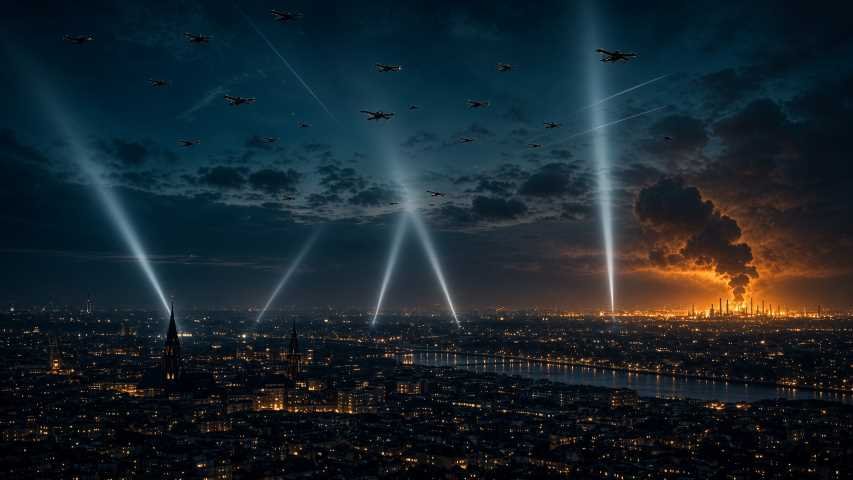
On the night of 19–20 September 2026, Ukrainian forces carried out a large combined operation of long-range drones and missiles against targets inside Russia. The heaviest public attention fell on the Moscow region, where Russian officials said the capital had faced its largest drone assault of the war. Ukraine said the raid was aimed at oil and logistics facilities that help finance and sustain Russia’s war effort. Independent reporting, geolocated video, and later industry sources confirmed a serious fire at the Gazprom Neft Moscow Oil Refinery in Kapotnya and damage at other sites. Civilian casualties were reported in surrounding municipalities. The two governments offered different figures for how many drones were launched, intercepted, or reached a target. Those differences are not a minor footnote. They are the central reporting problem of this story.
The raid did not occur in isolation. It came on the final day of Russia’s first wartime parliamentary elections, during a months-long Ukrainian campaign against Russian refineries, and after U.S. President Donald Trump proposed an energy-strikes moratorium that Ukraine said it would accept and that Russia had not agreed to implement. It also came after a summer in which President Vladimir Putin publicly acknowledged fuel shortages linked to Ukrainian strikes. The night of 19–20 September therefore sits at the intersection of military technology, energy economics, domestic politics, and information warfare.
This article separates confirmed information, official claims, independent reporting, and analysis. Government statements from either side are treated as claims until corroborated. Numbers that cannot be independently counted are presented as attributed figures, not as settled fact.
Executive summary
When: Night of 19–20 September 2026, publicly reported on Sunday, 20 September 2026.
Russian numerical claims: The Defense Ministry said it shot down 1,110 Ukrainian drones overnight across Russia, occupied Crimea, and the Black Sea. In a wider 24-hour tally the same ministry said air defenses destroyed 1,951 fixed-wing drones and eight Flamingo cruise missiles. Moscow Mayor Sergei Sobyanin said more than 1,600 drones had been intercepted since 19 September, including about 450 approaching Moscow.
Ukrainian account: President Volodymyr Zelensky confirmed strikes on a key oil facility and a logistics site in the Moscow region and listed multiple domestic drone and missile types. Ukraine did not publish a matching launch total.
Best-supported physical effects: Fire and damage at the Moscow Oil Refinery; fire at a warehouse complex near Sofyino; acknowledged strikes in 17 Moscow-area municipalities; two to three deaths and about 20 injuries reported by regional authorities; more than 400 flight delays or cancellations across Moscow’s four main airports.
Later industry reporting: On 21 September, Reuters cited three oil-industry sources saying crude processing at the Moscow refinery had halted after both primary distillation units caught fire, and that repairs could take several weeks.
Strategic context: The strike continued Ukraine’s 2026 campaign against Russian refining and logistics. It did not, by itself, decide the war.
What We Know and What Remains Unclear
What can be stated with reasonable confidence
A large Ukrainian long-range package reached the Moscow region and other Russian areas on the night of 19–20 September 2026. Russian officials, Ukrainian officials, geolocated footage, Reuters witnesses who saw smoke over the capital, and later industry sources all point to a fire and damage at the Moscow Oil Refinery. A warehouse complex near Sofyino also burned. Residential buildings were hit in the wider region. Airports around Moscow faced overnight restrictions and a long tail of delays. The operation formed part of a documented campaign against Russian energy infrastructure that had already produced nationwide fuel-market stress earlier in 2026.
What remains unclear
The exact number of drones Ukraine launched is unknown. Russian intercept figures are not the same as launch figures, and Russia’s own statements are not internally identical. The share of armed strike drones versus decoys is unknown. The full list of damaged military or industrial sites beyond the refinery, the warehouse, and reported residential hits has not been independently published. The lasting loss of refining capacity will depend on repair timelines that operators have not officially confirmed. The identity of the system Zelensky called “Pelican” is still disputed in open sources. Casualty counts come from Russian regional authorities and have not been audited by independent investigators in public.
Why a 1,000-drone night matters
By September 2026 the full-scale war was in its fifth calendar year. The front line in eastern and southern Ukraine remained a grinding contest of artillery, glide bombs, small attack drones, and infantry. Behind that line, both sides had built long-range strike campaigns. Russia has used missiles and Shahed-type drones against Ukrainian cities, power plants, and railways throughout the war. Ukraine has spent 2024–2026 industrializing long-range one-way drones and, later, cruise missiles, then sending them against airbases, ammunition sites, and especially oil refineries.
A raid described in four-digit drone numbers is significant for three reasons.
First, scale tests air defense differently from a dozen or even a hundred incoming tracks. Radars, command posts, missile batteries, guns, electronic-warfare teams, and fighter aircraft can handle sparse targets. They struggle when tracks arrive in waves, from several directions, at low altitude, mixed with decoys.
Second, the target set was strategic rather than tactical. A refinery that supplies a large share of fuel to Moscow and the surrounding region is not a trench position. It is part of the economic machinery that keeps a large army and a large city running.
Third, the political timing was deliberate or at least highly convenient for messaging. Russia was concluding a tightly controlled three-day parliamentary election. Ukrainian officials framed the raid as pressure on the war economy. Russian officials framed it as an attempt to disrupt voting. Both frames were aimed at domestic and international audiences.
The broader context includes a failed or unimplemented energy ceasefire idea. On 14 September 2026, President Trump proposed a moratorium on strikes against energy infrastructure. The Institute for the Study of War noted that Zelensky had repeatedly said Ukraine would accept a mutual pause, while Putin had rejected such proposals. The 19–20 September package therefore took place in the absence of any such agreement, not after one had collapsed.
What Happened?
Timeline of major events
Date | Event |
14 September 2026 | Trump proposes an energy-strikes moratorium. Ukraine signals willingness. Russia does not agree. |
Night of 19–20 September 2026 | Large Ukrainian drone-and-missile package against Russia, including Moscow Oblast. |
Early hours, 20 September 2026 | Fires at the Kapotnya refinery and a Sofyino warehouse complex. Residential strikes in the wider region. Temporary restrictions at Moscow airports. |
Morning, 20 September 2026 | Sobyanin calls the raid the largest drone attack on Moscow to date. Zelensky confirms oil and logistics strikes. Final day of State Duma voting. |
Midday–evening, 20 September 2026 | Flight boards show hundreds of delays and dozens of cancellations after restrictions are lifted. |
21 September 2026 | Reuters reports, citing three industry sources, that the Moscow refinery has halted crude processing. |
Night of 20–21 and 21–22 September 2026 | Russia continues drone and missile attacks on Ukraine. |
How the numbers differ
Readers should keep four categories separate:
Drones launched.
Drones detected.
Drones intercepted or jammed.
Drones or debris that reached a target or a populated area.
Public figures available on 20–21 September 2026 mainly describe category 3, as claimed by Russia.
Source and date | Claim | What it covers |
Russian Defense Ministry, 20 September | 1,110 drones shot down overnight | Russia, occupied Crimea, Black Sea |
Mayor Sergei Sobyanin, 20 September | More than 1,600 intercepted since 19 September; 450 approaching Moscow | Capital approaches plus a multi-day running total |
Russian Defense Ministry, 24-hour summary, 20 September | 1,951 fixed-wing drones, eight Flamingo cruise missiles, eight guided aerial bombs, four HIMARS rockets | A full-day national tally, not only the Moscow wave |
Ukrainian presidency, 20 September | Confirmed a major long-range package; listed system types; no launch total | Intent and claimed targets |
ISW assessment, 20–21 September | Largest combined missile-and-drone package against Moscow Oblast since 2022, based on available claims and imagery | Analytical judgment, not an independent drone count |
The 1,110 overnight figure and the 1,951 daily figures can both be true inside Russian accounting if they measure different windows or if the daily number includes other regions and later waves. They can also be inflated, double-counted, or padded with decoys. There is no public radar log that outsiders can audit. Ukraine’s silence on a launch total is also a choice: announcing a number would either confirm Russian claims or expose a gap that Moscow could exploit in messaging.
Areas and targets reported
The most detailed confirmed cluster is in and around Moscow.
Moscow Oil Refinery, Kapotnya. This Gazprom Neft plant sits in the southeast of the city, about 450 kilometers from the Ukrainian border and about 15 kilometers from the Kremlin area. It is one of Russia’s largest refineries. Company and industry data cited by Reuters say it processed 11.6 million metric tons of crude in 2024, or about 230,000 barrels a day, and produced 2.9 million tons of gasoline, 3.2 million tons of diesel, and 1.3 million tons of bitumen. Ukrainian officials have said it supplies more than a third of the Moscow region’s fuel and a high share of gasoline and aviation kerosene used around the capital. Those supply-share figures are Ukrainian or secondary estimates; the processing volumes are firmer.
The Ukrainian General Staff said the strike damaged:
the AVT-6 primary crude-processing unit;
an integrated or combined oil-processing unit, widely identified in later reporting as the Euro+ / KUPN complex;
an isomerization unit, which helps produce higher-quality gasoline components.
Reuters later reported that the AVT-6 unit accounts for about 53 percent of the plant’s capacity (21,400 tons a day) and the Euro+ combined unit about 47 percent (18,800 tons a day). If both primary lines are down, the plant is not merely running at reduced rate. It has stopped making new product from crude.
Warehouse complex near Sofyino. Ukrainian manufacturer Fire Point said its FP-1 drones hit warehouses of Modern Warehouse Technologies LLC. Geolocated footage showed a large fire there. Russian officials acknowledged a fire at the warehouse complex.
Residential and municipal sites. Russian officials said strikes occurred in 17 Moscow municipalities. Governor Andrei Vorobyov described a drone hitting a three-storey residential building in Sofyino and a private house in the Orekhovo-Zuyevo district. A fire at a 21-storey building forced the evacuation of about 400 people, including children. Cars were damaged. These are the events that turn a strategic-infrastructure story into a civilian-harm story.
Other Russian regions. The Defense Ministry listed intercepts over a long belt of regions, including Belgorod, Bryansk, Kursk, Tula, Ryazan, Kaluga, Smolensk, Vladimir, Nizhny Novgorod, Tambov, Saratov, Voronezh, Lipetsk, Oryol, Rostov, Volgograd, and Samara oblasts, Krasnodar Krai, the Moscow region, Crimea, and the Black Sea. An intercept map is not a damage map. Many of those tracks may have been destroyed far from any intended aim point.
Casualties, fires, and property damage
Casualty reporting evolved during 20 September.
Vorobyov first reported two dead: a 74-year-old man and a 44-year-old woman, plus about 20 injured.
Reuters and several other outlets later reported a third death after a wounded person died in hospital.
In Sofyino, five people including two children were among the injured, according to the governor.
Some reports said 15 of the wounded were hospitalized.
These figures are official Russian regional claims. They are consistent across major agencies, which makes them more credible than a one-off social-media post, but they are still not a forensic count.
On the industrial side, Reuters witnesses in Moscow heard blasts and saw plumes of smoke from the refinery area. BBC journalists verified social-media videos of night explosions over Moscow and a burning warehouse. ISW cited geolocated footage of large fires at both the refinery and the Sofyino warehouses. That is stronger evidence than a press statement alone.
One analytical caution is necessary. A fire at a refinery can be started by a direct hit on a processing unit, a hit on a tank farm, falling interceptor debris, or a failed intercept over the site. Russian officials have sometimes blamed damage on their own air-defense missiles in earlier incidents. For 20 September, Ukrainian sources, Russian acknowledgments, and imagery all converge on a Ukrainian strike reaching the plant. The precise terminal event at each unit is less certain.
Aviation disruption
Rosaviatsia, Russia’s federal aviation authority, imposed overnight restrictions at Moscow’s four main airports: Sheremetyevo, Domodedovo, Vnukovo, and Zhukovsky. Restrictions were lifted Sunday morning. The operational aftershock lasted much longer.
Russian business daily reporting compiled from flight boards, later summarized by multiple outlets, pointed to more than 400 delayed or cancelled flights. Approximate board totals circulating on 20 September included:
Airport | Reported disruption on 20 September |
Sheremetyevo | Roughly 30–35 cancellations; about 120 delayed arrivals and 120 delayed departures; some diversions to Nizhny Novgorod, Kazan, Cheboksary, and St. Petersburg |
Vnukovo | 11 cancellations; about 69 delayed arrivals and 60 delayed departures; gradual restoration announced around 12:50 |
Domodedovo | 1 cancellation; about 27 delayed arrivals |
Zhukovsky | 2 cancellations; a handful of delayed movements; operations resumed around 09:00 |
Cancelled or delayed routes included domestic cities such as Sochi, St. Petersburg, Perm, and Mineralnye Vody, plus international destinations such as Istanbul, Antalya, Sharm el-Sheikh, Cairo, Yerevan, and Almaty. Aeroflot and other carriers shifted times and diverted aircraft. This is what a capital-region air-defense event looks like in civilian life: not a permanent shutdown, but a ruined travel day and a reminder that unmanned aircraft now compete with airliners for the same sky.
Ukraine’s drone strategy
Ukraine’s turn to long-range drones was born of necessity. In 2022 and 2023, Kyiv had limited stocks of Western cruise missiles and faced political restrictions on using some of them against Russian territory. Drones could be designed, assembled, and launched with less diplomatic friction. They could also be built in many workshops rather than one politically sensitive factory.
By 2026 the strategy had several layers.
Economic pressure. Zelensky and other Ukrainian officials repeatedly describe refinery and logistics strikes as “long-range sanctions.” The phrase is political, but the mechanism is real: if less crude can be turned into gasoline, diesel, and jet fuel, Russia must ration, import, draw down reserves, or move product over longer distances. Putin himself admitted in late June 2026 that strikes were causing “obvious” problems and a “certain shortage,” while insisting it was “not critical.”
Military logistics. Armies run on diesel. Aircraft run on kerosene. Repair crews, truck convoys, and generators all consume refined product. A campaign that knocks units offline does not have to starve every tank to matter. It only has to make supply less reliable and more expensive.
Air-defense diversion. Every battery tied to Moscow or to a refinery is a battery that cannot cover a bridge, an airfield, or a front-line city. Ukraine cannot know the exact redeployment map, but the incentive is clear.
Political signaling. Striking near the capital on election day tells Russian citizens that distance is no longer protection. It also tells foreign partners that Ukraine still has offensive options even when the land war is static.
Saturation. A few expensive missiles can be intercepted by a well-prepared belt around Moscow. Hundreds or thousands of cheaper aircraft, launched in waves, raise the chance that some will leak through. Decoys multiply that effect.
Domestic production underwrites the whole approach. Open reporting in 2026 described a Ukrainian drone sector that had grown from a handful of pre-war firms to hundreds of producers. FPV drones used at the front are counted in the millions. Long-range strike drones are far fewer but still numerous enough for repeated deep raids. Fire Point, one of the most visible firms, has claimed high daily output of FP-1-class aircraft and a growing cruise-missile line. Those production claims come from the company and from government-friendly briefings. They should be treated as claims. What is not in serious dispute is the trend: Ukraine can now generate large packages that would have been unthinkable in 2023.
The evolution is visible in the public record. Earlier deep strikes used tens of drones. In 2025 and early 2026, Russian overnight intercept claims often sat in the low or mid hundreds. On 18 June 2026, Russian tallies around 992 drones marked a record at the time, and Moscow’s Kapotnya refinery was already a repeated target. By 20 September, official Russian figures had crossed well beyond 1,000 in a single night or day. The direction of travel is larger, more mixed, and more coordinated packages.
The strategy has limits. Drones miss. Air defenses improve. Russia repairs plants. Civilian deaths undermine Ukraine’s political case. Retaliation hits Ukrainian cities. And no refining campaign, however successful, substitutes for holding ground.
Drone technology explained
The systems associated with this raid belong to a family of weapons that sit between hobby aircraft and classic cruise missiles. The following explanation is conceptual. It is not a guide to building, modifying, programming, targeting, or launching any weapon.
Fixed-wing versus multirotor
A multirotor drone, the familiar four-rotor machine, is agile and can hover. It is excellent for short-range reconnaissance or a close attack. It is inefficient for a flight of hundreds of kilometers. A fixed-wing drone looks more like a small airplane. It uses lift from wings and can travel much farther on the same energy. Almost all long-range one-way attack drones in this war are fixed-wing.
One-way attack drones
These aircraft are not meant to land. They carry a warhead to a point on a map. In military language they are loitering munitions or one-way attack unmanned aerial vehicles. In plain language they are cheap, slow cruise weapons. Their value is volume and reach, not elegance.
Navigation, in general terms
Long-range drones typically combine satellite navigation with onboard inertial sensors. Satellite systems tell the aircraft where it is when signals are available. Inertial sensors estimate motion if those signals are jammed or spoofed. Additional methods used in modern unmanned aviation can include pre-loaded route data and, in more advanced designs, optical or other sensors for terminal guidance. The public lesson is simple: attackers design for a contested electromagnetic environment, and defenders try to create one.
Autonomy and communications
A drone flying for many hours cannot depend on an unbroken video link from a pilot. Semi-autonomous flight — follow this route, arrive at this area, then use a stored profile — is the practical solution. Communications links may still allow mid-course updates when they work. When they do not, the aircraft continues on its last plan. That architecture is why electronic warfare is now as important as missiles.
Low-altitude flight
Flying low reduces radar horizon and hides an aircraft behind terrain and ground clutter. It also increases the risk of crashing into obstacles and makes civil air-traffic management harder. Defenders respond with low-level radars, acoustic sensors, optical trackers, guns, and fighter patrols. The contest is between aircraft that try to stay under the radar and networks that try to close that gap.
Warheads and payloads
Public reporting on Ukrainian long-range drones describes warheads intended to damage industrial equipment, fuel infrastructure, or military structures. A processing unit at a refinery is a different target from a tank in a field. Attackers care about whether a blast or fire can stop a machine that takes weeks or months to replace. Defenders care about netting, blast walls, redundancy, and spare parts. None of that requires publishing a recipe.
Mass-launch concepts
“Swarm” is an overused word. In this war it usually means a mass, sequenced launch of many aircraft, sometimes of several types, not a fully self-organizing robot cloud. Waves can exhaust missile magazines. Cheap decoys can look enough like armed drones to force an engagement. Mixing slow propeller drones with faster missiles can force defenders to choose which track to take first.
Commercial and military overlap
Engines, batteries, chips, radios, cameras, carbon fiber, and mapping software exist in civilian markets. War has pulled those components into military production. That is why output can scale faster than traditional missile plants. It is also why export controls, sanctions on electronics, and domestic substitution have become part of the war.
The cost mismatch
A defensive missile may cost many times more than the drone it destroys. A gun or jammer may cost less per shot but needs crews, vehicles, and sensors. A fighter interceptor burns expensive flight hours. The attacker’s bet is that the defender cannot afford a perfect shield. The defender’s bet is that enough intercepts, plus rapid repair, will keep society and the army functioning. The night of 19–20 September is one more round of that wager.
Zelensky publicly named systems used in the package. Open reporting describes them at a high level as follows. Specifications below are manufacturer or official claims, not independently verified performance on this night.
Name as given by Ukraine | Publicly described class | Notes relevant to this event |
FP-1 | Long-range one-way attack drone | Fire Point product; company said it hit the refinery and Sofyino warehouses |
RZ-100, MICH-2000, Palyanytsia, Vendetta, Lyutyi, Bars, Sichen | Long-range strike drones of various Ukrainian designs | Named by Zelensky; detailed performance not independently confirmed for this raid |
Flamingo (FP-5) | Ground-launched cruise missile | Russia said it shot down eight; Ukraine released launch footage in circulation |
Pelican | Disputed | Some Ukrainian sources call it a one-way drone; some Russian and other sources link the name to a ballistic missile project. ISW said it could not verify ballistic-missile use |
Russia’s Defense Ministry acknowledged Flamingo missiles in its 24-hour summary. That is a rare case of both sides naming the same class of weapon. It still does not prove how many were launched or whether any reached a target. The ministry said those approaching the Moscow region were intercepted.
Russia’s air-defense response
Moscow is among the most heavily defended cities in the world. Publicly known layers include long-range surface-to-air systems on the approaches, medium- and short-range batteries closer in, point defenses around sensitive sites, fighter aircraft, electronic-warfare units, and a dense radar picture. After years of Ukrainian raids, Russia has also added nets, physical barriers, mobile fire groups, and patrols around refineries and other infrastructure.
Official Russian messaging on 20 September had three parts:
Almost everything was shot down.
A few objects still caused damage at the refinery and a residential building.
The attack failed in its alleged political goal of disrupting the election.
Sobyanin’s phrase “the largest ever” referred to the capital, not necessarily to every previous nationwide intercept total. The Defense Ministry’s 1,110 overnight figure was itself a record-level claim for a single night in some 2026 tallies. Bloomberg noted that it exceeded a previous 2026 overnight high of 822 in August.
What the claims do not settle is effectiveness. If 450 drones were inbound to Moscow and most were destroyed, the defense worked in a numerical sense. If a primary processing unit and a warehouse still burned, the defense failed in a functional sense. Both statements can be true at once. That is the uncomfortable arithmetic of saturation attacks.
Independent monitors also recorded a domestic communications issue. ISW reported that air-alert sirens and SMS warnings were not activated as some residents expected, while mobile service was restricted. Kremlin-linked and nationalist commentators criticized the lack of warning. That debate is about trust as much as tactics. A government that asks people to vote while drones fly overhead has to decide whether a public alert helps safety or hurts turnout and calm.
Fighter aircraft and electronic warfare almost certainly played a role. Russia routinely uses both against Ukrainian drones. Specific unit-level after-action data was not released in usable form. Analysts should not invent which regiment fired which missile.
Comparison of claims versus verification:
Intercept totals: Russian claims only.
Fire at Kapotnya: confirmed by imagery, witnesses, Ukrainian statements, and Russian acknowledgment of damage to a facility on the site.
Processing halt: industry sources to Reuters on 21 September, not an official company statement.
Civilian deaths: Russian regional officials; consistent across major wires; not independently audited.
Airport restrictions: confirmed by aviation reporting and airport board data.
Russia’s military and strategic response
Russia’s first visible response was rhetorical and administrative: praise the air-defense forces, accuse Ukraine of election interference, keep polling stations open, and present the day as proof of resilience. The second response was military continuity. Russia did not announce a pause in its own long-range campaign.
On the night of 19–20 September, while Ukraine struck toward Moscow, Russian forces also launched drones at Ukraine. ISW cited Ukrainian Air Force figures of 138 Shahed- and Gerbera-type drones and decoys that night, with 101 claimed downed and strikes at multiple locations. On subsequent nights the packages continued. Ukrainian Air Force reports for the night of 21–22 September described a mixed Russian attack including more than 200 Shahed-type drones, decoys, cruise missiles, and ballistic missiles, with air defenses claiming 186 targets shot down or suppressed and hits still recorded at more than 20 locations. Those Ukrainian figures are also claims. They show, at minimum, that the war’s long-range exchange did not stop.
Possible Russian adaptations, stated as analysis:
Thicker point defense at remaining large refineries and at repaired units that have already been hit.
More electronic warfare on likely approach corridors to Moscow.
Relocation of interceptors from quieter regions to the capital, which would improve Moscow’s shield and weaken other areas.
Faster repair kits, spare distillation components, and temporary workarounds such as shipping product from distant plants.
Tighter information control around industrial damage, which already exists and may tighten further.
None of these adaptations is confirmed as a formal new doctrine after 20 September. They are the logical menu. Each item costs money, people, or coverage somewhere else.
Retaliatory intent is easy to assert and hard to isolate. Russia strikes Ukraine every week. A strike on Zaporizhzhia or Dnipro the next day may be vengeance, routine scheduling, or both. Responsible analysis does not treat every subsequent Russian raid as a one-for-one answer to Kapotnya.
Impact on Russia
Military and energy facilities
The most important industrial question is not whether a fire looked dramatic on video. It is whether primary processing stopped and for how long.
Primary crude-distillation units are the front door of a refinery. If they stop, secondary units that make gasoline components, diesel, and jet fuel eventually starve of feedstock. Reuters’ sources said both primary lines at Kapotnya caught fire and that restoring them could take several weeks. Fire Point claimed the plant paused refining and that Russia’s offline refining share rose from 10 to 14 percent. The first statement, from industry sources to a major agency, is more useful than the second, which comes from a combatant manufacturer.
History urges caution. The same plant was badly damaged in June 2026. Some reports then said it might stay down into 2027. Other later accounts said it returned sooner than expected. Repair estimates in this war have often been too long or too short. The honest position on 22 September is: processing was reported halted; duration is unproven.
Transportation and aviation
More than 400 delayed or cancelled flights is a real economic and social cost: hotels, missed connections, cargo holds, crew hours. It is not a strategic defeat. Moscow’s airports reopened the same morning. The more durable aviation effect is psychological and procedural. Airlines, insurers, and passengers now treat drone nights as a recurring operational risk in a city that once marketed itself as far from the front.
Regional economies and civilian life
For residents of Sofyino, Orekhovo-Zuyevo, and apartment blocks that caught fire, the impact was immediate: death, injury, evacuation, damaged homes and cars. For most of Moscow, the impact was smoke on the horizon, phone-network oddities, and travel chaos.
The larger civilian story in 2026 is fuel. After earlier waves of refinery strikes, Russia saw queues at filling stations, regional rationing, export curbs on gasoline and jet fuel, and official discussion of a diesel-export ban. In June, Putin said reserves included about 1.7 million tons of gasoline and that the shortage was manageable. Whether the September hit on Kapotnya recreates June’s queues in the capital will depend on inventories, transfers from other plants, and how long AVT-6 and Euro+ stay down.
Air defense as a resource
Every mass raid consumes interceptor missiles, gun ammunition, aircraft hours, and crew endurance. Russia can replace some of those stocks. It cannot treat them as free. If large Ukrainian packages become monthly rather than exceptional, the air-defense economy around Moscow becomes a running tax on the rest of the war.
Public perception
Russian officials tried to own the story: the enemy failed; voting continued; damage was limited. Visible fire at a plant that supplies the capital cuts against that script. ISW noted discontent in nationalist online spaces about missing sirens. That does not mean a political crisis. It means the gap between official calm and sensory evidence is now a regular management problem for the Kremlin.
Impact on Ukraine
Ukraine’s military objectives, as stated by its president and general staff, were to damage oil and logistics capacity that funds and fuels the Russian army, and to show that long-range pressure continues in the absence of an energy ceasefire.
Potential benefits:
Temporary loss of a major refining node serving the capital region.
Forced Russian expenditure of interceptors and attention.
Demonstration of a mixed domestic arsenal, useful for deterrence messaging and for arguing that partners should add sanctions rather than restrain Ukrainian strikes.
Pressure on Russian repair capacity already stretched by a year of repeated hits.
Potential costs and risks:
High consumption of long-range drones and cruise missiles.
Immediate Russian strikes on Ukrainian cities and infrastructure, which continued in the same 48 hours.
Civilian harm in Russia that Moscow will use in diplomacy and propaganda.
Intelligence exposure: large packages reveal routes, timing, and which designs Ukraine is willing to commit.
Opportunity cost. Airframes sent to Kapotnya cannot also be sent to an ammunition dump or an airfield on the same night.
Resource requirements are not only money. They include launch teams, route planners, satellite and human intelligence, electronic-warfare support, and a factory network that can absorb combat losses. Zelensky’s list of ten system names suggests Ukraine is spreading that load across designs so that the loss of one production line does not end the campaign.
Drones sit alongside — not above — conventional weapons. Ukraine still needs artillery shells, air-defense missiles, armored vehicles, and trained units. A famous night over Moscow can coexist with a difficult week on the Pokrovsk or Zaporizhzhia axes. Treating unmanned systems as a substitute for a ground force is a category error.
Regional impact
Eastern Europe already lives inside the spillover zone of this air war.
Airspace security. Drones and debris do not always respect intended maps. NATO states on the eastern flank have spent two years recording incursions, airport closures, and unidentified tracks. A 1,000-plus-drone night inside Russia raises the background risk that something strays, is misidentified, or triggers a response over a neighboring country.
NATO’s eastern flank. Alliance policy after 2022 has been to arm Ukraine and to harden the border states, not to enter the war directly. Counter-drone sensors, guns, electronic-warfare units, and air-policing aircraft are now part of that posture. The 20 September raid does not change the treaty map. It reinforces why those investments exist.
Aviation. Civil aviation in the region has had to write drone-night playbooks: hold patterns, diversions, temporary closures, passenger communication. Moscow’s 400-plus disrupted flights are a large example of a smaller problem already seen at other airports when unmanned aircraft appear.
Bordering states. Countries next to Ukraine or Russia have to plan for debris, lost drones, hybrid incidents, and public alarm. That planning is already underway. This event adds urgency, not a new category of threat.
The regional lesson is defensive. Governments that never expected to police low, slow, cheap aircraft now treat that mission as ordinary.
Global military technology implications
Militaries far from the Dnipro are studying this war because it compresses several future problems into the present.
Inexpensive unmanned systems matter. A state under arms-import limits can still build a deep-strike arm if it industrializes simple aircraft.
Saturation changes air-defense math. The scarce resource is not always radar coverage. It can be missiles, crew sleep, or the willingness to fire an expensive interceptor at a cheap object.
Offense and defense are co-evolving. Nets, jammers, mobile guns, acoustic sensors, and cheaper interceptors are spreading as fast as attack drones. Neither side has a final answer.
Electronic warfare is central. Navigation and communications are battlefields. The side that can fly without a clean satellite signal, or deny that signal to the other side, gains hours of advantage.
Autonomy will grow. Not because science fiction arrived, but because jammed links make full remote control unreliable at long range.
Manufacturing is strategy. Distributed plants are harder to destroy than a single missile factory. That model will be copied.
Infrastructure is now a standard target class. Refineries, substations, rail yards, and depots were always theoretically vulnerable. They are now practically reachable by mid-sized powers.
The lesson is not that drones win wars. The lesson is that any country that assumes its capital, its airports, or its energy plants are too far from a border to worry is using an obsolete map.
Economic and industrial impact
Cost of attack versus cost of defense
Manufacturer interviews in 2026 have placed some Ukrainian long-range drones in a price band of tens of thousands of dollars, with cruise missiles much higher and still below many Western equivalents. Those figures are commercial claims. Interceptor missiles used by large air-defense systems commonly cost far more per round. Guns and jammers change the exchange rate in the defender’s favor when they work. The strategic point does not require a precise invoice: a campaign that forces nightly high-end intercepts will strain budgets and magazines.
Refining and fuel markets
By mid-2026, independent energy analysis described a severe stress test of Russian refining. The International Energy Agency noted that a Russian refinery was being hit on average once every three days in the first eight months of 2026, and that Ukrainian tactics had shifted toward repeated waves against the same plants. The Oxford Institute for Energy Studies reported that 22 of Russia’s 34 refineries had been attacked in 2026, covering a large majority of national capacity, and that throughput had fallen sharply in the second quarter. Exact percentages vary by source and date. Ukrainian officials have at times claimed offline shares above 40 percent. The IEA has used lower but still serious figures, including “more than 20 percent” at some points. Fire Point’s 10-to-14 percent claim after 20 September is at the conservative end and still unaudited.
What is consistent across reputable energy reporting is direction, not a single magic number: repeated drone strikes have reduced Russian refining flexibility, forced export curbs, and created domestic shortages that even the Kremlin eventually acknowledged.
If Kapotnya remains down for weeks, Moscow and the surrounding region must pull gasoline, diesel, and jet fuel from farther away. That raises transport cost and competes with military demand. If the plant returns quickly, the raid’s economic effect shrinks to a fire, a scare, and a repair bill. The next monthly throughput data will tell more than any statement issued on Sunday morning.
Aviation and logistics
Hundreds of delayed flights impose a one-day cost on airlines and travelers. Repeated events impose a structural cost: buffer time, extra fuel for holding, higher uncertainty, and, eventually, insurance and scheduling changes. Logistics warehouses, if damaged as claimed at Sofyino, add friction to retail and military supply chains that already run tight.
Defense industry and the counter-drone market
Demand is rising for radars that see small slow targets, effectors that shoot them down cheaply, electronic-warfare kits, airport counter-drone systems, and physical protection for tanks and processing units. That demand reaches semiconductor, radio, optics, and aerospace suppliers worldwide. The 20 September raid is not the origin of that market. It is another advertisement for it.
Information warfare and competing narratives
Ukraine’s story: a precise blow against the economic base of an aggressor state, using domestic weapons, on behalf of a country fighting for survival.
Russia’s story: a terrorist-style attempt to frighten civilians and sabotage a national election, largely defeated by professional air defense.
Each story omits something. Ukraine’s story underplays residential hits and the inherent inaccuracy of mass night launches over a metropolitan region. Russia’s story underplays that the chosen industrial target is a cornerstone of fuel supply and that smoke over Kapotnya is hard to reconcile with a picture of total interception success.
Verification tools and their limits:
Official statements are fast and biased.
Geolocation can prove that a fire happened at a known plant.
Satellite imagery can show burn scars and roof damage days later, not always the cause.
Industry sources can reveal whether units actually stopped, which officials may hide.
Social video is abundant and contaminated by old footage.
Casualty lists change and are rarely open to outsiders.
This is why intercept numbers diverge and why responsible coverage prints ranges and attributions. Recycled video is a special problem. After every large night, clips from previous Moscow or refinery fires reappear with new captions. Some outlets and many social accounts do not check. That noise does not mean nothing happened. It means the public square is a poor instrument for counting drones.
International reaction
As of 22 September 2026, major Western institutions had not issued a detailed standalone communiqué devoted only to this one package. That absence should be reported plainly rather than filled with invented quotes.
What is documented around the same window:
Zelensky publicly asked the United States, Europe, and the G7 to add sanctions and to “force peace through strength.”
He said he had spoken with President Trump on Sunday, 20 September, and that they had agreed to meet in New York to discuss de-escalation ideas, including energy security, food security, and protection of civilians.
NATO and the European Union were already, throughout 2026, treating drones, airspace violations, and infrastructure protection as first-order problems after earlier incidents on alliance territory. Those debates predate 20 September and were not launched by it.
No serious government needed a new press release to understand the military meaning of a four-digit drone wave against a European capital region. The diplomatic track — sanctions, summits, proposed ceasefires — continued on its own clock.
What could happen next?
This section is analysis. None of these paths is certain.
Further large-scale Ukrainian packages. Production trends and recent intercept claims suggest Ukraine can assemble waves of this magnitude again. Whether it chooses to do so will depend on stockpiles, weather, intelligence, and political talks.
A thicker Russian shield around Moscow and refineries. The capital’s political importance and Kapotnya’s fuel role make that likely. The hidden cost would be thinner coverage over other oblasts.
Higher output of drones and counter-drone systems. Both defense industries now have a clear requirement. Expect more designs, more decoys, and more cheap interceptors rather than only more elite missiles.
More electronic warfare. Jamming and deception scale faster than building new long-range missile batteries.
Continued infrastructure warfare. Without an implemented energy moratorium, both sides have shown they will keep striking power, fuel, and logistics. Trump’s 14 September proposal remains a diplomatic marker, not a battlefield fact.
Repair-and-strike cycles. Russia repairs; Ukraine hits the same plant again. Kapotnya has already lived that cycle in 2026. The September fire fits the pattern more than it breaks it.
Diplomatic activity. A leaders’ meeting in New York, if it happens, could produce a pause, a narrower energy deal, or only photographs. Military events of this size sometimes move talks. Sometimes they only decorate them.
Uncertainty is not a rhetorical flourish. Launch rates, interceptor stocks, component supplies, and political red lines are all partly hidden. Anyone who claims to know the next three months of this air war is guessing.
Key takeaways
Russian officials said more than 1,000 Ukrainian drones were destroyed on the night of 19–20 September 2026, and more than 1,900 in a 24-hour national tally that also included cruise missiles. Ukraine confirmed a major long-range strike and did not confirm those counts.
Russia presented the night as a successful defense that failed to stop every leaker. Visible fires and later industry reporting on a refining halt show why “most drones were shot down” and “the target still burned” can both appear in the same story.
The publicly named toolkit mixed many one-way drones with at least one cruise-missile type. That mix, not any single miracle aircraft, is the technological story.
Human impact in the Moscow region, by official Russian figures, was two to three dead and about 20 injured, plus evacuations. Economic impact depends on how long the capital’s main refinery stays offline and how much spare product Russia can move.
For Ukraine, the raid advances a campaign that has already shaken Russian fuel markets in 2026. It also spends scarce munitions and invites further retaliation.
For the region, mass unmanned operations near major air corridors are now a standing security and aviation problem.
For militaries elsewhere, the night is evidence that saturation by relatively cheap unmanned systems can trouble even a heavily defended capital.
The largest unknowns remain the true launch number, the real repair timeline at Kapotnya, and whether diplomacy will interrupt the cycle or merely talk around it.
The events of 19–20 September 2026 will be remembered less for a single explosion than for what they reveal about the current phase of the war. Ukraine can now generate long-range packages large enough that Russian officials themselves use four-digit numbers. Russia can still knock down most of what it sees and still lose a processing unit at a refinery that helps fuel the capital. Civilians die in buildings that were not the stated target. Airports stumble for a day. Both governments tell a cleaner story than the wreckage supports.
That is why the raid matters for the future of drone warfare and air defense. The deciding variables are no longer only stealth and speed. They are production volume, decoy ratios, electronic-warfare resilience, repair time, and the cost of each intercept. Countries that study this night and conclude only that “drones are dangerous” will have learned the advertisement. Countries that study the mismatch between intercept claims and industrial damage will have learned the problem.
The war did not turn on 20 September. It did offer a clear, grim illustration of how unmanned systems are changing the defense of cities, refineries, and airspace — and how much of that change is still hidden behind numbers that cannot yet be independently counted.
 |  |  |
 |  |  |