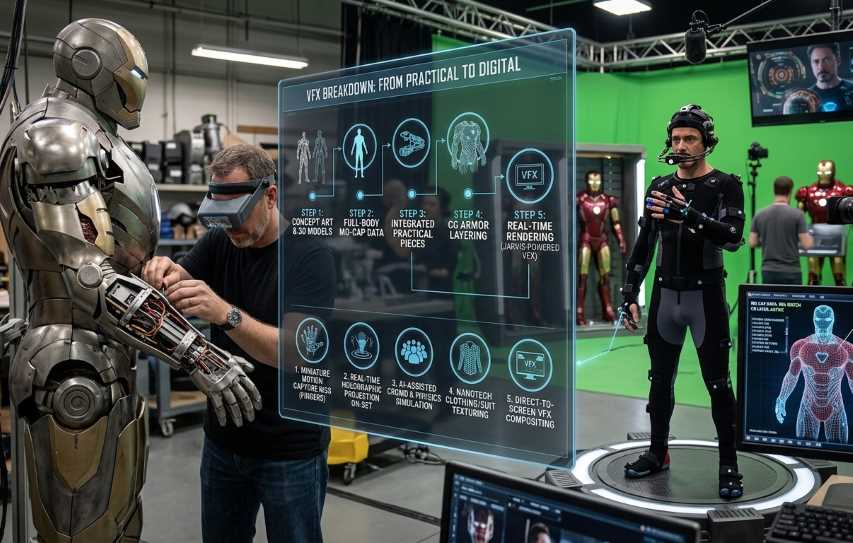
The Iron Man trilogy, released between 2008 and 2013, did far more than simply kickstart the Marvel Cinematic Universe; it fundamentally redefined what was possible in modern blockbuster filmmaking by merging groundbreaking visual effects, practical engineering, and digital wizardry into a seamless experience.
Directed primarily by Jon Favreau, these films emphasized a level of photorealism that made Tony Stark’s high-tech armor feel like something that could genuinely exist in our world rather than pure fantasy. The creative teams blended heavy metal practical suits built by hand with hyper-detailed computer-generated imagery, motion-capture performances that captured every nuance of Robert Downey Jr.’s charismatic acting, and futuristic holographic interfaces that felt intuitive and alive.
This hybrid approach not only delivered jaw-dropping action sequences but also allowed the story to remain emotionally grounded, focusing on Stark’s wit, vulnerability, and genius. What follows is an exhaustive exploration of the behind-the-scenes technology, techniques, and challenges that brought Iron Man to life across all three films, revealing how real-world innovation met cinematic ambition at every turn.
Practical Suits: The Tangible Foundation That Grounded Everything in Reality
At the heart of the trilogy’s realism were the physical armor suits meticulously constructed by Legacy Effects, the renowned studio that evolved from Stan Winston’s legendary workshop. These suits served as the essential reference point for lighting, shadows, reflections, and textures, ensuring that even the most elaborate digital enhancements felt authentic.
The very first suit, the Mark I built for the cave escape sequence in Iron Man (2008), was an absolute monster of engineering—weighing in at a staggering 90 pounds and assembled from thick epoxy armor shells, flexible urethane panels, real leather strapping, and aluminum framing. Every surface was deliberately distressed with simulated welds, torch burns, dents, and grime to convey the desperate, improvised nature of Tony Stark’s invention under life-or-death pressure. The suit was so cumbersome and restrictive that performers could hardly walk, let alone fight or fly, which forced the production to rely heavily on digital doubles for any dynamic movement. Yet those practical limitations paid off: the raw, industrial texture provided VFX artists with perfect real-world data to match in post-production.
As the franchise progressed, Legacy Effects refined their craft for Iron Man 2 and Iron Man 3. They created a library of modular “football jersey” style pieces—partial chest plates, shoulder pads, gauntlets, and half-helmets—that could be quickly swapped on set. The Mark V briefcase suit, for instance, was engineered with collapsing segments that snapped together in a believable mechanical fashion, while the Mark VI and War Machine armors incorporated heavier plating and weapon mounts that were fully functional for close-up shots. Whiplash’s electric whips and harness were built with actual glowing elements and mechanical joints, and the Hammer drones featured lightweight foam-core bodies painted with metallic finishes for on-set interaction.
By Iron Man 3, the team had produced elements for over 36 distinct suit variants, including specialized hero versions like the Shotgun suit (with oversized repulses) and the Nightclub suit (optimized for stealth and close-quarters combat). These physical assets were never meant to perform the impossible stunts; instead, they gave actors something solid to interact with, provided accurate lighting references under real-world conditions, and allowed directors to capture genuine performances without greenscreen everything. The result was armor that reflected light naturally, cast believable shadows, and even dented under impact in ways that pure CGI could never replicate on its own.
CGI Mastery: How Industrial Light & Magic and Global VFX Teams Brought the Impossible to Life
While practical suits provided the foundation, Industrial Light & Magic (ILM) shouldered the enormous task of transforming those assets into fully realized, flying, combat-ready suits of armor. In the first film alone, ILM delivered more than 400 individual visual effects shots, scanning every practical piece with high-resolution cameras to create digital twins accurate down to the millimeter.
The digital pipeline began with detailed 3D modeling that captured every rivet, seam, and brushed-metal finish. Custom shaders were developed to simulate real-world materials—everything from the matte military gray of the Mark II (inspired by stealth aircraft) to the glossy, sports-car-inspired red-and-gold of the Mark III. Techniques such as image-based lighting allowed the team to pull real photographs of the filming locations and environments, then project those exact lighting conditions onto the digital armor so reflections and highlights matched the live-action plates perfectly. Advanced ray-tracing algorithms handled complex interactions like sunlight glinting off curved surfaces or explosions casting dynamic glows across metallic panels.
By Iron Man 2, the workflow had matured significantly. Improved motion-capture integration and faster rendering pipelines meant that entire sequences, such as the Stark Expo fight, could be animated with greater fluidity. The Hammer drones and Whiplash’s harness started as practical builds but were enhanced digitally with energy effects and weapon fire that would have been impossible to achieve safely on set. Iron Man 3 represented the peak of this evolution: more than 2,000 VFX shots were distributed across 17 different studios worldwide, with Digital Domain taking the lead on modeling the revolutionary Mark 42 modular suit. Weta Digital, Scanline VFX, Trixter, and others shared a unified asset library to maintain perfect consistency across dozens of armor variants appearing simultaneously in the climactic final battle. Specialized tools allowed animators to dynamically slice and damage geometry in real time—showing panels shattering, repulsors overheating, or entire limbs detaching—without breaking the underlying rig. This global collaboration ensured that the suits didn’t just look good in isolation; they behaved like real machines under stress, with believable physics, weight, and mechanical intricacy that elevated every action beat.
Motion Capture: Capturing Robert Downey Jr.’s Essence Inside the Armor
Robert Downey Jr.’s performance was never sacrificed for technology; instead, the production built the technology around him. ILM developed a proprietary system called IMoCap (Image Motion Capture), which involved Downey Jr. wearing a specialized black suit covered in hundreds of reflective markers. Multiple high-speed cameras captured his every movement, facial expression, and subtle improvisation in incredible detail.
This data was then transferred directly onto the digital armor models, preserving Downey Jr.’s signature swagger, head tilts, and sarcastic gestures even when the character was fully encased in metal. On set, he often wore partial practical pieces—such as the helmet, chest arc reactor plate, and shoulder armor—combined with tracking markers and witness cameras that recorded his exact position relative to the environment. Greenscreen rigs and timing cues helped him react naturally to invisible suit components flying into place during the famous Mark 42 assembly sequence in Iron Man 3. Animators later layered in the 24 individual armor pieces with precise choreography, making it look effortless while Downey Jr. performed blind to the final effect.
The system evolved with each film. In Iron Man 2, previs animations were generated directly from stunt performers’ mocap data, allowing directors to test complex sequences weeks in advance. By the third film, the IMoCap suit had been refined to capture micro-expressions around the eyes and mouth, ensuring that even the smallest emotional beats—fear during freefall or determination in combat—translated perfectly. This hybrid performance capture approach meant audiences never felt they were watching a cartoon character; they were watching Tony Stark, complete with his wit and humanity, piloting a machine that felt alive because the actor inside it truly was.
The Legendary Heads-Up Display: The Interface That Made Audiences Feel Like Tony Stark
One of the most memorable and technically innovative elements was the glowing Heads-Up Display (HUD) visible inside the helmet—the digital cockpit through which Tony Stark viewed the world. Primarily designed by The Orphanage visual effects house (with later refinements from Cantina Creative), the HUD was engineered to feel like a natural extension of a genius inventor’s mind: sleek, responsive, and never overwhelming.
The interface reacted dynamically to Downey Jr.’s real eye movements and head turns, captured by two tiny cameras mounted inside the practical helmet. This data drove “artificial foveation,” a technique that simulated human eye-tracking so the most important information always stayed in sharp focus while peripheral elements subtly blurred or shifted. Under stress—during dogfights or power failures—the graphics introduced realistic lag, parallax depth, and even minor glitches to heighten tension. The design evolved across films: the Mark II featured a busy cyan color scheme with a bottom dock of mode-switching widgets for diagnostics, weapons, and flight controls; the Mark III streamlined everything into a cleaner white “Omega widget” system that unlocked 3D sub-menus like a holographic keyhole. Iron Monger’s HUD, by contrast, used a stark red military aesthetic to underscore its more brutish nature.
Compositing these intricate graphics required massive computational power. Frames often took up to 48 hours to render in early tests, involving layers of NUKE and After Effects work to blend the HUD seamlessly over Downey Jr.’s live-action eyes. Reflections and lens flares were re-projected onto digital eyeballs to maintain perfect integration. The result was not just a special effect but a storytelling device: audiences literally saw the world through Tony’s eyes, sharing his calculations, fears, and triumphs in real time.
Standout Sequences and Technical Breakthroughs Across the Trilogy
Each film featured landmark sequences that showcased the technology at its peak. In Iron Man (2008), the first flight test combined wire rigs anchored at the feet with full CGI for the suit’s physics, while the cave escape and F-22 dogfight relied on layered explosions, missile trails, and environmental destruction handled by multiple VFX houses. The goal was always photoreal metal that could fool audiences into believing it was entirely practical.
Iron Man 2 (2010) refined the hybrid workflow further. The tuxedo-to-armor transformation at the Stark Expo was achieved entirely in CGI animated over Downey Jr.’s real clothing, with no mocap suit required, proving the system’s flexibility. Hammer drones swarmed in epic aerial battles thanks to improved particle simulations and crowd animation tools that made each drone feel individually intelligent yet part of a coordinated army.
Iron Man 3 (2013) pushed boundaries hardest with the Mark 42’s modular design. Thirty-six unique suits appeared throughout, many capable of detaching pieces as autonomous weapons or shields. Weta Digital’s “Guide Rig Puppet” system allowed animators to cut and reshape geometry on the fly for realistic battle damage. The Extremis virus effect, created by Framestore, used volumetric rendering inspired by real auroras and medical X-rays to make glowing energy flow visibly through veins and skeletons—over 150 shots were automated across studios for flawless consistency. The Mandarin’s mansion attack and the Air Force One rescue sequence combined full digital environments, intricate smoke and fire simulations, and digital doubles performing stunts too dangerous for live actors.
Additional Layers: Sound Design, Directorial Vision, and Lasting Legacy
Beyond visuals, sound design played a crucial supporting role. Every repulse blast, suit clank, and thruster roar were recorded from real machinery and layered with synthesized elements to feel tactile and powerful. Jon Favreau’s insistence on practical reference footage guided every department, ensuring technology served the story rather than overshadowing it.
The trilogy’s innovations rippled outward, establishing the template for the entire Marvel Cinematic Universe. Techniques pioneered here—hybrid practical-CGI pipelines, performance-driven interfaces, and modular digital assets—influenced everything from The Avengers to later phases of the franchise. What began as a single desperate inventor in a cave evolved into a fully realized technological ecosystem that continues to inspire filmmakers and engineers alike. The Iron Man movies remain a masterclass in how cutting-edge technology, when paired with creative vision and human performance, can turn science fiction into something profoundly believable and emotionally resonant. The suits may be fictional, but the ingenuity behind them was very, very real. 🛠️✨
 |  |  |
 |  |  |