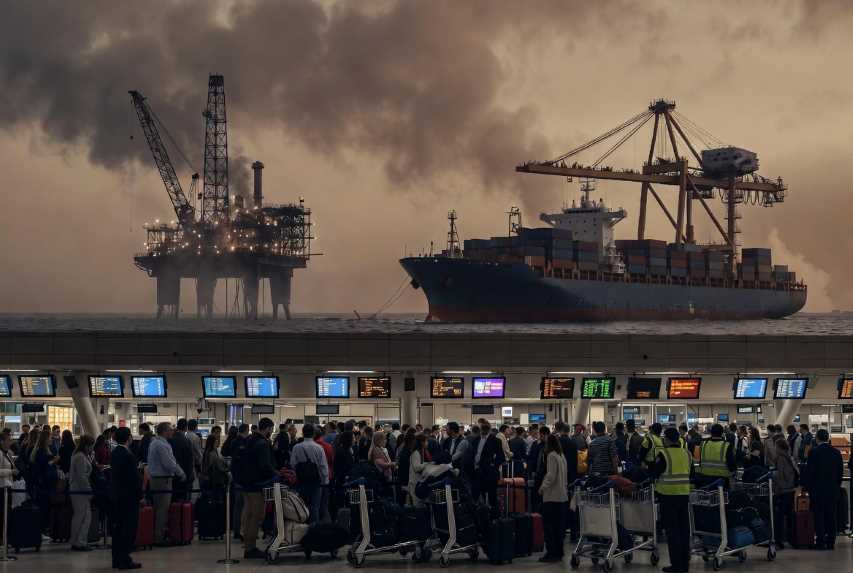
In a dramatic escalation that has gripped the world, the ongoing conflict involving Iran, the United States, and Israel—now entering its third week—has unleashed profound disruptions across key global industries. What began as joint United States-Israeli airstrikes on Iranian nuclear facilities and military targets in late February has evolved into a multifaceted war, with Iran retaliating through missile barrages, drone swarms, and proxy attacks on Gulf states. This has effectively closed the vital Strait of Hormuz, a narrow waterway that serves as a linchpin for international trade and energy flows. The strait, flanked by Iranian territory on one side and Oman on the other, has become a perilous flashpoint, halting shipments and triggering ripple effects that threaten economic stability worldwide. As energy prices soar to unprecedented levels, airlines ground entire fleets amid safety concerns, and shipping routes detour thousands of miles around continents, experts warn of prolonged challenges that could reshape global supply chains for years to come. This article delves into the detailed impacts on aviation, transport, and energy sectors, exploring not only the immediate consequences but also the potential long-term ramifications, drawing on the latest developments from the frontlines and economic analyses.
The Energy Sector: A Chokepoint Crisis Fuels Global Volatility and Long-Term Uncertainty
The war's most immediate and severe blow has landed squarely on global energy markets, where the Strait of Hormuz acts as a critical artery for the transportation of oil, natural gas, and other vital commodities. This 21-mile-wide passage, one of the world's busiest maritime chokepoints, typically facilitates the transit of approximately 25 percent of the world's seaborne oil and 20 percent of liquefied natural gas, making it indispensable for energy security. Iran's retaliatory strikes, which have included sophisticated drone assaults on key infrastructure in Saudi Arabia, the United Arab Emirates, Qatar, and other neighboring countries, have brought transit through the strait to a near-complete standstill. This has suspended the flow of about a fifth of the global crude oil supply and a significant portion of natural gas, leading to immediate shortages in importing nations.
Oil prices have surged dramatically, climbing more than 25 percent since the conflict's onset, with Brent crude briefly surpassing 100 dollars per barrel in early March and showing signs of further volatility. This spike is driven not just by market speculation but by tangible disruptions, including severe damage to refineries, export terminals, and pipelines. Major producers like Saudi Arabia and Kuwait have been forced to halt shipments totaling up to 140 million barrels, an amount equivalent to roughly 1.4 days of global daily demand. Qatar, which dominates the liquefied natural gas market, has issued urgent warnings to its customers about potential delivery failures following an Iranian drone strike on the world's largest liquefied natural gas processing facility. These interruptions are compounding existing pressures from seasonal demand peaks and prior supply chain strains, pushing energy costs to levels not seen since the early 2020s oil crises.
The broader implications extend far beyond immediate price hikes, affecting emerging economies that are particularly vulnerable to energy cost fluctuations. Industries reliant on energy-intensive processes, such as petrochemicals, manufacturing, and heavy industry, are experiencing sharp rises in production costs, which could fuel widespread inflation and slow economic recovery in post-pandemic regions. In Europe, where reliance on Middle Eastern liquefied natural gas has grown amid diversification away from Russian supplies, households and businesses are bracing for higher heating bills and potential rationing during the upcoming winter. Asian powerhouses like Japan and South Korea, which import nearly all their energy needs, are facing factory shutdowns and increased reliance on costlier alternatives like coal, potentially undermining their green transition goals.
In response to the crisis, international bodies have mobilized unprecedented measures. The International Energy Agency has authorized the release of 400 million barrels from member countries' emergency reserves—the largest coordinated drawdown in its history—while the United States has committed to tapping 172 million barrels from its Strategic Petroleum Reserve to help stabilize prices. However, analysts caution that a prolonged closure of the strait could lead to sustained higher prices, as repairing damaged infrastructure might take months or even years, depending on the extent of sabotage and the availability of spare parts amid global sanctions. Beyond hydrocarbons, the region is a major supplier of critical commodities like helium (accounting for 40 percent of global production from Qatar), ammonia, and nitrogen-based fertilizers. Disruptions here could cascade into unrelated sectors, such as semiconductor manufacturing, which depends on helium for cooling, and global agriculture, where fertilizer shortages might reduce crop yields and exacerbate food insecurity in developing nations. This interconnected web of dependencies highlights the fragility of the global energy ecosystem, prompting calls for accelerated investments in renewable sources and diversified supply routes to mitigate future risks.
Aviation Under Siege: Reroutes, Cancellations, Soaring Costs, and Safety Overhauls
The aviation industry, often seen as a barometer of global connectivity and economic health, is reeling from the conflict's multifaceted fallout. Iranian missiles have targeted major airports in Dubai and Doha, which serve as bustling hubs for millions of passengers annually, leading to widespread cancellations that have stranded over a million travelers and disrupted international travel patterns. Airspace closures across the Persian Gulf region have compelled airlines to reroute long-haul flights, avoiding the volatile area entirely. For example, popular routes from Europe to Southeast Asia are now being diverted over safer corridors, such as those passing through northern Turkey, the Caspian Sea, or even as far north as Russia, adding several hours to flight times and increasing fuel consumption by up to 30 percent. These changes not only extend passenger journeys but also strain aircraft maintenance schedules and crew rostering, amplifying operational complexities.
Fuel costs, which already constitute 20 to 30 percent of an airline's operating expenses, have skyrocketed in lockstep with the broader oil crisis, with jet fuel prices mirroring the rise in crude oil. This financial double whammy—coupled with the inefficiencies of longer routes—has hammered airline stocks, causing share prices to tumble by as much as 15 to 20 percent in the war's initial week and prompting credit rating downgrades for several carriers. More than 20 international airlines, including regional giants like Emirates and Qatar Airways, as well as European mainstays such as Lufthansa and British Airways, have suspended all services to and from the Middle East, affecting not only passenger travel but also the air cargo sector, which handles about a third of global trade by value. The reduction in cargo capacity is driving up freight rates for time-sensitive goods like pharmaceuticals, perishable foods, and high-tech electronics, further straining already fragile supply chains that were tested during recent global events.
Governments worldwide are stepping in with emergency measures, organizing evacuation flights for citizens trapped in the region and providing subsidies to offset fuel surcharges. However, the industry faces a longer-term reckoning that could transform its landscape. Even if the conflict resolves swiftly, restoring normal operations might prove challenging, as insurance companies are hiking premiums for any flights near Middle Eastern routes, and pilots' unions are demanding enhanced safety protocols, including advanced missile defense systems on commercial aircraft. For carriers in the Asia-Pacific region, which often rely on Gulf airports for refueling stops on ultra-long-haul flights, the disruptions are especially acute, potentially delaying fleet expansions and leading to across-the-board fare increases that could dampen travel demand among cost-sensitive consumers. Moreover, the crisis is accelerating discussions on sustainable aviation fuels and electric aircraft as hedges against fossil fuel vulnerabilities, though these innovations remain years away from widespread adoption. In the interim, airlines are exploring partnerships for shared routes and capacity to minimize losses, underscoring the sector's adaptability in the face of geopolitical turmoil.
Transport and Shipping: Detours, Delays, and Reshaping of Global Trade Networks
The war's tentacles extend deeply into the maritime transport sector, where the closure of the Strait of Hormuz has paralyzed essential shipping lanes. This chokepoint not only handles energy shipments but also facilitates about 4.5 percent of annual global trade volume, including dry bulk commodities such as aluminum, cement, iron ore, and precious metals. Major shipping conglomerates like Maersk, Mediterranean Shipping Company, and Hapag-Lloyd have been compelled to divert their vessels around Africa's Cape of Good Hope, a detour that adds 10 to 14 days and thousands of nautical miles to voyages connecting Asia to Europe and the Americas. These extended routes are significantly inflating operational costs, with shipping companies introducing "conflict surcharges" to cover heightened insurance risks, additional fuel expenses, and crew overtime, which are ultimately passed on to consumers through higher prices for imported goods.
The fallout is multisectoral and far-reaching, affecting everything from construction to consumer goods. Supply chains for building materials are being hit particularly hard, with delays in steel, cement, and fertilizers leading to widespread project postponements, cost overruns, and potential slowdowns in infrastructure development worldwide. Food security is emerging as a critical concern, as interrupted shipments of fertilizers from Gulf producers could diminish global crop yields, particularly in fertilizer-dependent regions like sub-Saharan Africa and South Asia, echoing the shortages experienced during previous geopolitical disruptions. Asian economies, which are heavily reliant on Middle Eastern energy imports, are grappling with acute shortages of liquefied natural gas, a fuel that is notoriously difficult to store or reroute quickly due to its specialized handling requirements. This is forcing some countries to revert to dirtier energy sources, potentially reversing progress on climate commitments.
The crisis is also exposing deep vulnerabilities in the just-in-time logistics model that underpins modern global trade, where minimal inventories amplify the impact of any delay. Companies are now scrambling to rethink their supply chains, with a surge in interest for nearshoring—relocating production closer to end markets—and diversifying suppliers to reduce dependence on high-risk routes. Ports in alternative regions, such as those in Southeast Asia and the Mediterranean, are seeing increased traffic as shippers seek workarounds, though this is straining capacity and leading to congestion. In the longer term, the conflict could spur investments in alternative infrastructure, like expanded pipelines through Central Asia or enhanced Arctic shipping routes, though these come with their own environmental and geopolitical challenges. Overall, the transport sector's disruptions are a stark illustration of how regional instability can cascade into global economic headwinds, prompting a reevaluation of trade resilience strategies.
Broader Economic Ramifications and the Path Forward Amid Uncertainty
While the Middle East as a whole contributes only 2 to 3 percent to global Gross Domestic Product, the war's indirect effects could shave significant points off worldwide growth projections if the conflict drags on, according to economic forecasts. Inflationary pressures stemming from elevated energy and transport costs are posing substantial political risks, especially in the United States amid upcoming midterm elections, and could force central banks to tighten monetary policies more aggressively, potentially tipping fragile economies into recession. Developing nations, with limited fiscal buffers, may face debt crises as import bills balloon, while wealthier countries contend with consumer backlash over rising living costs.
Yet, amid the gloom, there are glimmers of resilience. Global oil intensity—the amount of oil needed per unit of Gross Domestic Product—has declined by about 36 percent over the past 25 years thanks to technological efficiencies and shifts toward renewables, providing a buffer that buys time for adaptive measures. As diplomatic efforts intensify at the United Nations, with urgent calls for ceasefires, humanitarian corridors, and safe maritime passages, the international community is mobilizing to contain the fallout. A quick de-escalation could limit the damage, but lasting scars on physical infrastructure, investor confidence, and international trust may endure for decades. For now, the Iran war serves as a poignant reminder of the interconnectedness of our world, underscoring the urgent need for diversified energy sources, robust contingency planning, and stronger multilateral frameworks to prevent such crises from recurring.
 |  |  |
 |  |  |