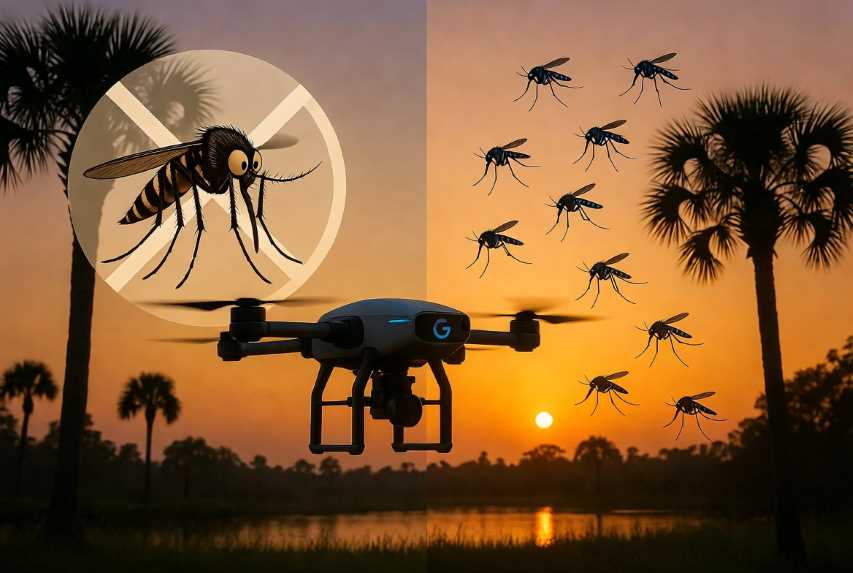
In recent days, dramatic claims have spread across social media and news feeds suggesting that Google plans to “release millions of mosquitoes on humans” across Florida. The headlines are eye-catching and, in many cases, deliberately sensational. The actual story is far more interesting, scientifically sophisticated, and grounded in decades of public health research combined with cutting-edge technology.
Alphabet’s life sciences company Verily, through its long-running Debug project, has submitted a formal request to the U.S. Environmental Protection Agency for an experimental use permit. If approved, the project would involve the release of up to approximately 32 million specially treated male mosquitoes over a two-year period in targeted areas of Florida and California. These are not ordinary mosquitoes. They are laboratory-reared males infected with a naturally occurring bacterium that prevents them from successfully reproducing with wild females. The goal is to gradually and sustainably reduce populations of disease-carrying mosquitoes without relying heavily on chemical pesticides.
This is not a reckless experiment or a sci-fi plot. It represents the latest evolution in a field known as biological vector control — using nature’s own tools, enhanced by modern automation and data science, to solve a persistent public health challenge. Florida, with its warm climate, abundant water sources, and history of mosquito-borne illness, is a logical place to test and refine such approaches. But before exploring the details, it is important to understand exactly what is being proposed and why the viral framing misses the mark entirely.
The Proposal in Full Context
Verily’s application centers on the southern house mosquito, Culex quinquefasciatus. This species is a known vector for West Nile virus, St. Louis encephalitis virus, and other pathogens that can cause serious illness in humans and animals. Unlike the more famous Aedes aegypti mosquito that spreads dengue, Zika, and yellow fever, Culex mosquitoes are particularly active at dusk and dawn and often breed in urban and suburban water sources such as storm drains, ditches, and containers.
The request calls for the release of up to 16 million treated male mosquitoes per year for two years in Florida, with a parallel program in California. The total figure of roughly 32 million across both states over the full period has been widely cited in coverage of the Federal Register notice. These releases would not happen everywhere at once. They would be carefully targeted to specific zones where mosquito surveillance shows high populations of the target species. The mosquitoes would be released in controlled, monitored batches using precision methods developed over years of testing.
Importantly, every mosquito released would be male. Male mosquitoes do not bite humans or animals because they do not require blood meals for reproduction. Only female mosquitoes bite. This single biological fact dramatically changes the risk profile of the project. There is no possibility of increased biting pressure on residents. The released insects are also infected with Wolbachia pipientis, a common bacterium found naturally in many insect species around the world. It does not make the mosquitoes more aggressive or dangerous. Instead, it creates a reproductive barrier.
How Wolbachia-Based Suppression Actually Works
To understand why this approach is promising, it helps to look at the underlying biology. When male mosquitoes carrying a specific strain of Wolbachia mate with wild females that lack that strain, a phenomenon called cytoplasmic incompatibility occurs. The eggs the female lays either fail to develop properly or the resulting larvae die before reaching adulthood. Over multiple generations, this leads to a measurable decline in the overall mosquito population in the release area.
This is not the same as releasing genetically modified insects that carry a lethal gene designed to kill all offspring. It is also different from traditional sterile insect technique programs that rely on radiation or chemicals to sterilize males. The Wolbachia method uses a naturally occurring symbiotic relationship that has been studied extensively for more than fifteen years. Because only males are released and they cannot pass the bacterium on in a self-sustaining way through the wild population, the effect is largely self-limiting. Once releases stop, the suppression effect gradually fades as new wild mosquitoes move into the area or reproduce normally.
Scientists describe this as an inundative release strategy. Large numbers of incompatible males are flooded into the environment for a defined period, overwhelming the wild population’s ability to produce the next generation. It is a form of biological control that leaves non-target species largely untouched and avoids the broad environmental footprint of widespread insecticide spraying.
Florida’s Ongoing Battle with Mosquitoes
Florida has long been on the front lines of mosquito control in the United States. The state’s subtropical climate, extensive coastline, wetlands, and rapid urban development create ideal conditions for several mosquito species. West Nile virus has caused periodic outbreaks, sometimes leading to serious neurological illness and, in rare cases, death. Other mosquito-transmitted pathogens also circulate. Local mosquito control districts work year-round using a combination of source reduction, larvicides, adulticides, and public education.
Despite these efforts, mosquitoes remain a persistent nuisance and a genuine public health concern. Chemical pesticides, while effective in the short term, can contribute to resistance in mosquito populations over time. They may also affect beneficial insects, pollinators, and aquatic ecosystems when used broadly. This is why vector control professionals have long sought additional tools that are species-specific, environmentally gentler, and capable of providing longer-term suppression.
The Culex quinquefasciatus species targeted in Verily’s proposal is particularly well-suited to this Wolbachia approach because it is a competent vector for several viruses and because previous research has shown that Wolbachia can induce strong incompatibility in this group. Florida’s existing mosquito surveillance infrastructure and experienced control districts make it a practical location for a well-designed field evaluation.
The Debug Project: More Than a Decade of Development
Verily’s Debug initiative did not appear overnight. It grew out of earlier work at Google’s life sciences efforts and has been running for more than ten years. The project’s core mission is to develop scalable, data-driven technologies that reduce the global burden of mosquito-borne diseases without relying exclusively on chemicals or traditional pesticides.
Early work focused heavily on Aedes aegypti, the primary vector for dengue. Partnerships in places like Singapore demonstrated that large-scale releases of Wolbachia-treated males, combined with advanced rearing and release technology, could achieve dramatic population reductions. In Singapore’s Project Wolbachia, suppression rates exceeding 90 percent were recorded in some study sites, correlating with meaningful drops in dengue transmission. Similar positive results emerged from trials in California’s Central Valley, where reductions approaching 95 percent were observed in certain areas.
The current proposal marks an expansion of the technology to a new mosquito species and new geographic contexts in the United States. While the underlying biological principle remains the same, adapting it to Culex quinquefasciatus required additional laboratory work to identify the most effective Wolbachia strain and to optimize rearing protocols. The shift also highlights how the same platform can potentially address multiple disease vectors by tailoring the approach to local ecology and epidemiology.
The Critical Role of Automation, AI, and Precision Technology
One of the most distinctive aspects of Verily’s contribution is not the biology itself but the engineering layer built around it. Producing and releasing millions of high-quality male mosquitoes requires solving several difficult logistical problems at scale.
First, mosquitoes must be sex-sorted with extremely high accuracy. Releasing even a small percentage of females would be counterproductive because females bite and could potentially transmit disease. Traditional manual sorting is slow and error-prone. Verily developed AI-powered computer vision systems that can distinguish males from females based on subtle physical differences, often at speeds and accuracy levels far beyond human capability.
Second, rearing millions of insects consistently requires sophisticated automation. Larval rearing robots, environmental controls, and data monitoring systems help maintain optimal conditions while minimizing labor and variation between batches. Third, once the males are ready, they must be transported and released in precise locations and quantities. GPS-enabled release systems and route optimization software allow teams to cover large areas efficiently while adjusting in real time based on surveillance data.
These technologies turn what was once a labor-intensive, artisanal process into something closer to a precision manufacturing and logistics operation. The result is greater consistency, lower cost per mosquito over time, and the ability to scale releases to the levels needed for meaningful population impact. In an era when artificial intelligence and robotics are transforming industries from manufacturing to agriculture, it is notable to see the same tools applied to entomology and public health.
Potential Benefits That Extend Beyond Disease Reduction
If the experimental releases prove successful, the advantages could be substantial. A sustained reduction in Culex populations would likely translate into fewer West Nile virus cases and lower overall mosquito nuisance levels. Because the method is species-specific, it avoids the collateral damage sometimes associated with broad-spectrum insecticides. This is particularly relevant in ecologically sensitive areas or neighborhoods where residents prefer to minimize chemical exposure.
There are also economic considerations. Mosquito control is expensive for local governments and districts. Effective biological tools could complement existing programs and potentially reduce the frequency or intensity of pesticide applications in certain zones. Over the longer term, successful demonstration projects could accelerate the development of similar programs in other states facing comparable challenges.
From a broader innovation perspective, the project illustrates how computational biology, automation, and field ecology can converge to create new solutions. It shows that technologies originally developed for very different purposes — image recognition, robotic handling, large-scale data analysis — can be repurposed to address longstanding problems in global health.
Safety Considerations and Common Questions Addressed
Any proposal involving the release of large numbers of insects naturally raises questions. The most frequent concerns include whether the mosquitoes will bite people, whether the bacterium could spread uncontrollably, and what the long-term ecological effects might be.
On biting: Only female mosquitoes take blood meals. All insects in the proposed releases are males, which feed exclusively on nectar and plant juices. There is no mechanism by which these releases would increase biting activity.
On Wolbachia spread: Because the strain induces incompatibility, infected males produce non-viable offspring when mating with wild females. The bacterium does not easily establish itself in the wild population through these releases. This distinguishes it from “replacement” strategies in which both males and females carrying Wolbachia are released with the goal of eventually replacing the wild population with a disease-resistant version.
On ecological impact: Extensive research and previous field deployments have shown that Wolbachia-based male releases have minimal effects on non-target species. The approach is highly specific to the target mosquito. Regulatory reviews by the EPA and similar agencies in other countries are designed to evaluate these questions rigorously before any permit is granted.
It is also worth noting that this is an experimental use permit, not a full commercial registration. The primary purpose of the proposed work is to generate high-quality field data under real-world conditions. Results would inform future decisions about whether and how to scale the technology.
The Regulatory Path and Current Status
The application was formally noticed in the Federal Register in early May 2026. The EPA opened a public comment period that concluded on June 5, 2026. During that window, any interested party could submit scientific, environmental, or community perspectives. As of mid-June 2026, the agency is reviewing the full application package, including supporting data on the mosquitoes, the release strategy, and environmental considerations.
An experimental use permit is a standard regulatory tool used for field testing of new pest control products. It allows limited, controlled releases under strict conditions while additional data is collected. Approval, if granted, would come with specific requirements for monitoring, reporting, and containment. It would not automatically authorize unlimited or permanent releases across the entire state.
The process is deliberately transparent and science-based. Decisions ultimately rest on whether the proposed activities are likely to be effective and whether risks are adequately managed.
What Success Could Mean for the Future
Should the Florida and California evaluations demonstrate clear population suppression with acceptable safety and practicality, several pathways could open. Other states dealing with Culex-transmitted viruses might explore similar programs. The underlying platform — automated rearing, AI sorting, and precision release — could be adapted to additional mosquito species or even other insect vectors.
More broadly, the work contributes to a growing toolkit of biological and genetic approaches to vector control. These methods sit alongside traditional integrated pest management rather than replacing it entirely. The most effective programs of the future will likely combine source reduction, targeted pesticides where needed, community engagement, and advanced biological tools like the one Verily is testing.
For technologists and innovators, the project offers a compelling case study in applying advanced engineering to messy, real-world biological systems. It underscores the importance of rigorous field validation, regulatory partnership, and clear communication with the public.
Key Takeaways
The proposal from Verily’s Debug project is a serious, science-driven effort to expand the options available for mosquito control in the United States. It builds on more than a decade of laboratory and field research, leverages sophisticated automation and artificial intelligence, and targets a specific public health problem with a biologically precise tool.
The mosquitoes involved are male, non-biting, and infected with a naturally occurring bacterium that disrupts reproduction in the target species. Releases would be limited, monitored, and subject to EPA oversight. While headlines may suggest something dramatic or risky, the underlying approach is conservative in its biology and ambitious in its engineering.
Florida’s residents and mosquito control professionals have every reason to follow the regulatory process closely. Whether or not this particular permit is approved, the larger trend is clear: biology and technology are converging to create new, potentially more sustainable ways to protect communities from insect-borne disease.
In a world facing evolving infectious disease threats and growing awareness of the environmental costs of certain control methods, innovations like this deserve careful consideration rather than reflexive alarm. The coming months will reveal how regulators weigh the data and how the public conversation evolves. For now, the accurate story is one of patient scientific development meeting modern technological capability in service of a very old human challenge: living more comfortably and safely alongside the natural world.
 |  |  |
 |  |  |