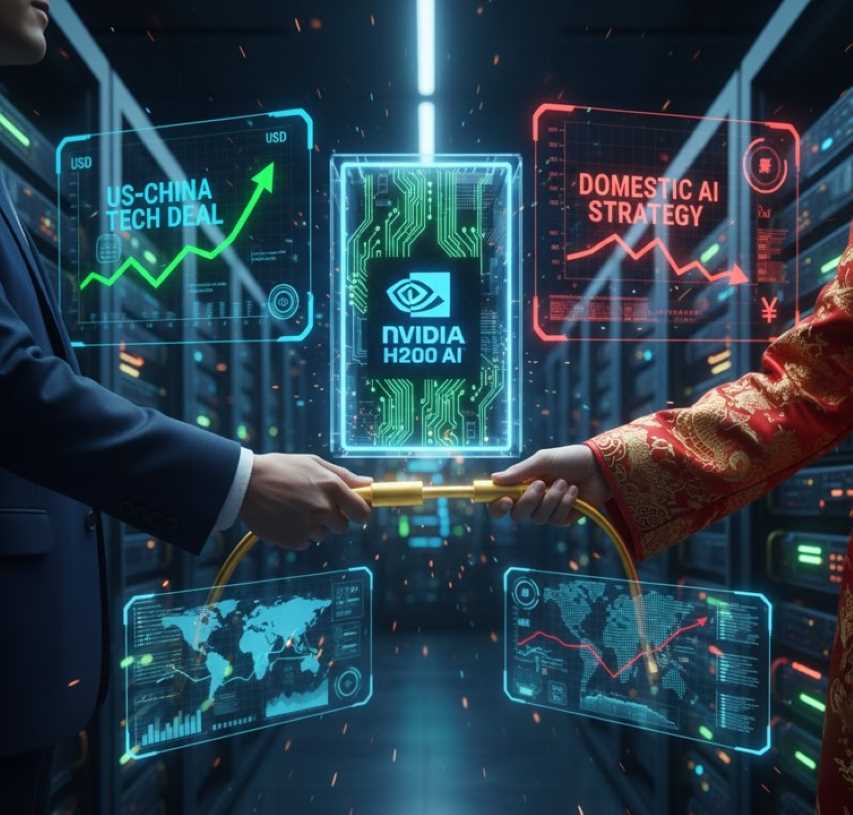
In a surprising turn within the ongoing United States and China technological rivalry, President Donald Trump announced earlier this month that the United States would lift export restrictions on Nvidia’s advanced artificial intelligence chips. This policy shift allows for the sale of the H200 model to approved customers in China. However, Beijing has largely rebuffed the gesture, signaling a preference for domestic alternatives and underscoring its push for technological self-sufficiency.
The Announcement: A Reversal of Long-Standing Restrictions
On December 8, 2025, President Trump declared the policy shift via his social media platform, Truth Social. He revealed that he had informed Chinese President Xi Jinping of the decision, claiming the Chinese leader responded positively.
Key Details of the New Policy:
Product: Nvidia is permitted to ship H200 processors—the company’s second-most powerful artificial intelligence chips—to China.
Oversight: Sales remain subject to national security reviews by the United States Department of Commerce.
Revenue Sharing: In a unique stipulation, 25% of revenues from these sales will be funneled back to the United States government as a fee, collected as an import tax from Taiwan, where the chips are manufactured.
This decision marks a significant departure from decades of United States export controls. Previous restrictions were designed to prevent advanced semiconductors from bolstering China’s military capabilities and surveillance systems. The H200 is nearly six times more powerful than the H20—the downgraded version previously offered to China—offering substantial improvements in artificial intelligence training and inference.
President Trump framed the policy as a victory for American interests, arguing it would protect national security, create jobs, and maintain United States dominance in artificial intelligence. The announcement followed intense lobbying by Nvidia Chief Executive Officer Jensen Huang and advocacy from White House artificial intelligence coordinator David Sacks.
China’s Refusal: A Strategic Snub
Despite the optimistic portrayal from Washington, China’s response has been far from enthusiastic. In the weeks following the announcement, Beijing has effectively turned down the H200 chips, instructing state-backed entities and technology firms to prioritize domestic semiconductors.
"China is 'outfoxing' United States strategy by favoring homegrown options like those from Huawei, Cambricon, and Moore Threads." — David Sacks, White House Artificial Intelligence Coordinator
Analysts suggest this rejection is part of a broader strategy to reduce reliance on American technology. While private Chinese giants like ByteDance and Alibaba have expressed interest in the H200, government directives have discouraged purchases, leading to estimates of up to $10 billion in potential lost revenue for Nvidia.
Implications for Global Technology Relations
This episode highlights the complexities of United States and China relations during President Trump’s second term. The move has faced criticism and praise from different factions:
Perspective | Argument |
|---|---|
Critics | Argue that the export approval is a failure that hands China a competitive edge in artificial intelligence without gaining meaningful concessions. |
Proponents | Believe the rejection proves China is making a strategic miscalculation that will hinder its progress while United States firms advance with next-generation chips. |
Market Impact | Nvidia stock initially surged but has since tempered due to reports of China’s lack of interest. |
As of late December 2025, the broader impact on global supply chains and the artificial intelligence arms race remains uncertain. What is clear is that the attempt at a technological olive branch has been met with skepticism, reinforcing Beijing's resolve to forge its own independent path in high technology.
 |  |  |
 |  |  |