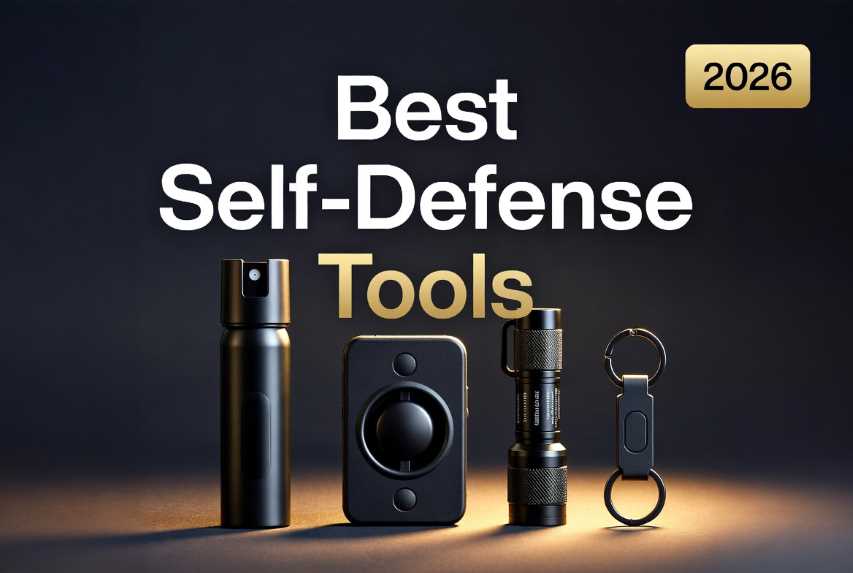
Stay aware, stay prepared, and prioritise safety above all.
Choosing a self‑defense tool is a deeply personal decision. The right tool depends on your lifestyle, your local laws, your physical abilities, and your comfort level with different technologies. This guide explores the most common, legally accessible options available today, explains how they work, and helps you make an informed choice.
🛡️ Pepper Spray & Pepper Gel
The Everyday Standard
Pepper spray is widely considered the gold standard for non‑lethal, personal protection. It is legal in all 50 US states (with some restrictions), affordable, and requires very little training to use effectively.
Pepper spray products deploy Oleoresin Capsicum (OC) , an oil‑based resin extracted from hot peppers. When it contacts an attacker's eyes, skin, and respiratory system, it triggers immediate and involuntary effects: intense burning, temporary blindness, coughing, and difficulty breathing. These effects typically last 30 to 45 minutes but are not permanent.
Pepper gel is a modern alternative. Instead of a liquid mist, it releases a thick, sticky gel that travels in a concentrated stream. Gel is less affected by wind and less likely to blow back into your own face, and it sticks to the attacker's skin, making it harder to wipe away. It does require better aim than a traditional spray.
Key features to look for:
Range: Most sprays reach 6 to 12 feet, while premium gels can reach up to 18 feet.
Burst count: A typical compact canister provides 12 to 18 half‑second bursts.
Carry method: Keychain models, clip‑on holsters, and palm straps are available.
Dye marker: Some products include an invisible UV dye to help police identify an attacker.
Recommended practice: Buy an inert practice unit and test it outdoors to understand its spray pattern and range. Always check the expiration date and replace the unit every 2–3 years.
⚡ Stun Guns vs TASERs
Close‑Contact vs Stand‑Off Protection
Although the terms are often used interchangeably, stun guns and TASERs work very differently. Choosing the wrong type could leave you vulnerable in a critical moment.
Feature | Stun Gun | TASER® |
|---|---|---|
| Range | Contact only – must touch attacker's body | Up to 15 feet – fires two probes |
| Effect | Pain compliance and sensory disruption | Neuromuscular incapacitation (loss of muscle control) |
| Mechanism | Two metal prongs deliver high‑voltage, low‑amperage shock | Probes embed in skin; electrical pulses disrupt motor nerves |
| Reusability | Can be used repeatedly until battery dies | Cartridge is single‑use; device body is reusable |
| Size | Compact, easy to conceal | Bulkier, shaped like a pistol |
| Legal status | Illegal in some states (HI, MA, RI, MI, and others) | Legal in most states with restrictions |
Stun guns require you to get within arm's reach of an attacker, which is inherently risky. However, they are small, concealable, and can be used repeatedly.
TASERs fire two small probes that attach to the attacker's clothing or skin, delivering an electrical pulse that temporarily overrides the body's neuromuscular system, causing involuntary muscle contractions and loss of coordination. This gives you a stand‑off distance to escape.
⚠️ Important: Voltage ratings are misleading. A 50,000‑volt stun gun may sound powerful, but the actual incapacitating effect depends on microcoulombs, not volts.
🔊 Personal Alarms
The No‑Contact Deterrent
Personal alarms are small, keychain‑sized devices that emit a deafening siren — typically 130 dB, roughly as loud as a rock concert — when a pin is pulled or a button is pressed.
How they help:
The sudden loud noise can startle an attacker and attract attention.
They are legal in all 50 states and suitable for all ages, including children and seniors.
They can be activated quickly, even under stress.
However, alarms do not physically stop an attacker. In noisy environments or isolated areas, the sound may not attract help. Experts warn that a personal alarm alone is not a reliable self‑defense tool, but it can be a useful addition to a broader safety strategy.
🔑 Keychain Self‑Defense Tools (Kubotons, Cat Ears, Striking Tools)
Keychain‑sized striking tools come in many forms: kubotons (small rods), pointed "cat ear" keychains, and weighted knuckle tools.
Kubotons (or tactical keychains) are 5–6 inch rods made of hard plastic or metal. They are designed to amplify the force of a strike, allowing you to target pressure points such as the collarbone, groin, solar plexus, or temple.
Cat‑ear keychains feature two sharp points intended for scratching or striking. However, these are illegal in many states, including California, Illinois, Michigan, New York, Massachusetts, and New Jersey, and are prohibited in carry‑on luggage by the TSA.
Kubotons are generally legal in most states, but their legality can vary by city.
🔑 The most important factor is training. Without proper technique, these tools provide little more than a false sense of security. Simply carrying one does not make you safe.
✍️ Tactical Pens
Everyday Carry That Blends In
A tactical pen is a pen‑shaped device built from durable materials such as aircraft‑grade aluminum, stainless steel, or titanium. It functions as a normal writing instrument but includes a hardened strike tip for breaking glass or striking an attacker.
Because tactical pens resemble ordinary pens, they are generally easier to carry legally in places where knives or firearms are restricted. They are compact, discreet, and offer a non‑lethal option for self-defense. Some models include a "DNA catcher" – a textured surface that can collect skin cells from an attacker for later forensic identification.
However, effectiveness requires training and physical strength. A tactical pen is a close‑contact tool; you must be within arm's reach to use it effectively. Some jurisdictions may classify it as a weapon depending on local laws, and they are prohibited in carry‑on luggage for air travel.
🧭 How to Choose the Right Tool: A Decision Guide
Your priority | Recommended tool | Why |
|---|---|---|
| Legal everywhere, easy to use | Pepper spray or gel | Legal in all 50 states, requires minimal training |
| Maximum stand‑off distance | TASER | Fires probes up to 15 feet away |
| No physical contact, no legal risk | Personal alarm | Legal for all ages in all states |
| Discreet, pen‑shaped, everyday carry | Tactical pen | Looks like a normal pen; useful for escape and utility |
| Last‑resort impact tool | Kuboton (with training) | Amplifies striking force; small and concealable |
| Close‑contact pain compliance | Stun gun | Small, reusable, but check local laws first |
⚖️ Legal Landscape & Travel Considerations
Laws regarding self-defense tools vary significantly. Carrying a tool that is legal in one state could result in criminal charges as soon as you cross into another.
Pepper Spray Restrictions
California: Maximum container size of 2.5 oz; some formulas banned.
New York: Cannot be shipped; must be purchased in person from a licensed dealer.
Massachusetts: Requires a Firearms Identification Card to possess pepper spray.
Most states require users to be at least 18 years old.
Stun Guns and TASERs
Stun guns are illegal to sell in Hawaii, Massachusetts, Rhode Island, Michigan, and some cities including Chicago.
Keychain Tools
Cat‑ear and knuckle keychains are illegal in many states, including CA, IL, MI, NY, MA, and NJ. TSA prohibits them in carry‑on luggage.
TSA Air Travel Rules
With limited exceptions, self-defense tools are not allowed in carry‑on luggage:
Pepper spray must be checked and cannot exceed 2% tear gas concentration.
Stun guns, TASERs, kubotons, cat ears, and tactical pens must be placed in checked baggage.
Personal alarms are generally permitted in carry‑on luggage.
⚠️ Always check local laws before purchasing or carrying any self-defense tool, especially when travelling across state lines or internationally.
🧠 Common Self‑Defense Myths & Misconceptions
❌ Myth: "Any tool is better than no tool."
✅ Fact: A tool you cannot deploy, do not know how to use, or have not practiced with is more dangerous than no tool at all. It can give you false confidence and escalate a confrontation.
❌ Myth: "Personal alarms will stop an attacker."
✅ Fact: Alarms attract attention; they do not physically stop anyone. In noisy or isolated environments, they may be ignored.
❌ Myth: "Voltage tells you how powerful a stun gun is."
✅ Fact: Incapacitation depends on microcoulombs (current × time), not voltage. Voltage only helps the current penetrate clothing.
❌ Myth: "One class or YouTube video is enough training."
✅ Fact: Effective use of any self-defense tool requires regular, hands‑on practice under simulated stress. Muscle memory degrades without repetition.
🏁 Final Thoughts
No single tool guarantees safety. The most effective self-defense strategy combines:
Situational awareness – noticing potential threats before they escalate.
Avoidance and de‑escalation – whenever possible, the best fight is the one you never have.
A well‑chosen, legally compliant tool – one you have practiced with regularly.
Physical preparedness – basic fitness and an understanding of vulnerable targets.
Carrying a tool is not a replacement for training. A tool you have not practised with, cannot access quickly, or do not know how to deploy under stress is worse than carrying nothing at all. Spend time training, know your local laws, and always remember: the goal of self-defense is not to "win" a confrontation. It is to escape safely and go home.
 |  |  |
 |  |
|
