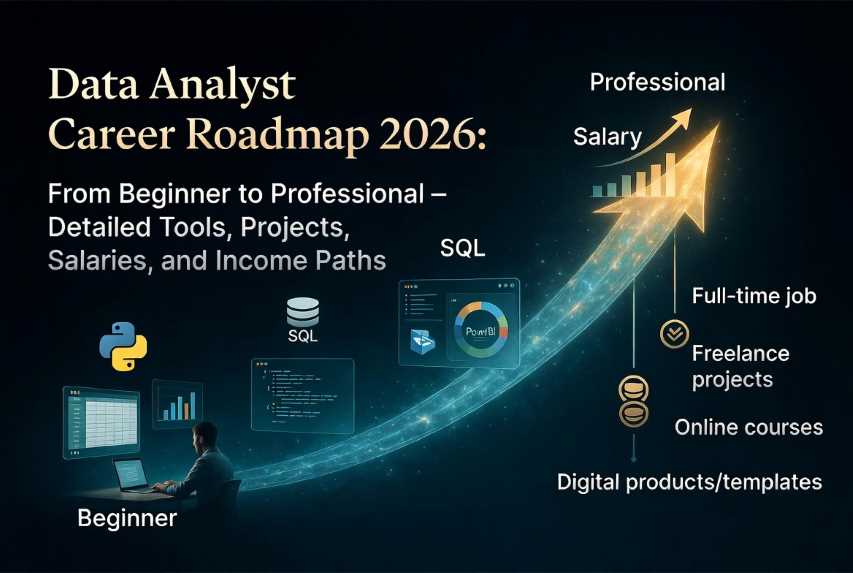
Data analysis stands as one of the most powerful and future-proof careers available today. In 2026, every major industry — from technology and finance to healthcare, retail, manufacturing, logistics, and even creative fields — depends on professionals who can transform raw numbers into clear stories that guide decisions. Companies no longer guess what customers want or where inefficiencies hide. They rely on data analysts to reveal patterns, predict outcomes, measure performance, and recommend specific actions that save money, increase revenue, improve customer satisfaction, and drive innovation.
The role has evolved dramatically because of artificial intelligence. Analysts who treat AI as a powerful co-pilot rather than a threat now complete deeper analysis in less time, explore more scenarios, generate hypotheses faster, and focus their human judgment on the highest-value insights and recommendations. This shift has increased demand for skilled analysts while raising the bar for what “good” looks like. The professionals who thrive combine strong technical foundations with business understanding, excellent communication, and smart use of modern AI-enhanced tools.
This guide gives you everything you need. It is written to be followed step by step, whether you are starting from zero, switching careers, or already working in a related field and wanting to move into data analysis or advance quickly. You will find detailed explanations of every skill, realistic timeframes, multiple learning paths, common obstacles and how to overcome them, in-depth coverage of the tools that matter most in 2026, five complete project walkthroughs you can build yourself, a full picture of how much money you can earn and exactly how to earn it through jobs, freelancing, and additional streams, interview preparation, portfolio advice, and long-term career strategies.
By the end of this guide, you will have a clear 6-to-12-month action plan and the confidence to begin or accelerate your journey.
The 2026 Data Analyst Landscape and Why This Is the Best Time to Start
The job market for data analysts remains strong and growing. Organizations continue to collect more data than ever from websites, apps, sensors, transactions, customer interactions, and internal systems. At the same time, AI tools have made it easier and faster to process and interpret that data, which actually increases the need for humans who can ask the right questions, validate results, translate findings into business language, and ensure ethical and accurate use of information.
Successful analysts in 2026 typically earn competitive compensation that reflects the value they create. Entry-level roles often start in a solid range, while professionals with two to five years of experience and strong portfolios or specialized skills regularly reach higher brackets. Senior analysts, leads, and those who combine analysis with domain expertise or advanced technical capabilities can command significantly more. Remote and hybrid arrangements are common, opening opportunities to work with companies in higher-paying markets regardless of physical location.
What sets top performers apart is not just tool knowledge but the ability to connect data work directly to business outcomes. They do not simply produce charts. They frame problems clearly, choose the right analysis approach, surface surprising or actionable findings, and present recommendations that stakeholders can understand and act upon. AI helps them move faster, but human judgment, creativity in questioning, and communication skills remain irreplaceable.
This guide prepares you for exactly that kind of success.
Core Skills Every Successful Data Analyst Needs
Technical skills form the foundation, but they work together with soft skills and AI fluency.
Technical skills include spreadsheet mastery, SQL for data extraction and transformation, Python or another programming language for deeper analysis and automation, statistics for trustworthy conclusions, data visualization for communication, and familiarity with modern data platforms and AI-assisted tools.
Soft skills include curiosity and problem framing, clear written and verbal communication, business acumen (understanding how companies make money and what metrics matter), stakeholder management, and the ability to translate technical findings into plain language with specific recommendations.
AI fluency means knowing how to use large language models and specialized analytics AI tools effectively for code assistance, insight generation, hypothesis exploration, summarization, and even initial dashboard suggestions, while always verifying outputs and maintaining deep understanding of the underlying methods.
The best analysts continuously balance these three areas. They use AI to handle repetitive or time-consuming parts of the work so they can spend more time on high-impact thinking and communication.
Complete Step-by-Step Roadmap
Here is the detailed path. Adjust the pace according to your starting point and available time. Most people who study consistently for 10–20 hours per week reach job-ready or freelance-ready status within six to nine months.
Step 1: Strengthen Your Foundations in Spreadsheets and Basic Statistics (2–4 weeks) Begin here because spreadsheets are still the most common starting point in most organizations. Focus on becoming fast and confident with real business data rather than toy examples.
Key areas to master:
Data import and cleaning using Power Query or equivalent tools (remove duplicates, handle missing values, change data types, split columns, unpivot data).
Core functions and dynamic arrays for flexible calculations.
PivotTables and PivotCharts for rapid summarization and exploration.
Advanced lookup functions and conditional logic.
Professional charting and basic dashboard layout principles.
Descriptive statistics: measures of central tendency, spread, distribution shape, correlation, and basic outlier detection.
Practice daily on messy real-world datasets. Set milestones such as building a personal budget tracker with automatic summaries and trend charts, or analyzing your own spending or fitness data. Common challenge: feeling overwhelmed by too many functions. Solution: focus on the 20 percent of features that solve 80 percent of everyday tasks and build from there through repeated projects.
Step 2: Master SQL for Data Extraction and Transformation (3–6 weeks) SQL is the standard language for pulling exactly the data you need from databases. It remains one of the most tested skills in interviews and one of the fastest ways to deliver value.
Progress through these layers:
Basic queries with filtering, sorting, and aggregation.
Joining multiple tables correctly (inner, left, right, and handling nulls).
Grouping data and using aggregate functions with proper filtering of groups.
Subqueries and Common Table Expressions for complex logic.
Window functions for running totals, rankings, previous period comparisons, and moving averages.
Performance awareness (selecting only needed columns, using appropriate filters early).
Practice on progressively harder datasets. Aim to write queries that answer real business questions such as “Which products have the highest profit margin in each region over the last 12 months, and how does that compare to the previous year?” Track your progress by timing yourself on standard practice problems and reviewing efficient solutions. Many learners hit a plateau around window functions; push through by applying them to time-series analysis in your own projects.
Step 3: Learn Python for Data Analysis and Automation (4–8 weeks) Python gives you repeatability, scalability, and access to advanced techniques that spreadsheets cannot easily provide. Focus on practical data work rather than general programming.
Core learning path:
Environment setup using Jupyter notebooks or modern alternatives for interactive exploration.
Pandas for loading, cleaning, transforming, merging, grouping, and reshaping data.
NumPy for efficient numerical operations.
Visualization libraries for quick exploratory charts and publication-quality graphics.
Basic statistical analysis and simple predictive modeling.
Writing reusable functions and scripts for automation.
Modern advantage: Use AI coding assistants to accelerate learning. Ask for explanations of concepts, help debugging errors, or suggestions for more efficient approaches. Always test and understand the code. A typical milestone project is loading a large CSV, performing full cleaning and feature engineering, running exploratory analysis, and exporting cleaned data or summary tables. Common pitfall: trying to learn too many libraries at once. Master Pandas and visualization first, then add others as projects demand them.
Step 4: Choose and Master a Primary Business Intelligence and Visualization Tool (3–5 weeks) Dashboards are how most stakeholders consume analysis. Choose one primary tool and become highly proficient.
Power BI offers strong integration with Excel and Microsoft environments plus powerful AI features that can suggest visuals, generate calculations, and help explore data through natural language. Tableau excels at beautiful, highly interactive visualizations and strong storytelling capabilities. Both have free or low-cost options for learning and portfolio work.
Key skills: connecting to data sources, data modeling basics (relationships between tables), creating calculated fields or measures, designing clear and interactive dashboards, using parameters and what-if analysis, and publishing or sharing reports securely. Practice building end-to-end solutions that start with raw data and end with a polished dashboard plus written insight. In 2026, experiment with the AI capabilities inside these tools to speed up initial dashboard creation while refining the final version manually for clarity and accuracy.
Step 5: Develop Statistical Thinking and Basic Predictive Capabilities (ongoing, start after Step 2) Statistics provide the foundation for trustworthy conclusions. You do not need to become a statistician, but you must understand when results are meaningful and when they are not.
Focus areas: exploratory data analysis process, hypothesis formulation and testing concepts, correlation versus causation, regression for relationships and prediction, clustering for segmentation, and basic A/B testing principles. Apply these concepts inside your projects rather than in isolation. For example, after building a sales dashboard, use simple regression to understand which factors most influence revenue or apply clustering to group similar customers.
Step 6: Integrate AI Tools into Your Daily Workflow (start early and continue forever) AI changes the speed and depth of analysis. Learn to use general-purpose models for code help, insight generation, summarization, and question brainstorming. Explore specialized analytics AI features inside Power BI, Databricks, Snowflake, and similar platforms that allow natural language questions against governed data.
Best practice: Use AI to generate first drafts of queries, code, or dashboard layouts, then critically review, edit, and improve everything. Document when and how you used AI assistance in your project notes. This transparency builds trust with future employers or clients.
Step 7: Earn Targeted Certifications to Validate and Structure Your Learning (parallel with other steps) Certifications provide structure, deadlines, and external proof of skills. The Google Data Analytics Professional Certificate offers an excellent broad foundation and includes a capstone project. Microsoft Power BI certification demonstrates tool-specific expertise valued by many employers. Tableau and other vendor certifications serve similar purposes. Choose one or two that align with your target roles and complete them while building projects.
Step 8: Build a Portfolio of 6–8 Strong Projects (ongoing throughout the journey) Your portfolio is often more important than your resume for landing the first role or freelance clients. Each project should demonstrate the full process: problem framing, data acquisition and cleaning, analysis, visualization, insights, and recommendations. Host everything on GitHub with clear README files that explain the business question, approach, key findings, and how to run or view the work. Supplement with a simple personal site or Notion page that showcases the best projects with screenshots and summaries.
Step 9: Gain Real Experience Through Freelancing, Volunteering, or Entry Roles (after you have 4–5 solid projects) Small freelance gigs on major platforms build confidence, testimonials, and income while you continue learning. Offer data cleaning, simple dashboard creation, or ad-hoc analysis to small businesses or individuals. Volunteer to analyze data for nonprofits or community organizations. These experiences provide stories and references that strengthen applications for full-time roles.
Step 10: Prepare for Interviews, Apply Strategically, and Negotiate Offers Customize your resume for each application, leading with quantifiable achievements from projects and any work experience. Prepare for technical interviews by practicing live SQL and Python exercises, case study presentations, and behavioral questions. Research companies and prepare thoughtful questions about their data challenges and team structure. When offers arrive, negotiate confidently based on market rates, your skills, and total compensation including benefits and growth opportunities.
In-Depth Guide to Modern Tools in 2026
Spreadsheets with AI Assistants Excel and Google Sheets remain essential. In 2026 both include powerful AI features that can suggest formulas, generate charts, summarize data, and even create initial analyses from natural language prompts. Master the core manual skills first so you can direct and verify the AI output. Use these tools for quick exploration, stakeholder deliverables that require easy editing, and situations where the full dataset fits comfortably in a spreadsheet.
SQL and Modern Data Platforms SQL works across traditional databases and modern cloud data warehouses. In 2026 many analysts also work directly in platforms such as BigQuery, Snowflake, and Databricks. These environments offer scalable compute, built-in AI features for natural language querying or code generation, and strong governance. Learning to write efficient SQL and understanding basic data modeling concepts transfers easily across platforms.
Python Ecosystem Python remains the leading language for custom analysis, automation, and advanced techniques. The combination of Pandas for data work, visualization libraries for exploration and presentation, and integration with AI coding assistants creates a highly productive environment. Many analysts also use Python to build lightweight internal tools or automated reporting scripts that run on schedules.
Business Intelligence and Visualization Platforms Power BI and Tableau continue to dominate dashboarding. Power BI’s tight integration with Microsoft tools and strong AI Copilot features make it especially attractive for many organizations. Tableau offers exceptional visual polish and flexibility. Both now incorporate AI assistance for faster initial creation while still requiring analyst judgment for final quality and business alignment. Learn one deeply and understand the concepts that transfer to the other.
Emerging AI-Native Analytics Tools Newer platforms allow users to ask questions in plain language and receive answers with supporting data, charts, and even generated explanations. These tools shine for rapid exploration and self-service by business users, while analysts use them to accelerate their own work and to build governed semantic layers that make self-service reliable. Experimenting with these tools helps you understand where traditional methods still add unique value and where AI can take over routine tasks.
Supporting Tools for Professional Work Version control with Git and GitHub helps you track changes in code and projects and demonstrates professionalism. Documentation tools keep your thinking organized and make it easy for others to understand or reproduce your work. Collaboration platforms facilitate sharing findings and gathering feedback. Basic project management habits ensure you deliver on time and communicate progress clearly.
Detailed Hands-On Project Examples
Here are five complete project ideas with step-by-step processes you can follow or adapt. Each one builds multiple skills and produces portfolio pieces that demonstrate real value.
Project 1: Comprehensive E-Commerce Sales Performance Analysis and Dashboard Use a public retail sales dataset containing orders, products, customers, and regions. Begin by importing the data and performing thorough cleaning: handle missing values, correct data types, remove or investigate duplicates, and create useful derived columns such as profit margin and order month. Perform exploratory analysis to understand overall trends, seasonality, top-performing categories and regions, and relationships between variables such as discount levels and profitability. Build an interactive dashboard with key performance indicators, trend lines, geographic views, and breakdown by segment. Add filters and drill-down capabilities. Write a clear summary that highlights the most important findings and gives specific, prioritized recommendations such as which product lines to promote more aggressively or which regions show untapped potential. This project demonstrates end-to-end capability from messy data to executive-ready insights.
Project 2: Customer Segmentation Using RFM Analysis and Clustering Work with transaction data that includes customer identifiers, purchase dates, order values, and frequencies. Calculate Recency, Frequency, and Monetary scores for each customer. Use these scores to create meaningful segments either through manual rules or clustering algorithms. Visualize the segments to show their size, value distribution, and behavior differences. Analyze what drives value in the best segments and identify at-risk customers in lower-performing segments. Deliver a dashboard or report that marketing or sales teams could use to design targeted campaigns. This project shows both analytical depth and direct business application in customer strategy.
Project 3: Operational Efficiency Analysis Using SQL-Heavy Techniques Choose a dataset with multiple related tables such as orders, order details, products, and customers. Write a series of SQL queries that answer operational questions: average time between order and delivery by region or product type, identification of bottlenecks, calculation of repeat purchase rates, and ranking of products or customers by various metrics using window functions. Export results or connect the queries to a visualization tool to create an operational dashboard. Add time-based comparisons and alerts for unusual patterns. This project proves strong SQL skills and the ability to turn database work into ongoing monitoring tools.
Project 4: Marketing Campaign or Website Performance Deep Dive Analyze data from marketing channels, website traffic, and conversions. Clean and combine sources, calculate key metrics such as cost per acquisition, conversion rates, and return on ad spend at different levels of granularity. Perform cohort analysis or funnel analysis to understand where users drop off. Use simple statistical techniques to evaluate whether differences between campaigns or time periods are meaningful. Build a dashboard that tracks performance over time and highlights the highest- and lowest-performing segments. Provide recommendations for budget allocation or creative testing. This type of project is highly relevant to many companies and demonstrates both technical and marketing-adjacent skills.
Project 5: Predictive Element or What-If Analysis Project Extend one of the previous projects by adding a predictive component. For example, build a simple regression model to understand which factors most influence sales or profit, or create a basic clustering model for customer groups and then analyze how different segments respond to changes in pricing or promotions. Use what-if analysis in your dashboard so stakeholders can adjust assumptions and immediately see projected outcomes. Document the limitations of the model clearly. This project shows you can go beyond descriptive analysis into forward-looking work while remaining realistic about what the data supports.
For each project, write a professional summary that includes the business question, data sources and limitations, methodology, key findings with supporting visuals, and clear next-step recommendations. These summaries often become the most valuable part of your portfolio because they demonstrate communication skills.
Building and Optimizing Your Portfolio
Quality matters more than quantity. Choose projects that showcase different skills and business contexts. For each project include a clean README or project page that explains the problem, approach, challenges overcome, results, and how the work could be extended. Use consistent formatting and professional visuals. Make it easy for recruiters or clients to understand your contribution quickly. Update your portfolio regularly with new work or improved versions of older projects. A strong portfolio signals that you can deliver end-to-end value, not just complete tutorials.
Gaining Experience and Breaking into the Field
Freelancing provides immediate practice and income. Start with well-defined, smaller-scope projects such as cleaning a dataset, building a specific dashboard, or answering a focused set of questions. Deliver high-quality work, communicate clearly, and ask for testimonials. Over time you can raise rates and take on more complex or ongoing work. Volunteering and contributing to open projects also builds experience and visibility. When applying for full-time roles, emphasize any quantifiable impact from projects or freelance work and prepare stories that illustrate your process and results.
Interview Preparation and Success
Technical preparation should include practicing SQL and Python exercises under time pressure, reviewing statistics concepts, and walking through past projects in detail. For case study interviews, practice structuring your approach, asking clarifying questions, stating assumptions, and delivering concise recommendations. Behavioral interviews benefit from the STAR method applied to your projects and any work or volunteer experiences. Research the company’s industry, recent news, and typical data challenges. Prepare thoughtful questions about team structure, data maturity, and success metrics for the role. After interviews, send brief thank-you notes that reference specific parts of the conversation.
How to Earn Money as a Data Analyst
Compensation varies by experience, location, industry, company size, and specific skills. In general, entry-level analysts can expect solid starting compensation that grows steadily with demonstrated ability. Mid-level professionals with strong technical skills and business impact often reach significantly higher ranges. Senior analysts, specialists in high-demand domains such as finance or healthcare, and those with leadership or advanced technical capabilities can achieve substantially higher compensation.
Remote work has expanded opportunities. Many analysts work for companies based in higher-paying markets while living in other locations, which can meaningfully increase earnings compared to purely local opportunities.
Freelancing and independent work offer flexibility and potentially higher hourly rates once you have experience and a track record. Common project types include dashboard development, data cleaning and preparation pipelines, ad-hoc analysis and reporting, and ongoing support for small businesses that cannot justify a full-time analyst. Successful freelancers niche down (for example, specializing in e-commerce analytics or marketing performance), maintain strong portfolios, deliver exceptional communication and reliability, and build systems for finding and onboarding clients. Pricing can be hourly or project-based. Many start in a moderate range and increase rates as demand and proven results grow. Some freelancers eventually build small agencies or move into higher-value consulting retainers.
Additional income streams multiply earnings and provide diversification. Many analysts create and sell digital products such as dashboard templates, Notion systems for data tracking, or automated reporting scripts. Others develop and sell online courses or recorded training on platforms that handle distribution. Content creation through video or written formats can generate revenue through advertising, sponsorships, and affiliate partnerships while also building personal brand and attracting clients or job offers. Some analysts offer specialized consulting or workshops to companies that need help improving their data capabilities.
A realistic path for many people involves starting with focused learning and portfolio building, moving into part-time freelancing or a junior role, then increasing earnings through raises, promotions, better opportunities, and additional income streams over time. Financial discipline around saving, investing in tools and learning, and managing taxes (especially important for freelancers) supports long-term stability and growth.
Common Pitfalls and How to Avoid Them
Many beginners try to learn every tool and technique at once and end up progressing slowly in all areas. Focus deeply on a core set and expand as projects require. Others build technically impressive projects but fail to articulate the business value or recommendations clearly. Always include the “so what” and specific action steps. Some rely too heavily on AI without understanding or verifying outputs, which leads to errors and shallow work. Use AI as an accelerator while maintaining personal mastery. Imposter syndrome is common; counter it by tracking concrete progress through completed projects and skills demonstrated. Finally, neglecting networking and personal brand slows opportunities. Share your work publicly in appropriate channels and engage with the community.
Staying Ahead and Building a Sustainable Career
The field evolves quickly, especially with new AI capabilities. Dedicate regular time to learning — perhaps one focused hour per week on a new technique, tool feature, or industry trend. Follow thoughtful practitioners, experiment with emerging tools on personal projects, and reflect on what is changing versus what remains fundamental. Protect your energy by setting boundaries around screen time, taking breaks, and maintaining interests outside work. Many successful analysts build careers that last decades by combining continuous learning with deliberate rest and reflection.
A Realistic Day in the Life of a Successful Data Analyst
A typical day might include reviewing data quality issues or new data sources in the morning, exploring a business question through analysis and visualization in the middle of the day, meeting with stakeholders to clarify requirements or present findings, and wrapping up by documenting work, planning next steps, or refining a dashboard based on feedback. The balance between individual analysis time, collaboration, and communication varies by role and company, but almost every successful analyst spends significant time understanding context and explaining results.
Your 30-Day Starter Action Plan
Week 1: Set up your learning environment, complete foundational spreadsheet work, and choose your first small dataset to explore. Week 2: Begin SQL practice and finish a simple cleaning and summarization project in spreadsheets. Week 3: Start Python basics and apply them to improve or extend your first project. Week 4: Choose your primary visualization tool, build your first dashboard, and write a clear summary of insights and recommendations.
Repeat similar focused cycles while adding statistics, AI tool usage, and more complex projects. Track your progress weekly and adjust as needed.
Conclusion and Encouragement
Becoming a successful data analyst in 2026 is entirely achievable with consistent, focused effort. The combination of timeless analytical thinking, practical tool mastery, and intelligent use of AI creates tremendous opportunity. The professionals who stand out are those who deliver clear insights that drive better decisions and who continue growing as the field evolves.
You now have a complete roadmap, detailed tool guidance, multiple project blueprints, and a full picture of how to earn money through this career. The only remaining step is to begin. Pick one action from the 30-day plan and take it today. In a few months you will look back with satisfaction at how far you have come, and you will be well positioned to build a rewarding career that creates real value for organizations and for yourself.
The data is there. The tools are powerful and accessible. The need is growing. Your journey starts now.
 |  |  |
 |  |  |
For anyone considering a…
For anyone considering a data analyst career, I’d focus on practical skills rather than collecting certificates. Excel, SQL, and a visualization tool like Power BI are a solid starting point, and learning some Python can open up more opportunities later. Building a few projects with real datasets is especially useful because it gives you something concrete to discuss in interviews. It’s also worth practicing how to explain what the numbers mean for a business, since analyzing data is only half the job; communicating useful insights is just as important.